

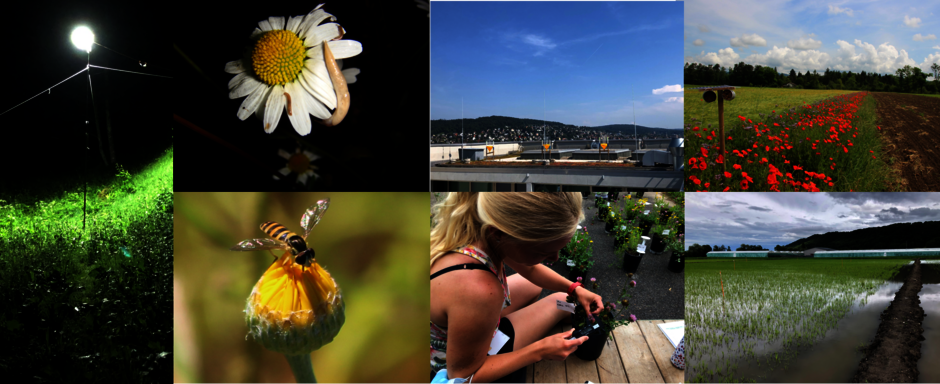
Focus: Plant-invertebrate communities in a changing world
We study how plants and invertebrates directly and indirectly interact and what the consequences for ecosystem functioning are. Particularly, we are interested in how species interact across trophic groups and how spatio-temporal dynamics of organisms affect those interactions. Thereby a focus is on direct and indirect interactions of organisms active at night (e.g., nocturnal pollinators).
Furthermore, we are interested in how global change alters those plant-invertebrate community processes. We thereby focus on multiple global change factors, but in particular land-use change (agricultural intensification, urbanization and the associated artificial light at night), climate change and invasive species.
Finally, we are interested in developing and improving conservation measures to preserve and promote species and the ecological and evolutionary processes linked to it. We do so by conducting transdisciplinary research and collaborating with stakeholders and authorities.
Focus: Global change and the temporal and spatial distribution of biodiversity
With about 50% of all described species being insects, they constitute a major part of the world´s biodiversity and provide many key ecosystem functions. Yet, we only are at the beginning of understanding of how they have changed over larger time scales and what the major drivers of such changes have been. We thus study how climate and land-use change have changed the occurrence of insects over the past decades. Also, we investigate whether and how insects have adapted those global change drivers, e.g., by reducing body size or colour.
Just as we know little about how insects have changed over time, we know little about how they move in space. We thus are interested in insect dispersal and migration movements, how they are linked to landscape factors, and what the consequences of such movements are for ecosystem functioning and local community processes.
Projects:
We are currently working on the following topics:
1. Causes and consequences of artificial light at night for plant-invertebrate communities and the ecosystem functions they fulfil.
2. Climate and land-use change as important factors for plant-invertebrate communities.
G4B: Grasslands for biodiversity (external link, opens in a new window) (project about the protection of biodiversity-rich grasslands in the Alps and Carpathians)
Showcase (external link, opens in a new window) (project to illustrate synergies between agriculture, biodiversity and ecosystem services)
Meiosis (external link, opens in a new window)(project on the ecological traits that make butterflies adaptable to climate change)
3. Movements and changes of insects at large spatio-temporal scales
HiRAD ( (external link, opens in a new window)project on the harmonisation and integration of radar-based approaches to biodiversity monitoring)
Status of Insects: An International Research Coordination Network (external link, opens in a new window) (project to develop tools needed to explain the phenomenon of insect decline)
InsectAI (external link, opens in a new window)(project on the use of image-based AI to monitor and protect insects)