
RESEARCH

Recent developments | |
Dr. Matthias Kronseder | |
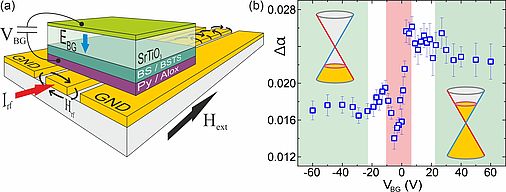
| Three-dimensional topological insulators (TIs) possess an insulating bulk while at each boundary to a trivially gapped material metallic topological surface states (TSSs) are introduced. These TSS exhibit spin-momentum locking which means that the carrier spins are orthogonal to their momentum. Around this feature revolves the concept that TSSs could provide a very efficient way to convert spin currents into charge currents and vice versa. In a collaboration with different groups at the UR (Prof. Gießibl, Dr. Marganska, Prof. Weiss) as well as the group of Prof. Back at the Technical University of Munich, Prof. Tserkovnyak, UCLA, Los Angeles, USA and Prof. Suri, Indian Institute of Science, Bangaluru, India, we investigated the spin-charge interconversion of TSS. Within this collaboration, the custom-tailored band parameters of Bi-based TIs in combination with back-gated structures allowed us to investigate the spin-charge interconversion and found a fingerprint for chiral tunneling between Dirac hole and Dirac electron areas by ferromagnetic resonance (FMR) spin-pumping experiments. This method is best described as FMR spectroscopy. In this measurement technique we combine FMR with energetically shifting the Dirac cone by the electrostatic action of a back-gate, see Fig. 1a). When the Dirac point is at the Fermi level, the damping parameter in FMR shows a pronounced minimum, while away from the Dirac point the damping increases, see Fig. 1b). Calculations done by Dr. Magdalena Marganska and the group of Prof. Dr. Tserkovnyak showed that the dissipated power during ferromagnetic resonance is linked to the density of states of surface and bulk states. While topological surface states govern the damping parameter for Fermi energies around the Dirac point, see Fig. 1b) red shaded area, hybridization effects of TSS with other trivial states fully mask the spin-charge interconversion mechanism of TSS for Fermi energies away from the Dirac point, see Fig. 1b) green shaded areas. Tracing Dirac points of topological surface states by ferromagnetic resonance, Phys. Rev. B 109, 064424 (2024) | |
 |
Magdalena Okon - 31.01.2025 12:25 