

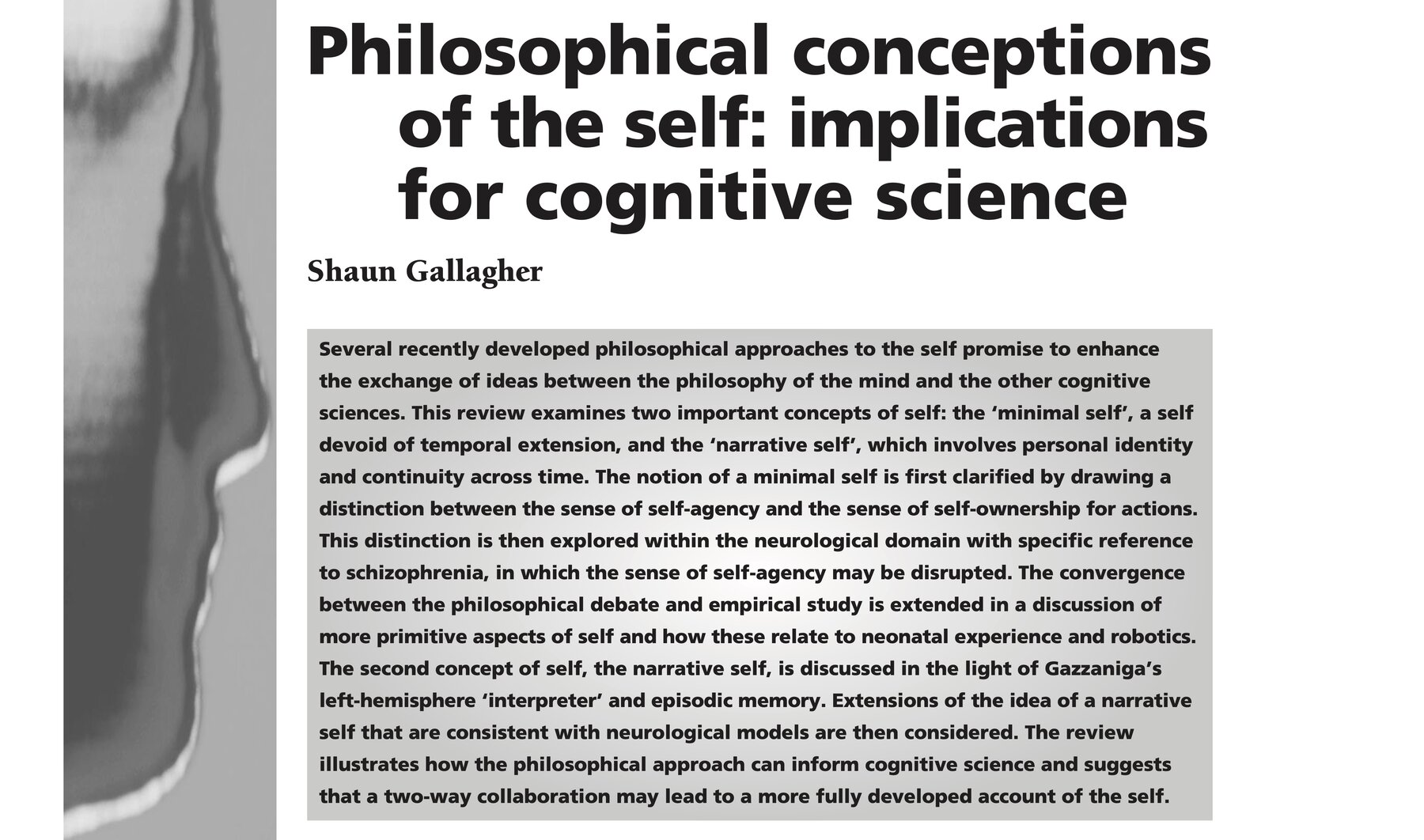
Philosophical Conceptions of the Self: Implications for Cognitive Science (Gallagher, 2000)
What do we actually mean when we speak of the “self”? In this influential review article, Shaun Gallagher shows that this term encompasses a variety of psychological and philosophical concepts. Particularly influential was his distinction between a minimal (pre-reflective) self—which underlies the immediate experience of one’s own perceptions and actions—and a narrative self, which emerges from autobiographical memories and one’s own life story. This conceptual differentiation has had a lasting impact on cognitive science research on the self and, at the same time, has opened up new perspectives on psychiatric disorders such as schizophrenia, in which disturbances of the minimal self are discussed. A concise and still-relevant introduction to cognitive science research on the self. [FJG]
Reference: Gallagher, S. (2000). Philosophical conceptions of the self: Implications for cognitive science. Trends in Cognitive Sciences, 4(1), 14–21. https://doi.org/10.1016/S1364-6613(99)01417-5 (external link, opens in a new window)
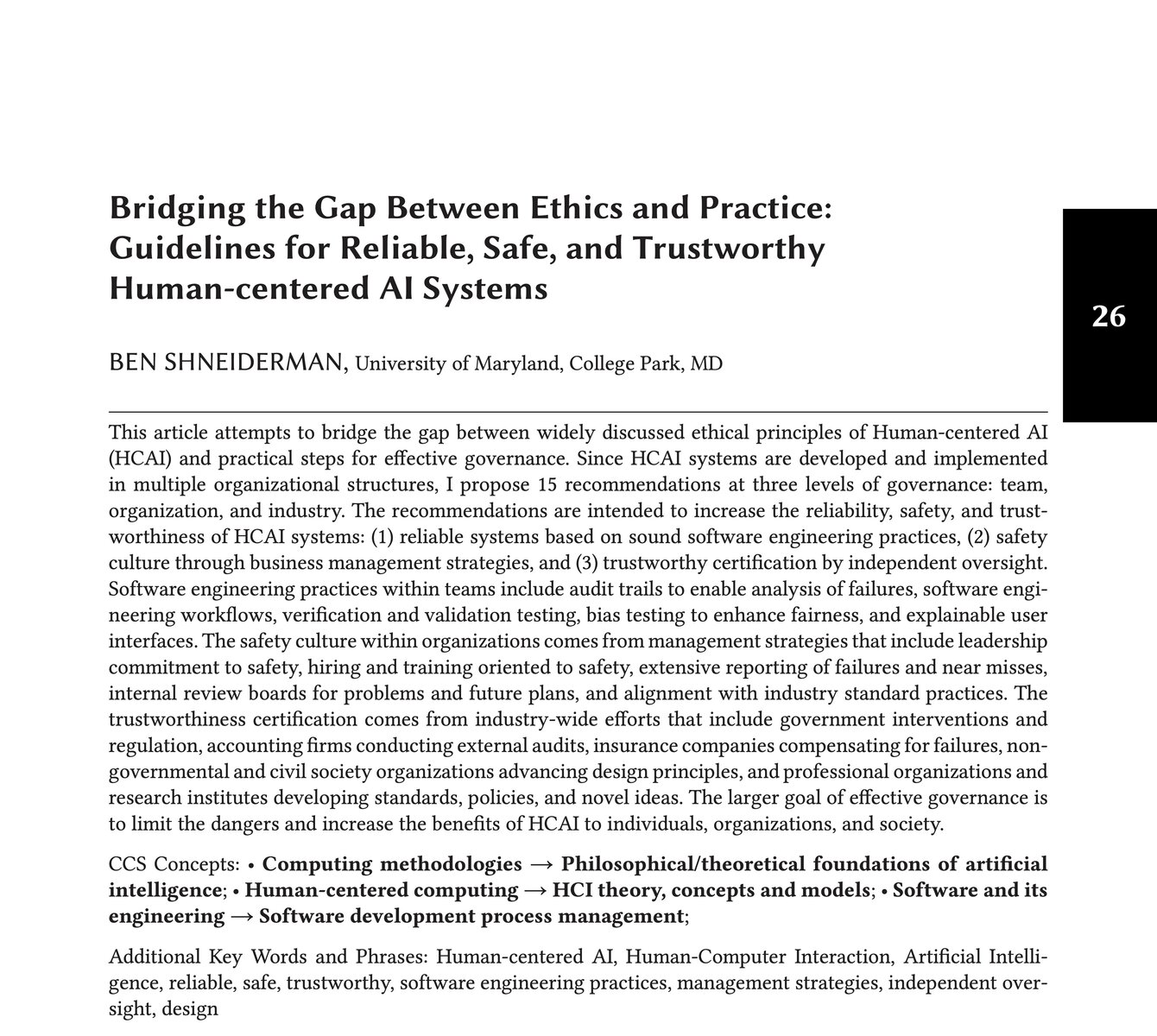
Bridging the Gap between Ethics and Practice: Guidelines for Reliable, Safe, and Trustworthy Human-Centered AI Systems (Shneiderman, 2020)
In Anthropic’s Super Bowl commercial, an AI assistant initially provides a competent answer to a question about a personalized workout plan. Suddenly, however, the conversation veers into a product recommendation for insoles designed to make the user appear taller. The commercial thus illustrates a central problem with modern AI systems: as soon as their responses no longer follow exclusively the interests of their users but instead external interests or incentives, trust and user well-being come into conflict with economic or institutional goals. This is precisely where Ben Shneiderman’s influential contribution to Human-Centered Artificial Intelligence (HCAI) comes in. He argues that we should not only formulate ethical principles but also translate them into concrete design principles for reliable, safe, and trustworthy AI systems that support human capabilities rather than influencing human judgments or decisions in the interest of third parties.
Reference: Shneiderman, B. (2020). Bridging the Gap between Ethics and Practice: Guidelines for Reliable, Safe, and Trustworthy Human-Centered AI Systems. ACM Transactions on Interactive Intelligent Systems, 10, 1–31. https://doi.org/10.1145/3419764 (external link, opens in a new window)

APA STYLE
If you want to write an academic paper, this is a must-visit site: The official website of the American Psychological Association (APA) provides clear, step-by-step instructions on how to cite sources correctly, organize your work clearly, and write professionally and persuasively—complete with plenty of practical examples and suitable for term papers, bachelor’s theses, or research papers. [KT]
Link: https://apastyle.apa.org (external link, opens in a new window)

Beware 'persuasive communication devices' when writing and reading scientific articles (Corneille et al., 2023)
The article gives tips on scientific writing, in particular warning against typical techniques used to distort research results. [GD]
Reference: Corneille, O., Havemann, J., Henderson, E. L., IJzerman, H., Hussey, I., De Xivry, J. O., Jussim, L., Holmes, N. P., Pilacinski, A., Beffara, B., Carroll, H., Outa, N. O., Lush, P. & Lotter, L. D. (2023). Beware 'persuasive communication devices' when writing and reading scientific articles. eLife, 12. https://doi.org/10.7554/eLife.88654 (external link, opens in a new window)
 Foto: UR/Antonia Pröls
Learning Statistics with R (by Danielle Navarro)
Today, instead of an article, I’d like to share a website called “Learning Statistics with R” (by Danielle Navarro), which is perfect for getting started with R. It’s also suitable for beginners with a basic understanding of statistics, and you’ll learn a lot about experimental design along the way. It’s updated regularly. [GD]
Link: learningstatisticswithr.com (external link, opens in a new window)

The primacy of behavioural research for understanding the brain (Niv, 2021)
Pure behavioural research is increasingly coming under pressure to justify itself in basic research in cognitive psychology. This makes this article, in which neuroscientist Yael Niv emphasises the importance of psychological behavioural research for understanding how the brain works, all the more significant. [GD]
Reference: Niv, Y. (2021). The primacy of behavioural research for understanding the brain. Behavioural Neuroscience, 135(5), 601-609. https://doi.org/10.1037/bne0000471 (external link, opens in a new window)