

Cameras in the courtroom
A challenge at the interface of law, media and culture
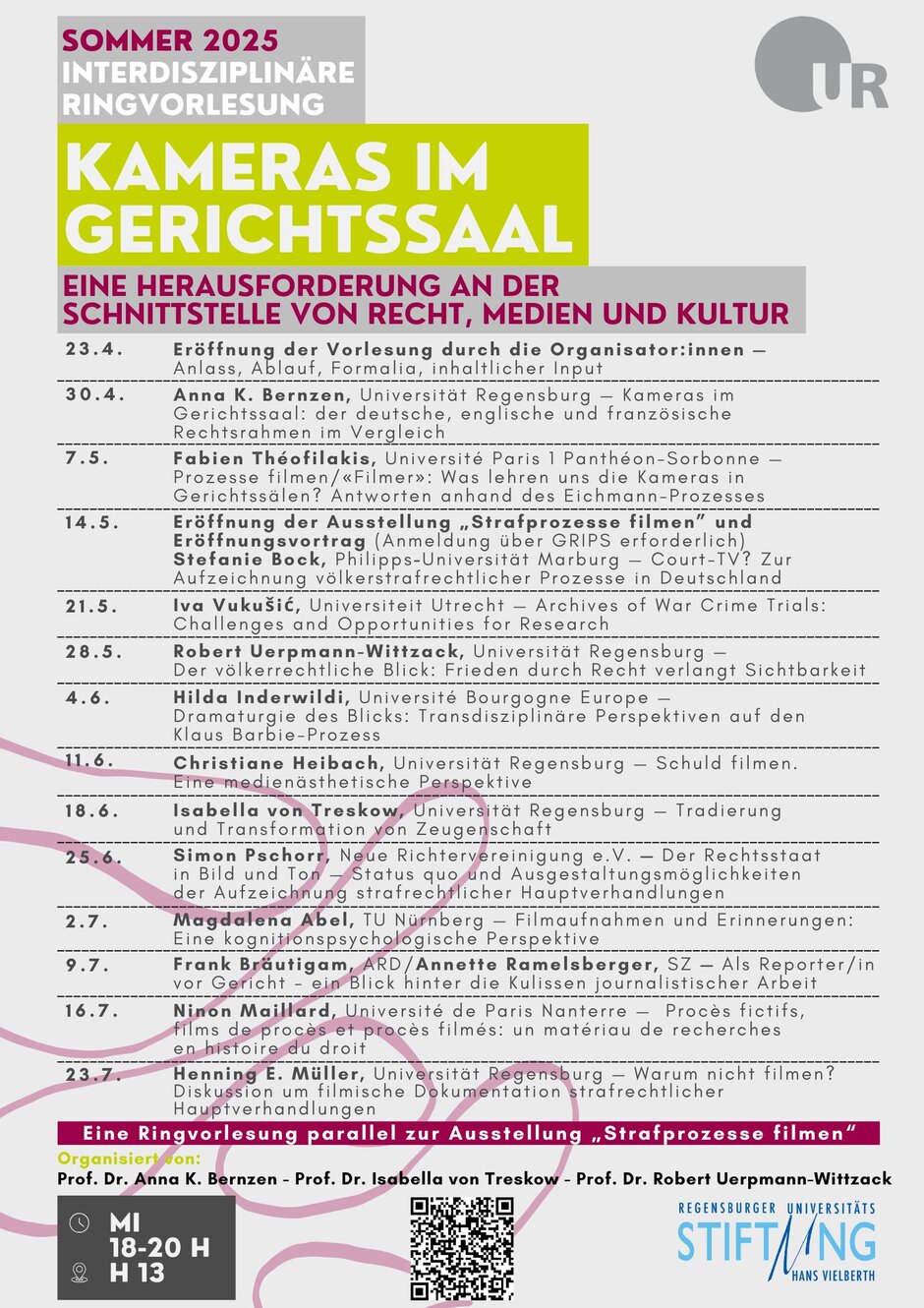
In the summer semester 2025, Prof. Dr. Isabella von Treskow is organising an interdisciplinary lecture series on the filming of criminal trials together with Prof. Dr. Anna Bernzen and Prof. Dr. Robert Uerpmann-Wittzack.
The lecture series will accompany the exhibition "Filming criminal trials: a challenge for society", which will take place in the Upper Foyer of the University Library from 15 May to 12 July 2025.
Interdisciplinary lecture series in the summer semester 2025
Wednesdays, 18-20 h, lecture theatre H 13 (external link, opens in a new window)
Current

Concept
The lecture series deals with the questions of the function and consequences of film recordings of or in criminal court proceedings from a legal and cultural studies perspective. The focus is on different legal frameworks in Germany, France and beyond, the function of international court proceedings for international understanding, also with a view to dealing with the past or transitional justice, communicative and cultural memory, concepts and practices of witnessing, and finally on individual and collective effects of filmed court documents and court films. The lecture takes up the impulse of the exhibition "Filming Criminal Trials", which will be shown in multimedia form at the University of Regensburg from 15 May to 12 July 2025. It deals with the material of major criminal trials shown there - Nuremberg and Eichmann trials, trials of Klaus Barbie (1987), Paul Touvier (1994) and Maurice Papon (1997-98) as well as a trial in connection with the Chilean dictatorship (2010) - and expands this circle with regard to the legal as well as the media studies, cultural studies and remembrance policy issues that go hand in hand with it under the following aspects:
- Why film court proceedings? What goals are associated with the use of cameras and microphones in the courtroom? How does the legal framework for filming court proceedings differ in different countries and cultures? What difference does it make how the audiovisual recordings are used - to improve the basis for judicial decisions, for publication or for archival purposes? What archival purposes could they be used for?
- What does the principle of judicial publicity "Justice must not only be done, but it must be seen to be done" mean in the digital age? Can the publication of film recordings in the sense of restorative or transitional justice strengthen the law or contribute to coming to terms with the past?
- Does filming change the process? What consequences do film recordings have for the preparation of and the actors in court proceedings? Do they possibly behave differently in the knowledge of the footage? How does their behaviour change - do they act out for the cameras, are they intimidated? What effect does this change in behaviour have on the proceedings?
- Is it possible to observe changes in witnessing that can be linked to film recordings? What is the relationship between concepts and practices of testimony (of former victims of persecution) after 1945 and court proceedings on Nazi crimes?
- What connections exist between recordings of or from court trials and products of the culture of remembrance, such as films, biopics or exhibitions?
- Can German, French and Franco-German specificities be found from a cultural studies perspective? If so, which and in what way does this influence the handling of documents of filmed trials and, more generally, media representations?
Programme
| 23.04.2025 | Opening of the lecture by the organisers - Occasion, procedure, formalities, content input |
| 30.04.2025 | Anna K. Bernzen, University of Regensburg See also the interview with Anna K. Bernzen: On court reporting (external link, opens in a new window), on the UR Science Blog. |
| 07.05.2025 | Fabien Théofilakis, Université Paris 1 Panthéon-Sorbonne Filming trials/"filmmakers": What do cameras in courtrooms teach us? Answers based on the Eichmann trial |
| 14.05.2025 10-12 h VG 0.04 | Special date (external link, opens in a new window): Martine Sin Blima-Barru, French National Archives Exposer des archives audiovisuelles de procès pour crimes contre l'humanité |
| 14.05.2025 | Opening of the exhibition "Filming criminal trials" Opening lecture: Stefanie Bock, Philipps University Marburg Court-TV? On the recording of international criminal trials in Germany (only with special registration via GRIPS (external link, opens in a new window)) |
| 21.05.2025 | Iva Vukušić, University of Utrecht Archives of War Crime Trials: Challenges and Opportunities for Research |
| 28.05.2025 | Robert Uerpmann-Wittzack, University of Regensburg The public international law perspective: Peace through law demands visibility |
| 04.06.2025 | Hilda Inderwildi, Université de Bourgogne Europe Dramaturgy of the Gaze: Transdisciplinary Perspectives on the Klaus Barbie Process |
| 11.06.2025 | Christiane Heibach, University of Regensburg Filming guilt. A media aesthetics perspective |
| 18.06.2025 | Isabella von Treskow, University of Regensburg Transmission and transformation of testimony |
| 25.06.2025 | Simon Pschorr, New Association of Judges e.V. The rule of law in image and sound - status quo and possibilities for shaping the recording of criminal law trials |
| 02.07.2025 | Magdalena Abel, TU Nuremberg Film recordings and memories: A cognitive psychology perspective |
| 09.07.2025 | Frank Bräutigam, ARD Annette Ramelsberger, Süddeutsche Zeitung As a reporter in front of a report - a look behind the scenes of journalistic work (external link, opens in a new window) |
| 16.07.2025 | Ninon Maillard, Universtité de Paris Nanterre Procès fictifs, film de procès et procès filmés: un matériau de recherches en histoire du droit |
| 23.07.2025 | Henning E. Müller, University of Regensburg Why not film? Discussion about film documentation of criminal law trials |
Presentation of the lecture series
Presentation of the lecture series "Cameras in the courtroom"
on the occasion of the opening of the exhibition: "Filming criminal trials - a challenge for society", on 14 May 2025
Prof. Dr. Robert Uerpmann-Wittzack
Mesdames et Messieurs, ladies and gentlemen,
it is a great honour for us to be able to present the exhibition: Filming criminal trials - a challenge for society at the University of Regensburg. We want this outstanding exhibition from the Archives nationales to be recognised and received here. The interdisciplinary lecture series: Cameras in the Courtroom, which accompanies the exhibition and which we - Isabella von Treskow, Anna Bernzen and I - have conceptualised, serves this purpose.
We are combining legal, media and cultural studies to illustrate connections that the representatives of a single discipline will often not be aware of. We are proceeding in three steps:
- The first part of the lecture series sheds light on the contemporary historical dimension of the trials and their recordings. It recognises the filming of trials as contemporary historical documentation. This morning, for example, Mrs Sin Blima-Barru from the Archives nationales reported on how she curated the exhibition. Madame Sin Blima-Barru, nous sommes heureux que vous soyez parmi nous aujourd'hui!
- The second part of the lecture series will explore the question of how audiovisual recordings can support a criminal trial. In other words, we will look at the significance of audiovisual recordings within a trial.
- Finally, in the third and last part, we will look at the media's view of trials.
I would like to take this opportunity to thank the Regensburg University Foundation Hans Vielberth, whose generous support has made this lecture series possible.
Ladies and gentlemen, allow me to say a few words about the first part, although I will not go into all the lectures that you will see in the lecture series programme. Anna Bernzen will then introduce you to the other parts of the lecture series.
The question of cameras in the courtroom arises in all trials. Criminal trials are of particular historical significance. This applies in particular to criminal trials in which international crimes are tried, i.e. where systemic injustice has to be dealt with. These are criminal trials that deal with the three core crimes under public international law:
- War crimes,
- Crimes against humanity and
- Genocide.
These are the trials shown in the exhibition, and the lecture series is dedicated to them. The Nuremberg war crimes trials, with which the exhibition begins, were a milestone. This was followed by further trials in connection with the Nazi dictatorship, from Adolf Eichmann to Maurice Papon. These are also shown in the exhibition. In last week's lecture series, Fabien Théofilakis introduced us to the filmic view of the Eichmann trial. Hilda Inderwildi will look at the Barbie trial in a similar way, before Christiane Heibach talks about filming guilt in general.
After the Nuremberg Trials, it took over forty years for their promise to counter international crimes with the means of criminal law to be applied to other situations beyond the Nazi dictatorship. A major step was the criminal law prosecution of the Balkan wars since 1993. Next week, Iva Vukušić will give a lecture on the audiovisual documentation of these trials in the lecture series. The trial on the Chilean dictatorship, which is shown in the exhibition, also falls into this category.
Ladies and gentlemen,
so much for the first part of the lecture series on contemporary history and so much for my part. Thank you very much.
Prof. Dr. Anna K. Bernzen
The second part of the lecture series will - as Robert Uerpmann-Wittzack said - examine the question of whether audiovisual recordings of a criminal trial can have a supporting function for the trial itself - namely as an audiovisual record of the trial. German criminal courts do not have a complete record of the course of the trial, which for example also reproduces witness statements in full. The court regularly makes its own notes, which it then uses to reach its judgement. A paragraph that would have provided for the recording and transcription of the trial was recently discussed, but unfortunately did not become law in time before the end of the last legislative period.
In this second part of the lecture series, Simon Pschorr - himself a former criminal judge and now a public prosecutor - will explain to what extent it would be desirable from the court's point of view to have film or at least audio recordings of criminal proceedings available for sentencing.
One argument for this could be that judges - not only in longer trials - can hardly remember with certainty what the defendant or witness said in detail, even on the basis of their notes. Magdalena Abel will explain how their memory works from the perspective of cognitive psychology.
Finally, in the third part of the lecture series, we will look at film recordings for the purposes of media coverage. The publicity of criminal trials, which is an important procedural principle, is increasingly changing from a classic courtroom publicity, which is created by the audience in the auditorium, to a media publicity, in which the events of the trial are brought to the attention of an absent audience in words, images and sound.
While it is sufficient for journalists from the print media to attend the trial in the courtroom for their reports, their colleagues from the radio need moving images. However, they are generally not allowed to produce these moving images in German criminal trials. In a joint presentation by Frank Bräutigam, head of the ARD legal editorial department, and Annette Ramelsberger, editor of the Süddeutsche Zeitung, we will find out how different the work of media professionals in court is as a result.
Film footage of real court trials could also help to correct the distorted image of the work of the German criminal justice system that has been painted in some people's minds, especially by US court films. In her lecture, Ninon Maillard will deal with the portrayal of criminal trials in such court films. She will examine the extent to which court films, but also film recordings of real trials, can be made fruitful for legal history research.
Finally, our Regensburg colleague Henning Müller will bring together the three parts of our lecture series in a closing event. He does this under the title "Why not film?" - or perhaps "Why not film?"? We will hear it in the last week of lectures.
Supported by:
Regensburg University Foundation Hans Vielberth
Concept: Prof. Dr. Anna Bernzen, Prof. Dr. Isabella von Treskow, Prof. Dr. Robert Uerpmann-Wittzack
Supported by: