

From Nuremberg to the Chilean dictatorship
Exhibition in the summer semester 2025
Period: 15 May to 12 July 2025
Location: Upper foyer of the university library
Isabella von Treskow: Words on the opening of the exhibition
Report on the opening of the exhibition (external link, opens in a new window)
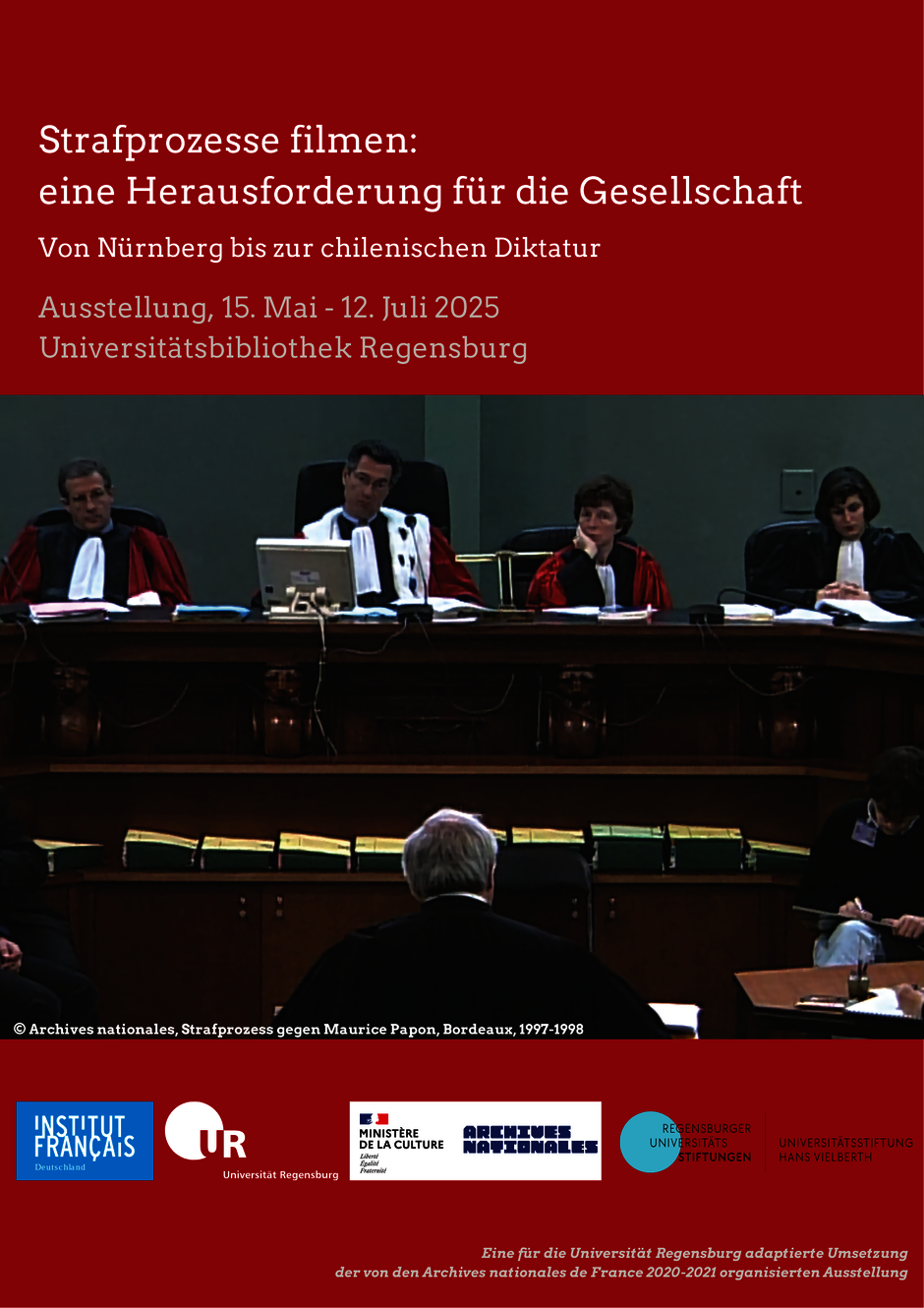
The exhibition was conceived by the Archives nationales in Paris, the French National Archives, under the title: Filmer les procès: un enjeu social, and will be shown for the first time in Pierrefitte-sur-Seine and Paris from 15 October 2020 to 18 December 2021. It is based on the ideas of curator Martine Sin Blima-Barru, historian and curator at the French National Archives, and curator Christian Delage, historian, long-time director of the Institut d'histoire du temps présent research centre and film director.
The exhibition marks the first time that the National Archives have turned to film sources from the justice sector. It makes it possible to understand the moral and ethical significance of the trials, to familiarise oneself with excerpts from selected court proceedings and to examine their significance for the history of democracy and the rule of law, in particular the question of whether and with what aim criminal court proceedings of high social relevance should be filmed.
Six films with memorable scenes from international trials will be shown in Regensburg:
- Main war crimes trials in Nuremberg (1945/1946)
- Trial of Adolf Eichmann in Jerusalem (1961)
- Trial of Klaus Barbie (1987)
- Trial of Paul Touvier (1994)
- Trial of Maurice Papon (1998)
- Trial of fourteen perpetrators of the Pinochet dictatorship (2010)
These are trial films relating to the Second World War - against Klaus Barbie, Paul Touvier and Maurice Papon. There is also a trial in connection with the Chilean dictatorship. They follow in the tradition of the two trials of historical significance that were filmed for the first time worldwide: the trial of Nazi perpetrators in Nuremberg and the trial of Adolf Eichmann in Jerusalem.
The Nuremberg trials were groundbreaking for the development of international criminal law. One of their most important results was that individuals can be held legally responsible for state behaviour. The International Criminal Court (ICC) has its origins in the Nuremberg Trials. Some of the ICC's decisions are currently at the centre of attention.
The exhibition is on display in the Upper Foyer of the University Library. The French exhibition was adapted for Regensburg by Prof Dr Isabella von Treskow.
The films have an average duration of approx. 10-25 minutes, are subtitled in German and can be accessed individually. Information on people, final judgements, relevance of the edited excerpts and camera technology is available on the screens.
The exhibition is accompanied by a lecture series, which is open to all interested parties without prior registration.
Opening words
Words on the opening of the exhibition Filming criminal trials
on 14 May 2025
Isabella von Treskow
Dear Mr. President, dear members of the university management, dear auditorium!
First of all, I would like to thank the French diplomatic corps, represented by the Consul général adjoint de France à Munich Monsieur Coulet and Madame Charléty of the Embassy in Berlin - bon soir ! -, for the impetus to show the exhibition "Filmer les procès" at our university. Merci beaucoup ! I thank the President for insisting that we show it. And the exhibition would not have existed without the initiative of Dr Sin Blima-Barru from the National Archives, who came all the way from Paris for the opening. Je vous remercie d'être parmi nous ce soir ! I would also like to extend a warm welcome to the Consul General of the State of Israel. Thank you for being here! My very special thanks go to the President of the Franco-German University, my colleague Prof Dr Eva Martha Eckkrammer, for her words of welcome at the opening of the exhibition "Filmer les procès" or, in German: "Filmer les procès - eine gesellschaftliche Herausforderung". Thank you very much!
Ladies and gentlemen, dear students: What did filming criminal trials mean to you before you heard today's keynote speech? You didn't know exactly? - That's understandable.
I would like to say that - apart from Stefanie Bock, whom I would like to thank for her clear presentation, Anna Bernzen, who has examined the issue in detail, and Robert Uerpmann-Wittzack, who knows what recordings mean for international jurisdiction - almost no one here in the foyer had a real opinion on the filming of court proceedings an hour ago. Some lawyers perhaps .... et encore. So we are almost all starting at the same point, that of the question, that of amazement.
At this point, I would like to draw attention to some aspects of the exhibition, both visible and invisible:
We see the criminals in the films. We don't see the crimes.
In the trial of the Chilean dictatorship, not even the defendants are there. We don't see them, we see empty benches. The victims are also missing. They have actually "disappeared", desaparecidos. However, the main trial brings the crime of the dictatorship to light, the "disappearance".
The core of the films is the representation of legal practice in all its complexity. The counterpart to the rule of law is not visible: show trials to humiliate those brought before the courts, arbitrary acts, lawlessness. They have to be taken into account, because only then can the twofold moral dimension of the films be understood.
Why twofold? Those who watch the films are not in the courtroom, but see processes of a second order, their own arrangement, the media layout. So dealing with the cases has several moral and media layers.
In last Wednesday's lecture, Fabien Théofilakis showed us how Adolf Eichmann deliberately staged himself as a bureaucrat because he knew that the film images would go around the world. The camera work, which focussed heavily on him, unintentionally contributed to the impression of a civil servant who is obsessed with correctness. He wears a neat suit, sorts his glasses, always puts his pen down parallel to the files, the piles of files grow. His aggression is not visible on the surface. Hannah Arendt partly fell for this self-stylisation, wrote of banality, and not only she.
The exhibition does not show the 1994 genocide trials in Rwanda, formerly a German and Belgian colony. It therefore has a stronger Franco-German accent. However, it lacks the impetus to reflect on the connection between colonial ideology, Nazi ideology and authoritarian regimes.
The exhibition aims to enrich our knowledge of the foundations of our democracies. The war, the end of which was ceremonially marked last week, the Shoah and monstrous crimes against humanity were interwoven. I would like to take a closer look at this aspect of the criminal trials. According to Wolfgang Form, co-founder and director of the Marburg Research and Documentation Centre for War Crimes Trials before you, dear Ms Bock, a crime is committed when a person is hit "in the depths of their personality", "that physical and emotional sphere of being and activity" which "in a condensed view constitutes their value and dignity", which includes: life, physical integrity, self-determination and individuality. A person must not be considered a "sub-human" and must not be treated as an object, not like an "apparatus" and then disposed of. This is the case when, in addition, "attacks on individuals simultaneously affect values generally attributed to humanity" and thus "have supra-individual effects" (2007, 42f.). Specifically, this refers to killing, enslavement, deportation, torture and rape committed as part of an extensive or systematic attack against a civilian population. (cf. Art. 7 of the Rome Statute of the International Criminal Court (external link, opens in a new window))
These crimes are revealed in the films above all in their effects, with the most terrible consequences for the Jewish children of Izieu, for example. Klaus Barbie coldly ordered their murder.
Anne-Marie Bauer (external link, opens in a new window) is not a witness in the trial film about Barbie, head of the Gestapo in Lyon from 1942 to 1944, but her fate is an example of a concrete crime against humanity and is intended to show a special connection between France and the exhibition here.
As a resistance fighter, Anne-Marie Bauer helped refugees in Clermont-Ferrand, Regensburg's twin city, was arrested at the age of 19 and interrogated by Barbie in the cellar of Montluc prison with his pistol in her neck. She was sent to Ravensbrück via Fresnes and Compiègne, then to Holýšov, Holleischen, a satellite camp of the Flossenbürg concentration camp in what is now the Czech Republic. She survived under the most difficult conditions, in freezing temperatures in the so-called "street column". Anne-Marie Bauer had studied British studies and wrote her final thesis on Emily Brontë. Her hands were so irreparably injured by the torture of interrogation and forced labour that after 1945 she was unable to write fast enough in the concours de l'Agrégation, a higher State Examination, so that she did not pass the concours, not even later, and never achieved her professional goal.
In Holýšov, she was friends with Catherine Roux. I would like to quote from her "Triangle rouge" on the deeper dimension of the crime against humanity:
"When the road column returns to the camp in the evening, day turns to night. [At this hour] the legacy of my [ancestor many millennia ago] weighs on my shoulders; how afraid he must have been of the night [...]. [...] Every day he went hunting, fishing, searching. He played with his friend during the day. He turned to his friend. He left him the care of thinking for him, of looking ahead, of watching. And as the man entrusted himself like this, quite naively, the brother, the friend, the refuge chosen by all, slowly moved away, treacherously, quietly tiptoeing away. The man remained alone, and he knew that the night was threatening, that the night was rolling towards him, that it was gaining ground and that he would soon be caught in the net like a fish. [...] He knew that he would be at the mercy of that [...] which chokes and sucks until death... And he was afraid, as I am afraid now. [...] A considerable number of centuries separate us, you and me. [...] On these evenings of captivity, when I return, while the warm light burns in the guard's window, a light that rejects me, sends me, the unwanted one, back into the night, then at the bottom of my heart - reflection of yours - is your misery, "ta détresse", your great, desperate question, "ton interrogation terrifiée." (1968 [1946], 211-213; translation I. v. T.)
Roux speaks of man's betrayal of his fellow man, the greatest opposite of humanity. The court judgements include this immense betrayal.
From the German side, looking at the legal reappraisal is part of the responsibility with regard to one's own history, from the French side also with regard to the Vichy regime. however, 80 years after the end of the war, it is still more about recognising the Resistance, mourning the victims, defeating the Nazi dictatorship and enforcing human rights. Commitment to universal human rights has been a firm pillar of the French self-image since their declaration in 1789, an important reason why there is a special commitment to them, even in very practical terms. This universal as well as practical approach makes it possible to film criminal trials and has led to an exhibition that is astonishing. For this we thank you, and therefore once again at the end: Merci beaucoup!
I would like to expressly thank my colleague Anna Bernzen for the exhibition texts on the added value of films. I would like to thank her and my colleague Robert Uerpmann-Wittzack for their legal advice on the exhibition, and I would like to thank Lasse Schaupp and Judith Lanzl from the bottom of my heart for their tireless practical help.
- Wolfgang Form: "Justizpolitische Aspekte west-alliierter Kriegsverbrecherprozesse 1942-1950", in: Ludwig Eiber/Robert Sigel: Dachau Trials. Nazi crimes before American military courts in Dachau 1945-48: proceedings, results, aftermath. (Dachau Symposia on Contemporary History, vol. 7, edited on behalf of the City of Dachau and the Dachau Youth Guest House by Bernhard Schoßig). Göttingen: Wallstein 2007, 41-66.
- Catherine Roux: Triangle Rouge. France, Allemagne, Tchécoslovaquie. First edition 1946, second edition 1950, third edition: Paris: Éditions France-Empire, 1968.