
Die maritime Villa von Bibione (DFG)
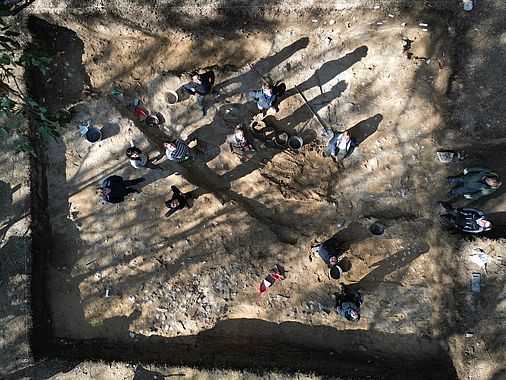



Die römische maritime Villa von Bibione und ihr Kontext
Seit 2018 erforscht das Institut für Klassische Archäologie der Universität Regensburg, unter Federführung von Prof. Dr. Dirk Steuernagel, in enger Kooperation mit Kolleginnen und Kollegen der Università degli Studi in Padua (Italien), eine römische Küstenvilla an der Adria, in Bibione (Gemeinde S. Michele al Tagliamento, Metropolregion Venedig, Italien). Die Villa wurde bereits bei Ausgrabungen im 19. Jahrhundert entdeckt und zwischen den 1930er und 1990er Jahren mehrfach archäologisch untersucht. Im Rahmen der aktuellen Forschungen werden nicht nur die architektonischen Überreste der Villa erkundet, sondern auch deren naturräumliches und siedlungstopographisches Umfeld in der Antike, mit dem Ziel einer wirtschafts- und sozialgeschichtlichen Kontextualisierung. Ausgedehnte Feldbegehungen zur Aufnahme oberflächlich feststellbarer archäologischer Befunde und Funde (Prof. Dr. Maria Stella Busana, Padua, Dipartimento dei Beni Culturali) gehen in diesem Sinne einher mit geomorphologischen Untersuchungen, vor allem Kernbohrungen zur Gewinnung von Bodenprofilen mit Aussagekraft für Landschafts- und Vegetationsgeschichte (Prof. Dr. Alessandro Fontana, Padua, Dipartimento di Geoscienze). Das Projekt ist damit Teil eines umfassenderen Forschungskontextes, der mit dem Ministerium für Kultur der Republik Italien, über die zuständige Soprintendenza Archeologia, Belle Arti e Paesaggio für den Großraum Venedig und die Provinzen Belluno, Padua und Treviso (Dr. Alessandro Asta), geteilt wird und der Rekonstruktion von Dynamiken der menschlichen Umgestaltung des nordadriatischen Küstenstreifens zwischen der Antike und der Nachantike dient. Seit November 2022 wird das Projekt durch eine Sachbeihilfe der Deutschen Forschungsgemeinschaft großzügig finanziell gefördert.
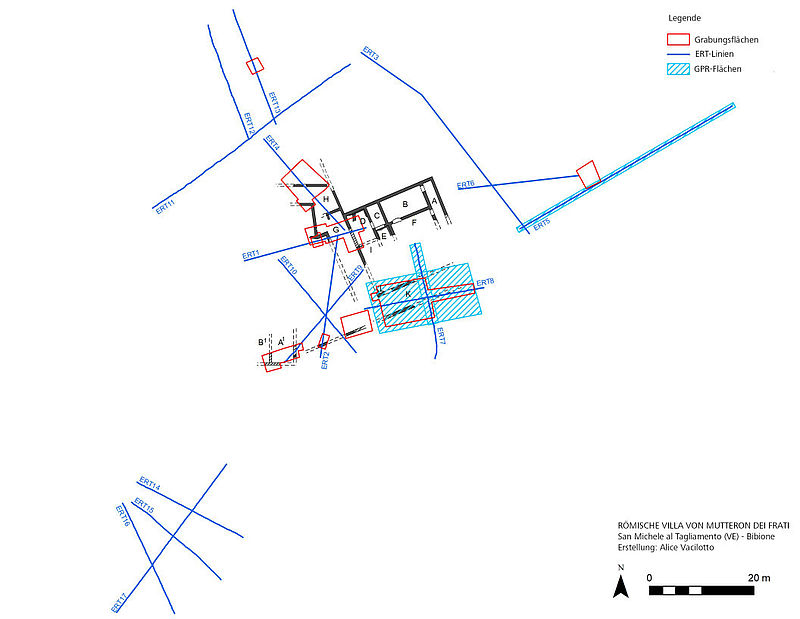
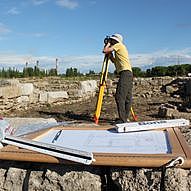
Der Schwerpunkt der Regensburger Forschungen im Rahmen des Projektes liegt auf der Durchführung und wissenschaftlichen Auswertung der Ausgrabungen im engeren Bereich der Villa. Zur Erkundung der potentiell interessanten Grabungsflächen wurden seit 2018 immer wieder geophysikalische Prospektionen vorgenommen, die durch Verzeichnung von aus dem Normbereich fallenden elektrischen Widerständen im Boden Hinweise auf mögliche antike Strukturen lieferten (Electric Resistivity Tomography, Untersuchungen unter der Leitung von Prof. Ing. Rita Deiana, Padua, Dipartimento dei Beni Culturali).
Nach ersten kleinen Sondagen im Dezember 2019 und einer kürzeren Grabungskampagne im Frühjahr 2022 konnten seit der Gewährung der Fördermittel durch die DFG drei weitere, je vierwöchige Grabungskampagnen durchgeführt werden. Das Ministero della Cultura der Republik Italien hat der Universität Regensburg dafür eine dreijährige Grabungskonzession erteilt, die gegebenenfalls verlängert werden könnte. Auch die Eigentümer und Pächter des Geländes, die Familie Ferri De Lazara bzw. Bibione Spiaggia srl, unterstützen das Projekt.
Die Regensburger Grabungen sind keineswegs die ersten archäologischen Unternehmungen am Ort. Schon seit dem 18. Jahrhundert gibt es immer wieder Nachrichten über Entdeckungen antiker Strukturen. Reguläre Ausgrabungen fanden 1931 und 1991-1994 statt. Sie konnten nur einen kleinen, wenngleich besonders gut erhaltenen Teil der römischen Villa freilegen (ca. 200 qm).
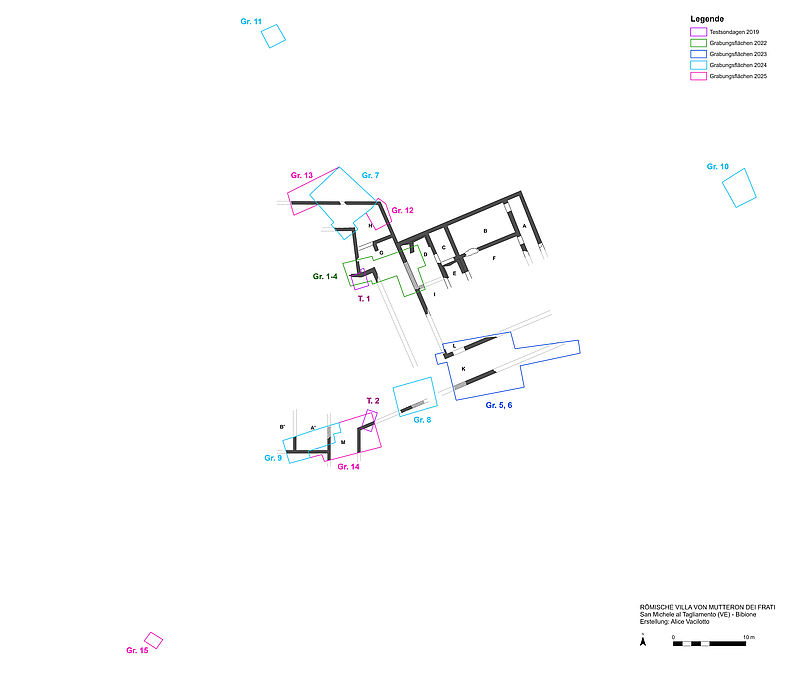
Die im Rahmen des aktuellen Projekts aufgenommenen Grabungen haben die untersuchte Fläche mittlerweile auf etwa 1.000 qm erweitern können
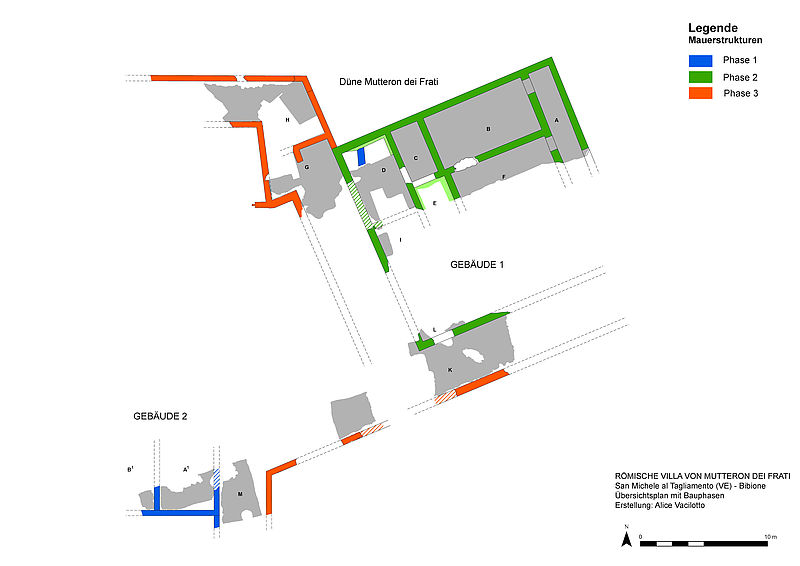
und dabei Baustrukturen in einer Ausdehnung von etwa 425 qm festgestellt. Zudem war es möglich, auch die bauliche Entwicklung des Komplexes über einen recht langen Zeitraum (Ende 1. Jh. v. Chr. bis Anfang 5. Jh. n. Chr.) in verschiedenen Phasen zu verfolgen.
Ein zuvor unbekanntes Gebäude, dessen mit Mosaikböden ausgestattete Räume für ein Wohngebäude sprechen, bildete möglicherweise den ersten Kern der gesamten Anlage, dem später ein zweites Wohngebäude im Osten zur Seite trat (das bereits seit längerem ausschnitthaft bekannte Gebäude). Das letztere wurde gegen den Hang einer auf prähistorische Zeit zurückgehenden Sanddüne errichtet, des sog. Mutteron dei Frati. Dieser erhebt sich 12 m über den Meeresspiegel und ist ein Teil einer das Gelände prägenden Kette fossiler Dünen. In einer Ausbauphase, die wohl in der ersten Hälfte des 3. Jhs. n. Chr. ansetzt und sich bis in die Spätantike fortsetzt, wird die Villa nicht nur deutlich erweitert, sondern auch die beiden vorher isolierten Gebäude 1 und 2 verbunden. Diese Verbindung ist Teil eines Systems von korridorartigen Räumen, auch einen in seiner Grundrissgestaltung unregelmäßigen Nordwestflügel und weitere, bisher unbekannte, weiter außen liegende Gebäude anband. Der Gesamtkomplex scheint im Wesentlichen auf eine nördlich gelegene Lagune ausgerichtet gewesen zu sein, aber mit seiner Südflanke möglicherweise auch Ausblicke auf das Meer eröffnet zu haben.
Die Fundobjekte aus den Grabungen bezeugen nicht nur eine lang andauernde Nutzung der Villa, sondern gewähren auch Einblicke in mit ihr verbundene wirtschaftliche Aktivitäten (z. B. Fischerei) und in über Seewege angeknüpfte Handelsbeziehungen (z. B. zum Import von Baumaterialien) und über die Wege ins Hinterland der antiken X Regio Venetia et Histria.
Aktuelle Informationen zum Fortgang der Forschungen finden Sie in den sozialen Netzwerken. Folgen Sie uns auf mehrsprachigen Kanälen mit dem Namen „Bibione antica: Discovering the Past“:
Beitrag für "Fold&r - FastiOnline" (2025)
Beitrag für Archeologia Veneta 47, 2024
Videoreportage in italienischer Sprache
Bericht in der regionalen Nachrichtensendung
Video zur letzten Grabungskampagne
Pressemitteilungen der Universität:
Grabungen in Bibione fortgesetzt
Forschungsprojekt hervorragend kommuniziert
UR Archäologen graben in Bibione
Das lange Leben der römischen Villa in Bibione
La villa marittima romana di Bibione e il suo contesto
Dal 2018, l'Istituto di Archeologia Classica dell'Università di Regensburg, sotto la guida del Prof. Dr. Dirk Steuernagel, sta conducendo ricerche intorno a una villa costiera romana sul mare adriatico a Bibione (comune di S. Michele al Tagliamento, regione metropolitana di Venezia, Italia) in stretta collaborazione con i colleghi dell'Università degli Studi di Padova (Italia). La villa era già stata individuata nel corso di sterri condotti nell’Ottocento, per poi essere indagata archeologicamente a più riprese tra gli anni ‘30 e ‘90 del XX secolo. Nell’ambito dellle ricerche attuali, si stanno indagando non solo i resti architettonici della villa, ma anche il suo ambiente topografico naturale e insediativo nell'antichità, con l'obiettivo di contestualizzarla in termini di storia economica e sociale. A estese indagini sul campo per la registrazione di elementi e reperti archeologici superficialmente accertabili (prof.ssa Maria Stella Busana, Padova, Dipartimento dei Beni Culturali) si affiancano in questo senso indagini geomorfologiche, soprattutto carotaggi per ottenere profili di suolo con valore informativo per la storia del paesaggio e della vegetazione (prof. dott. Alessandro Fontana, Padova, Dipartimento di Geoscienze). Il progetto si inserisce quindi in un contesto di ricerca più ampio, condiviso con il Ministero della Cultura della Repubblica Italiana, attraverso la Soprintendenza Archeologia Belle Arti e Paesaggio per la città metropolitana di Venezia (Venezia, Dr. Sara Bini, in passato Padova, Dr. Alessandro Asta), e che ha lo scopo di ricostruire le dinamiche della trasformazione umana del litorale adriatico settentrionale tra l'antichità e la tarda antichità. Da novembre 2022 il progetto è generosamente finanziato da una sovvenzione della Deutsche Forschungsgemeinschaft (DFG, Fondazione tedesca per la ricerca).
La ricerca gestita direttamente da Regensburg nell'ambito del progetto si concentra sulla realizzazione e sulla valutazione scientifica degli scavi nelle immediate vicinanze della villa. Per esplorare le aree di scavo potenzialmente interessanti, dal 2018 sono state effettuate ripetutamente prospezioni geofisiche, che hanno fornito indicazioni su possibili strutture antiche registrando resistenze elettriche nel terreno al di fuori dell'intervallo normale (Tomografia di resistività elettrica, indagini sotto la direzione della prof.ssa Rita Deiana, Padova, Dipartimento dei Beni Culturali). Dopo i primi piccoli scavi esplorativi del dicembre 2019 e una campagna di scavo più breve nella primavera del 2022, in base al finanziamento DFG sono state effettuate altre tre campagne di scavo, ciascuna della durata di quattro settimane. A tale proposito, il Ministero della Cultura della Repubblica Italiana ha concesso all'Università di Regensburg una licenza di scavo triennale, eventualmente prolungabile. Anche i proprietari e gestori del terreno, rispettivamente la famiglia Ferri De Lazara e Bibione Spiaggia srl, sostengono il progetto.
Gli scavi effettuati nell'ambito dell'attuale progetto hanno permesso di ampliare l'area esaminata a circa 1.000 m²
e di individuare strutture edilizie su una superficie di circa 425 m². È stato inoltre possibile seguire lo sviluppo architettonico del complesso in diverse fasi nel corso di un periodo piuttosto lungo (dalla fine del I secolo a.C. all'inizio del V secolo d.C.).
Un edificio finora sconosciuto, i cui ambienti con pavimenti a mosaico fanno pensare a un edificio residenziale, costituiva forse il primo nucleo dell'intero complesso, a cui si aggiunse successivamente un secondo edificio residenziale a est (quello noto da tempo). Quest'ultimo è stato costruito contro il pendio di una duna di sabbia di epoca preistorica, il cosiddetto Mutteron dei Frati. Questo sorge a 12 m sul livello del mare e fa parte di una catena di dune fossili che caratterizzano il territorio. In una fase di ampliamento, che ebbe inizio probabilmente nella prima metà del III secolo d.C. e proseguì fino alla tarda antichità, la villa non solo fu notevolmente ampliata, ma furono anche collegati i due edifici 1 e 2, precedentemente isolati. Questo collegamento fa parte di un sistema di stanze simili a corridoi, che collegava anche un'ala nord-occidentale dalla pianta irregolare e altri edifici più esterni, finora sconosciuti. L'intero complesso sembra essere stato orientato essenzialmente verso una laguna situata a nord, ma con il suo lato sud forse offriva anche una vista sul mare.
Gli oggetti rinvenuti durante gli scavi non solo testimoniano l'uso a lunga durata della villa, ma forniscono anche informazioni sulle attività economiche ad essa associate (ad esempio la pesca) e sui collegamenti commerciali stabiliti attraverso le rotte marittime (ad esempio per l'importazione di materiali da costruzione) e le vie di penetrazione verso l’interno della antica X Regio Venetia et Histria.
Potete trovare informazioni aggiornate sui progressi della ricerca nei social network. Seguiteci sui canali multilingue con il nome “Bibione antica: Discovering the Past”:
Contibuto per "Fold&r - FastiOnline" (2025)
Contributo per Archeologia Veneta 47, 2024
Videoreportage in italienischer Sprache
Bericht in der regionalen Nachrichtensendung
Video zur letzten Grabungskampagne
Comunicati stampa dell'università:
Grabungen in Bibione fortgesetzt
Forschungsprojekt hervorragend kommuniziert
UR Archäologen graben in Bibione
Das lange Leben der römischen Villa in Bibione
The Roman maritime villa of Bibione and its context
Since 2018, the Institute of Classical Archaeology at the University of Regensburg, under the direction of Prof. Dr. Dirk Steuernagel, has been researching a Roman coastal villa on the Adriatic Sea in Bibione (municipality of S. Michele al Tagliamento, Venice metropolitan region, Italy) in close cooperation with colleagues from the Università degli Studi in Padua (Italy). The villa had already been identified during excavations conducted in the 19th century, and was then archaeologically investigated on several occasions between the 1930s and 1990s. In the current research, not only the architectural remains of the villa are being studied, but also its natural and settlement topographical environment in antiquity, in order to contextualise it in terms of economic and social history. Extensive fieldwork to record superficial archaeological features and finds (Prof. Dr. Maria Stella Busana, Padua, Dipartimento dei Beni Culturali) are accompanied by geomorphological studies, in particular core drilling, to obtain soil profiles with informative value on landscape and vegetation history (Prof. Dr. Alessandro Fontana, Padua, Dipartimento di Geoscienze). The project is therefore part of a wider research context, shared with the Ministry of Culture of the Republic of Italy, through the competent Soprintendenza Archeologia Belle Arti e Paesaggio per la città metropolitana di Venezia (Venice, Dr. Sara Bini, formerly Padua, Dr Alessandro Asta), and aims to reconstruct the dynamics of human transformation of the northern Adriatic coast between Antiquity and the post-antiquity period. Since November 2022, the project has been generously funded by a grant from the German Research Foundation (DFG).
The focus of the Regensburg research within the project is to conduct and scientifically evaluate excavations in the immediate vicinity of the villa. In order to explore the potentially interesting excavation areas, geophysical prospections have been carried out repeatedly since 2018, which have provided indications of possible ancient structures by recording electrical resistances in the ground that lie outside the normal range (Electric Resistivity Tomography, investigations under the direction of Prof. Ing. Rita Deiana, Padua, Dipartimento dei Beni Culturali).
After the first small exploratory excavations in December 2019 and a shorter excavation campaign in spring 2022, three further excavation campaigns of four weeks each have been carried out since the DFG funding was granted. The Ministero della Cultura of the Republic of Italy has granted the University of Regensburg a three-year excavation concession for this purpose, which can be renewed if necessary. The owners and tenants of the site, the Ferri De Lazara family and Bibione Spiaggia srl, are also supporting the project.
The Regensburg excavations are by no means the first archaeological activity at the site. There have been reports of the discovery of ancient structures since the 18th century. Regular excavations took place in 1931 and 1991-1994. Only a small, but particularly well-preserved part of the Roman villa (about 200 square metres) was uncovered.
The excavations carried out as part of the current project have now extendes the area under investigation to around 1,000 square metres
and uncovered building structures covering an area of around 425 square metres. It has also been possible to trace the structural development of the complex over a fairly long period (from the end of the 1st century BC to the beginning of the 5th century AD) in various phases.
A previously unknown building, whose rooms with mosaic floors suggest a residential building, may have formed the first core of the entire complex, which was later joined by a second residential building to the east (the building that has been known for some time). The latter was built on the slope of a prehistoric sand dune called Mutteron dei Frati. It rises 12 metres above sea level and is part of a chain of fossil dunes that characterise the terrain. During a phase of expansion that probably began in the first half of the 3rd century AD and continued into late antiquity, the villa was not only significantly enlarged, but the two previously isolated buildings 1 and 2 were also connected. This connection is part of a system of corridor-like rooms, which also attached an irregularly shaped north-west wing and other, previously unknown, more distant buildings. The entire complex seems to have been oriented mainly towards a lagoon to the north, but its southern flank may also have offered views of the sea.
The artefacts found during the excavations not only testify to the long-term use of the villa, but also provide insights into the economic activities associated with it (e.g. fishing) and the trade links established via sea routes (e.g. for the import of building materials) and the inland access routes to the ancient X Regio Venetia et Histria.
Follow the progress of the research on our social networks. Follow us on the multilingual channels with the name 'Bibione antica: Discovering the past':
Contribution for "Fold&r - FastiOnline" (2025)
Contribution for Archeologia Veneta 47, 2024
Videoreportage in italienischer Sprache
Bericht in der regionalen Nachrichtensendung
Video zur letzten Grabungskampagne
University press releases:
Grabungen in Bibione fortgesetzt
Forschungsprojekt hervorragend kommuniziert
UR Archäologen graben in Bibione
Das lange Leben der römischen Villa in Bibione
Kordula Beck - 16.10.2025 14:20 
Forschung
Universitätsstr. 31
D-93053 Regensburg
Telefon +49 941 943-3756
Telefax +49 941 943-1983
E-Mail
Postanschrift:
D-93040 Regensburg