
Bioanalysis - an interdisciplinary field providing the methodologies to study fundamental questions of life and to cope with life's challenges in health diagnostics, pharmacy and medical technology. From probing single cells or molecules, providing point-of-care diagnostics to screening for new pharmaceutical drugs: developing novel bioanalytical tools is the basis of it all. The Master's degree programme in Chemistry with a focus on Bioanalysis aims to train a new generation of bioanalytical chemists who will have a broad foundation of chemical knowledge and an in-depth understanding of this interdisciplinary field where life sciences meet analytical chemistry. Practical courses and research lab courses prepare students for their independent Master's research project, skillful scientific presentations and navigating scientific literature.
We seek students with a background in chemistry, a curiosity for the life sciences and a passion for problem solving. Successful graduates will receive the degree “M.Sc. Chemistry with a focus in Bioanalysis”. A Bachelor of Science in Chemistry or an equivalent degree is required to apply.
Information leaflet for the M. Sc. Chemistry with focus on Bioanalysis
Application
Application procedure
You apply for a place on the Master's degree programme in Chemistry .
You only make the final decision for the specialisation programme at the start of studies.
You can find information on the application procedure on our M. Sc. Chemistry page.
Programme content
Overview of the modules
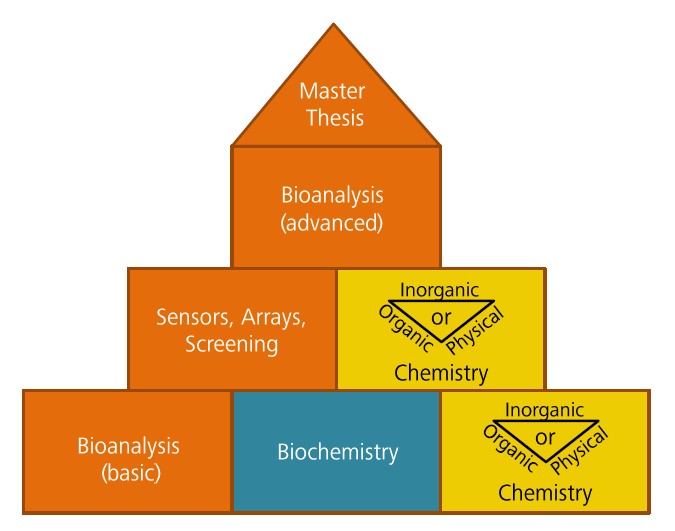
Basic Level
Core Module Bioanalysis & Biosensors:
Lecture Bioanalysis 1 / WiSe: The lecture covers established and state-of-the-art spectroscopic and imaging techniques to study biomolecules in the bulk phase with respect to concentration, structure and interaction partners. It includes specific approaches to analyze the molecules of life directly in such complex matrices such as directly in living cells or tissues.
Lab Course Bioanalysis / WiSe: This introductory lab course in bioanalysis provides hands-on experience with the most relevant bioanalytical techniques including (i) fluorescence and Raman microscopy, (ii) biomolecular separation and identification approaches and (iii) genetic finger printing and radio immuno assays.
Lecture Bioanalysis 2 / SoSe: The lecture covers instrumental aspects of bioanalytical methods. In particular, the potential of advanced separation techniques and mass spectrometry for solving bioanalytical challenges is in the focus of this lecture.
Core Module Biochemistry:
Lecture Molecular Biology of the Cell / WiSe : The lecture approaches the structure and functions of living cells from a chemist’s perspective focusing on a molecular description of processes that enable and sustain life. Starting from an introductory survey of different cell types and what makes them special, the major part is dealing with animal and in particular human cells starting from tissue architecture to cell division, gene regulation and protein biosynthesis.
Lecture Basic principles of Metabolism / SoSe: The lecture will highlight the most important metabolic pathways and emphasize their interconnection. As metabolism is considered an essential hallmark of life, this lecture will introduce you to how cells oxidize nutrients to sustain their fundamental functions like movement, communication or transport with metabolic energy (catabolism). It will also look into anabolism, where cells synthesize new macromolecules from small precursors during multiplication.
Research lab course Biochemistry / WiSe/SoSe: An individual research lab course at biochemistry labs across campus provides advanced and focused experience with biochemical laboratory techniques. The range of potential topics includes biochemistry of proteins or nucleic acids, biophysical chemistry, molecular biology or even clinical biochemistry projects.
Core Module in either Inorganic, Organic or Physical Chemistry:
Modules from inorganic, organic or physical chemistry give your master’s degree program a personal shape. Choose one core and one advanced module from your preferred chemistry branch. It will help sharpen and augment your specialization in bioanalytical chemistry and provide you with the unique option of a general Master’s in Chemistry with a specialization in Bioanalysis.
Advanced Level
Advanced Module 1 Bioanalysis & Biosensors:
Lecture Sensors, Arrays, Screening (SAS) / WiSe: In this course you’ll gain fundamental understanding of optical, electrochemical and miniaturized (bio)sensors, their arrays; and of bioanalytical screening technologies. You’ll learn about the current status quo and of the most relevant future advances on the horizon that lead to new solutions in the point-of-care, clinical diagnostics, food- and environmental monitoring, and in pharmaceutical drug screening.
Lab Course SAS / WiSe: This course allows you to step up from simply following protocols toward designing your own in the pursuit of creating your own (bio)sensors or screening assays and dive deep into the topic together with your course mentor.
Advanced Module 2 Bioanalysis & Biosensors:
Research Lab Course Bioanalysis: You join a research team of your choice to gain in-depth insight into a research topic, immerse yourself into independent studies and learn from the expert peers in the team. You will generate new knowledge that may even end up in a publication with you as co-author. In our research seminars you’ll learn about other research projects and are involved in discussions about the current scientific literature.
Special Lectures: Lectures on proteomics and metabolomics, electroanalytical chemistry, radioanalysis or nanomaterials for sensing applications are offered from which you choose two lectures.
Advanced Module 1 in either Inorganic, Organic or Physical Chemistry:
Modules from inorganic, organic or physical chemistry give your master’s degree program a personal shape. Choose one core and one advanced module from your preferred chemistry branch. It will help sharpen and augment your specialization in bioanalytical chemistry and provide you with the unique option of a general Master’s in Chemistry with a specialization in Bioanalysis.
Research Level
Excursion:
An excursion to a chemical company with your fellow chemistry students gives you a detailed view of a part of the chemical industry.
Research Methods Course:
Immersing in specialised bioanalytical techniques
Working Group Seminars:
Learn from and discuss scientific literature
Get exposed to the breadth of international science through the institute's seminar
Master's Thesis - Independent research project
Perform innovative and independent research in Bioanalysis
 UR/ Annika Schuppe
Contact us
Study programme coordination
Dr. Claudia Wanninger-Weiß
Program Coordination and Study Advisory specialised for (Business) Chemistry
-
E-mail address: studienberatung.chemie(at)ur.de
(opens your email program)
Secondary e-mail address: claudia.wanninger-weiss(at)ur.de (opens your email program) - Tel: +49 941 943 4573 (starts a telephone call, if your device allows this)
- Location: Chemistry and Pharmacy, CH 3.1.87
-
Important information: Programs: Chemistry (B.Sc./M.Sc.), Business Chemistry (B.Sc./M.Sc.), Medicinal Chemistry (M.Sc.)
Office hours are typically Monday and Thursday, Consultation appointments by arrangement