

Clinical Psychology

The comprehensive aim of the Chair's research activities in the field of clinical psychology is to contribute to the elucidation of the disturbed processing of emotional and social stimuli that occur in the context of psychological disorders. The integration of experimental and neuropsychological questions and study designs is essential for research into these general phenomena of psychological experience and behaviour. Fear and anxiety disorders are a major focus of research, with particular emphasis on the learning and attention processes involved. In particular, the investigation of context on the learning and unlearning of fear reactions is crucial for the understanding of anxiety disorders. The investigation of genetic polymorphisms and the interaction of genetics-environmental aspects are also considered. Innovative technical possibilities such as virtual reality are used to optimise the study environment and the ecological validity of the experimental investigations. See also projects.


Psychotherapy

Based on current developments, the method of exposure in virtual reality is being investigated as an innovative intervention method. This method has proven to be very effective for various anxiety disorders and is also very attractive for patients. The virtual reality method can also be used for therapy process research in particular, as it can be used to realise controlled and easily manipulated stimulus situations. Of particular interest here are the conditions for successful exposure therapy for anxiety disorders. (Example article: "Effect of multiple context exposure on renewal in spider phobia") (external link, opens in a new window)
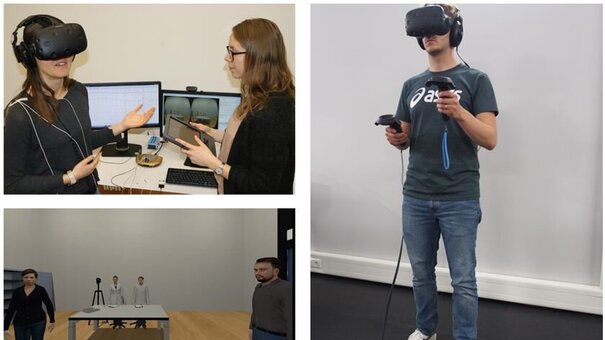
Social interactions are another focus of research. They are relevant for the experience of stress in private and professional contexts and are a decisive component in many psychological disorders and an important starting point for psychotherapy. To elucidate relevant aspects of social interactions, paradigms are to be established in virtual worlds in addition to process analyses in psychotherapies, which can be used to investigate social interactions, to treat social anxiety and also to prevent psychological disorders.

Publications

Publication list

Laboratories

  • Virtual reality

    The focus of the chair is the use of virtual reality (VR) in basic research and in the applied clinical field.

  • Multisensory laboratory (CAVE)

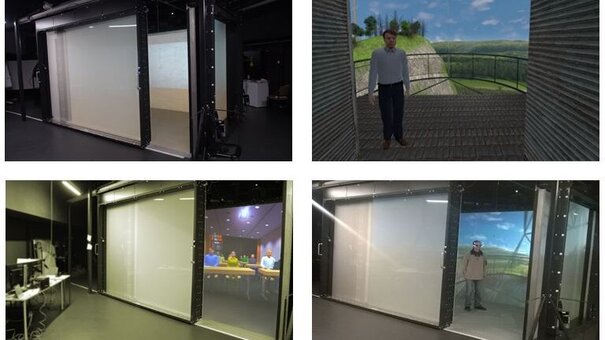
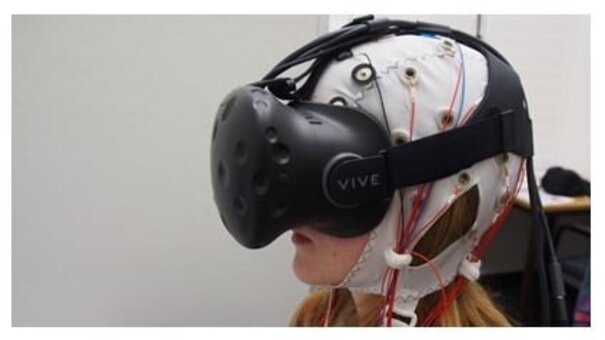
    The main component of the multi-sensory laboratory is a CAVE ("Cave automatic virtual environment") with a 5-sided stereo projection system. In the CAVE, virtual environments can be projected onto screens in 3D. The user can move freely within the CAVE. Loudspeakers, fans (e.g. for wind simulation in high-altitude scenarios), controlled presentation of odour-laden air and movement interactions are used for a multimodal presentation of virtual reality. The CAVE is used for research and therapy. For the latter, virtual scenarios are available for exposure therapy for anxiety disorders (e.g. fear of heights, fear of spiders). In addition, various behavioural measures (movement tracking and eye tracking) and physiological measures (peripheral physiology and EEG) can be measured in the CAVE.

    Supported by DFG grant INST 89/392-1 FUGG (large-scale research equipment).

  • Movement laboratory

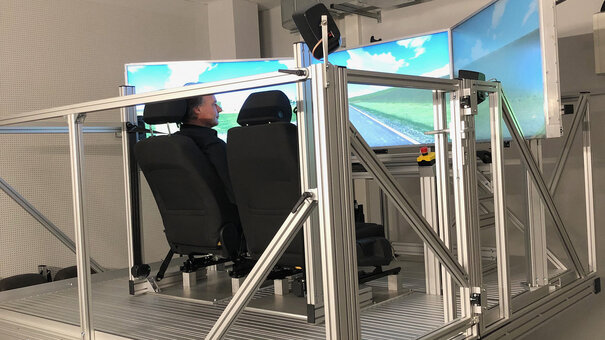
    Motion lab with motion platform for flight and driving simulation

  • Measurement methods

    (Neuro-)physiology, eye tracking, behaviour measurement

Virtual reality

The focus of the chair is the use of virtual reality (VR) in basic research and in the applied clinical field.

Multisensory laboratory (CAVE)

The main component of the multi-sensory laboratory is a CAVE ("Cave automatic virtual environment") with a 5-sided stereo projection system. In the CAVE, virtual environments can be projected onto screens in 3D. The user can move freely within the CAVE. Loudspeakers, fans (e.g. for wind simulation in high-altitude scenarios), controlled presentation of odour-laden air and movement interactions are used for a multimodal presentation of virtual reality. The CAVE is used for research and therapy. For the latter, virtual scenarios are available for exposure therapy for anxiety disorders (e.g. fear of heights, fear of spiders). In addition, various behavioural measures (movement tracking and eye tracking) and physiological measures (peripheral physiology and EEG) can be measured in the CAVE.

Supported by DFG grant INST 89/392-1 FUGG (large-scale research equipment).

Movement laboratory

Motion lab with motion platform for flight and driving simulation

Measurement methods

(Neuro-)physiology, eye tracking, behaviour measurement

To top