


Eye movements
 Foto: UR/Alexander Nacke
Current projects
- In digital learning environments, students are confronted with many possible distractions of various modalities, such as pop-up advertising. In general, distractions can have a disruptive effect on the learning process. An experimental study within a doctoral program is being conducted to investigate eye movements when learning with digital texts that include distractions. Maré Kondruß and Prof Dr Klaus-Peter Wild are in charge of the project.
- Cognitive learning strategies are techniques that allow us to actively control our learning. They help us structure and process information more effectively and store it in memory for the long term. Within the framework of a doctoral thesis, this study aims to investigate how cognitive learning strategies can be reflected in eye movements, as well as whether and how individual factors influence this process. Adelina Wagner and Prof Dr Klaus-Peter Wild are in charge of the project.
Goals
- Analysis of factors influencing attention during digital reading, including task relevance, affective valence and text difficulty
- Identifying eye-movement indicators during the use of cognitive learning strategies
Methods

- Computer-based experiments with a realistic design of learning situations, using screen-based eye trackers
- Using questionnaires to assess personal and context-related characteristics related to self-regulated learning and attention
Academic socialisation through friendships
Current project
This project examines the role of friendships in the university context. The main question is whether peer friendships provide a cognitively stimulating environment during studies and thereby strengthen students' identification with their role as students.
The focus is on the newly conceptualised friendship quality of intellectual stimulation or cognitive stimulation by peers. This means that friends can encourage students to think differently about study content, theories or subject-related issues and to critically examine them. The study examines the relationship between intellectual stimulation and study-related factors, such as interest in studying, motivation, and students' identification with their role as a student. Anna Wurm, Dr Sebastian Schmid and Prof Dr Klaus-Peter Wild are in charge of the project.
Goals
- Analysing conditional factors and consequences of friendships for the development of a student identity
- Consideration of quantitative and qualitative aspects of friendship relationships (e.g. intellectual stimulation)
- Consideration of different aspects of identity (e.g. identified regulation and interest in studying)
Methods
- A cross-sectional survey of friendship networks
 Foto: UR / Julia Dragan
Multimedia and game-based learning
 UR/ Annika Schuppe
Goals
- Identifying media design factors that promote learning, such as in games or video-based learning
- Interactions between media design factors and learner characteristics (e.g. prior knowledge, media experience)
- Investigation of conditional factors and models of technology acceptance
Methods
- Experiments in the control group design
- Longitudinal and cross-sectional questionnaire studies
Competences of students in working with scientific literature
Goals
- Analysing the knowledge needed for high competence, such as knowledge of text types and strategies for understanding and evaluating scientific texts
- Development of training courses and tests to record and support students in working competently with academic literature
Methods
- Paper-pencil tests
- Training experiments
- Analysis of eye-tracking data
Completed project - ASTRALITE
ASTRALITE - ASessment and TRAing of Scientific LITEracy
In almost all subjects, students are expected to work with original scientific literature. Successfully engaging with such texts involves more than just understanding their content. For example, students need to review many texts, identify suitable ones, and critically evaluate them, especially when writing final theses. The skills required for working with academic literature involve a wide range of strategies, which are rarely explicitly taught during degree programmes.
To broaden the range of relevant sub-skills in dealing with academic literature, we distinguish between two target types (receptive versus epistemic) and two ways of processing information (systematic versus heuristic). Readers with a receptive goal aim to understand and acquire knowledge, while those with an epistemic goal aim to develop their own position on the content. These goals can be pursued either systematically, through in-depth processing of the text, or heuristically, by focusing on surface-level features in a rule-based way.
The project is based on a cognitive-psychological understanding of competence as a system of knowledge and beliefs that enables successful performance in demanding situations. Accordingly, the focus of the project is on analysing the declarative and procedural knowledge that underlies a high level of student competence in dealing with scientific literature. In this way, the validity of the existing test procedures from the previous project (Competences of students in dealing with original scientific literature - KOSWO) is to be examined. The validation approach includes training experiments, an expert–novice study with eye-tracking, and the collection of ecologically valid performance data.
The project is managed by Dr Sebastian Schmid, Prof Dr Tobias Richter, Prof Dr Klaus-Peter Wild and Dr Sabrina Viehauser.
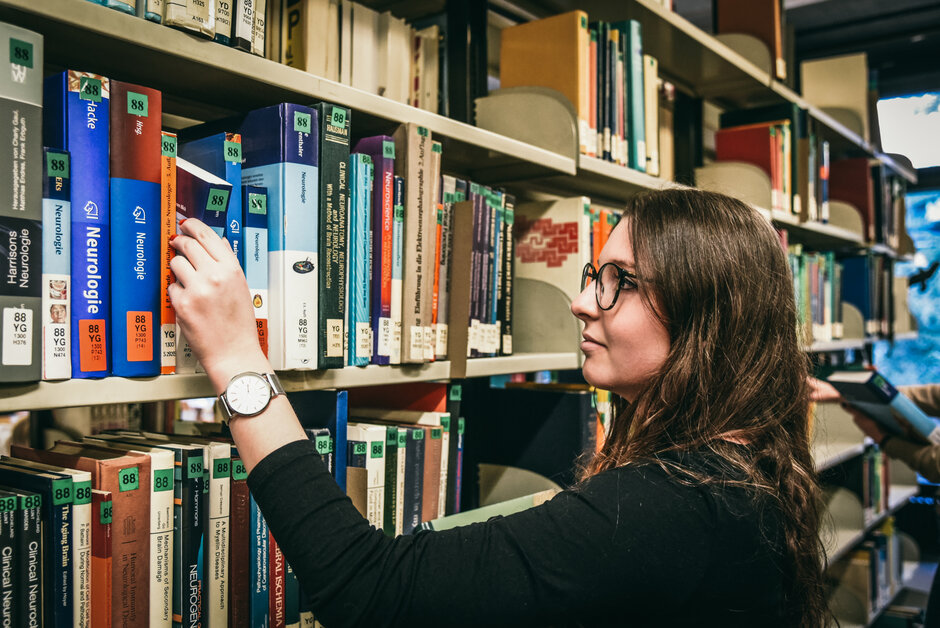 Foto: UR / Julia Dragan