


2026
Reading and Discussion: Enemy Literature
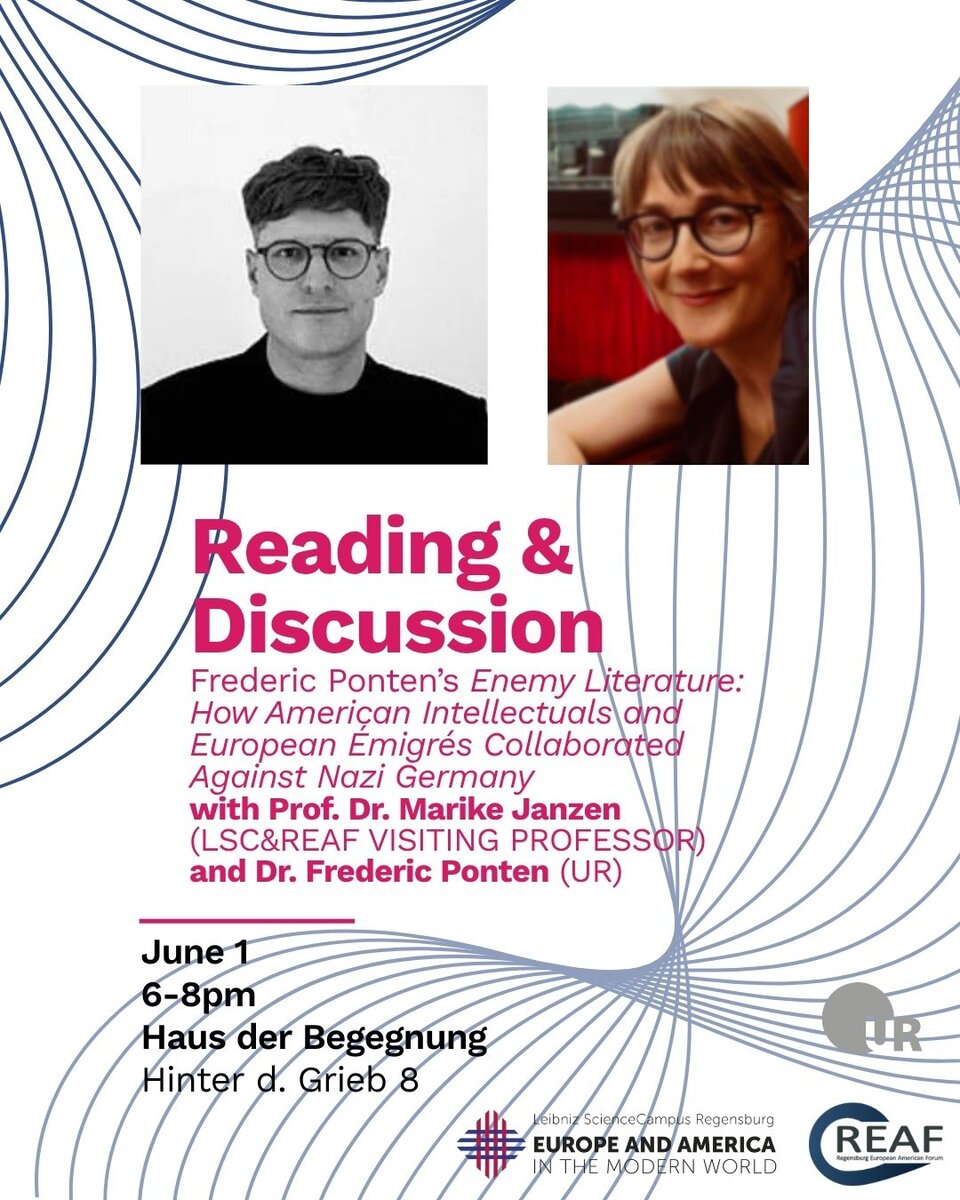
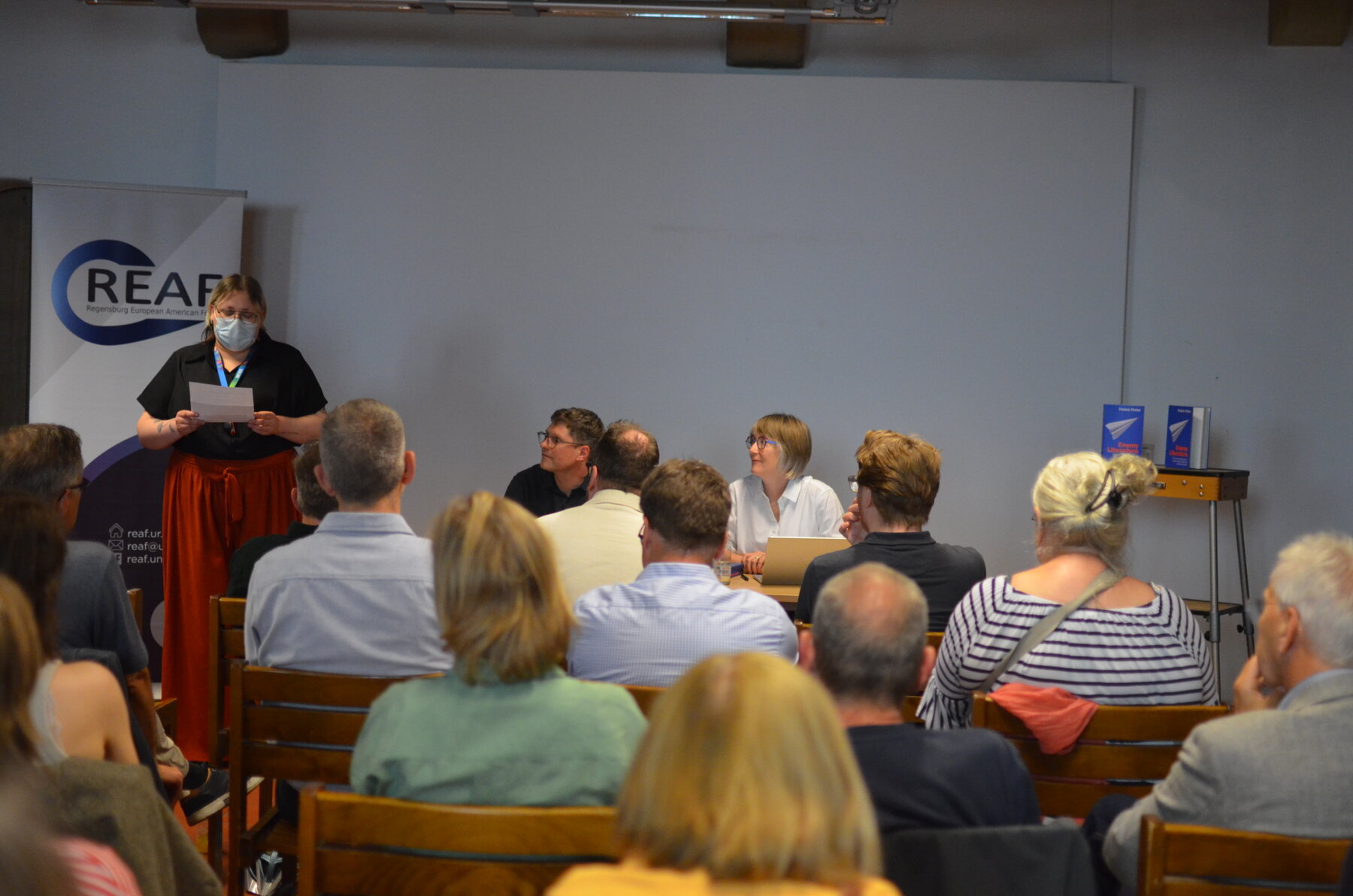
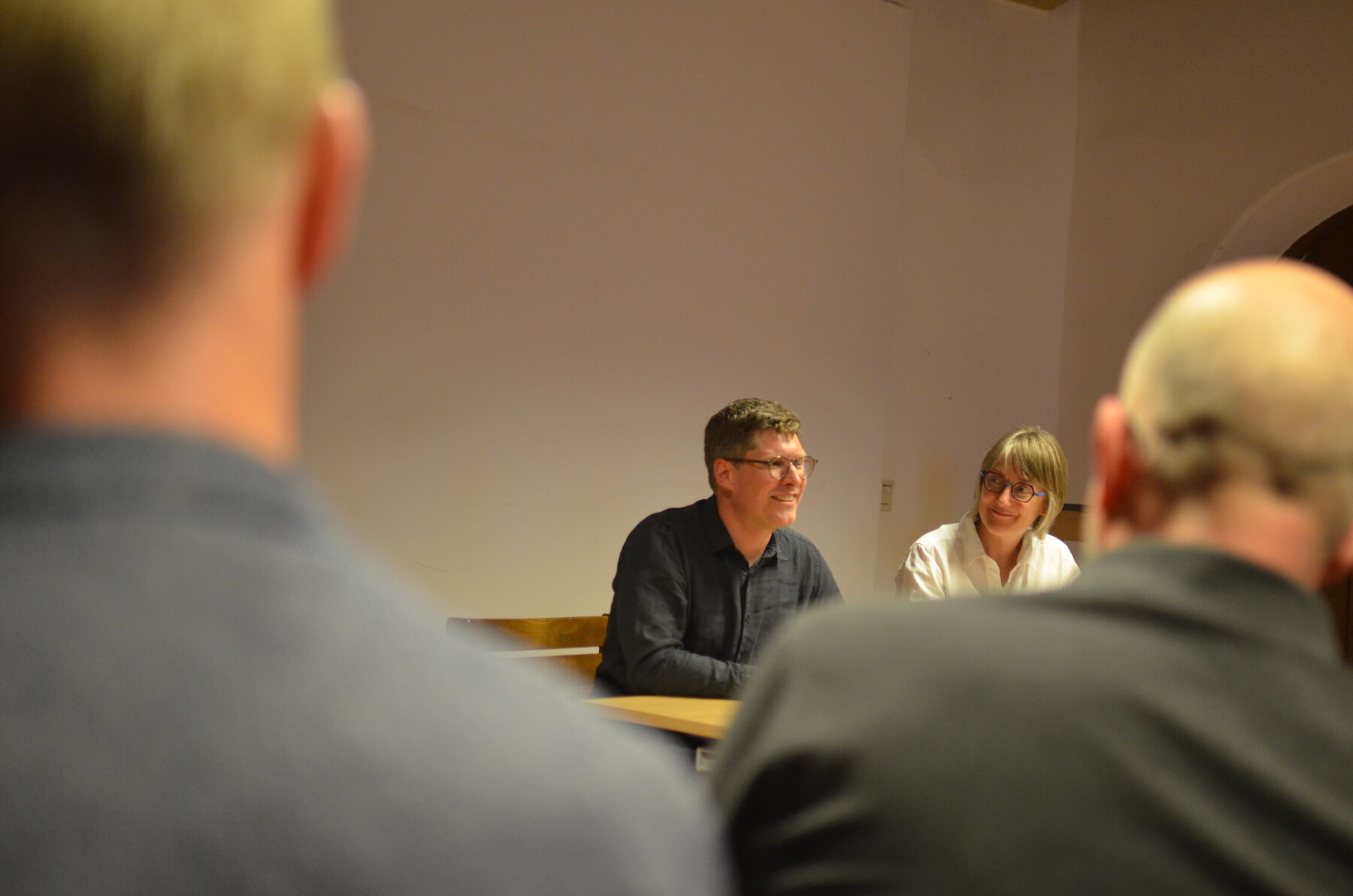
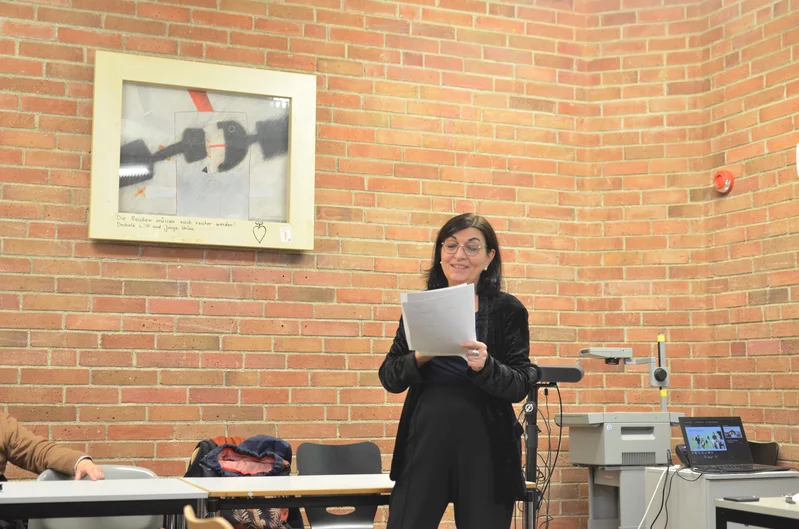
On 1 June 2026, 6-8pm, REAF and Leibniz ScienceCampus (external link, opens in a new window) hosted a reading and discussion with Prof. Dr. Marike Janzen (LSC and REAF Visiting Professor) and Dr. Frederic Ponten in Haus der Begegnung.
The two scholars read from and discussed Dr. Ponten's book Enemy Literature: How American Intellectuals and European Émigrés Collaborated Against Nazi Germany.
About the book (from Cambridge University Press (external link, opens in a new window)) : “An entire forgotten corpus of US writing on the Nazi German enemy boomed in a matter of a few years, peaked during World War II, and collapsed within months of the war ending. For a fleeting moment in history, significant parts of the intellectual world in the United States converged to provide a cool-headed analysis of the Nazi threat and a clear identification of the enemy. Starting in 1944, these writers also offered an elaborate plan for a postwar re-education that would transform the National Socialist German nation into a democratic ally. Readers alarmed by the current resurgence of authoritarianism will learn from the work of those activists who analyzed Nazi Germany during World War II. This book, the first monographic study of this literature, provides pointed introductions to the main intellectual projects, their unique collaborative spirit, and their epochal results.”
About the author and panelist Frederic Ponten:
Frederic Ponten is Wissenschaftlicher Mitarbeiter in Neuere deutsche Literaturwissenschaft at the University of Regensburg. After studying in Siegen, Barcelona, Berlin, and Baltimore, he completed his Ph.D. in German Studies at Princeton University. He currently holds a 2025-26 Sylvia Naish Postdoctoral Fellowship from the School of Advanced Study at the University of London.
Prof. Dr. Marike Janzen (University of Kansas) joined us on campus from May to July 2026 as a REAF and Leibniz ScienceCampus Visiting Professor (external link, opens in a new window).
Prof. Dr. Marike Janzen (external link, opens in a new window) is an Associate Professor in the Department of Slavic, German, and Eurasian Studies at the University of Kansas. She also serves as the Director of the Max Kade Center for German-American Studies (external link, opens in a new window). Her research focuses on 20th and 21st-century German literature, literature of human rights, migration and refugee experience, literary publics, and the literature of the international left, as well as broader questions in comparative and world literature. She holds a Ph.D. and M.A. in Comparative Literature from the University of Texas at Austin.

Heike Rafael-Hernandez
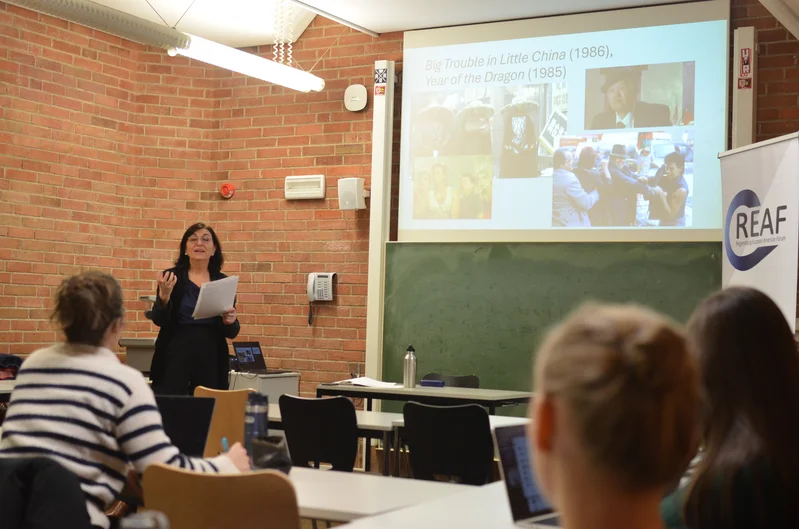
On January 21st, 2026, REAF had the honor of hosting a Guest Lecture by Dr. Heike Raphael-Hernandez (University of Würzburg, Germany) titled "Changing Images of Global South Immigrants and Hollywood's Part."
Dr. Raphael-Hernandez examined depictions of immigrants throughout the history of U.S. American film. Her talk, as well as the following in-class discussion, identified narratives of racialization and othering and focused on the group identification processes taking place in Hollywood movies, tying prevalent movie tropes to social, cultural, and political anxieties and changes throughout U.S. history of the last 100 years.
After her lecture, Dr. Raphael-Hernandez joined MEAS students and PhD candidates for an intimate Roundtable discussion about each person's respective research interests, and scholarly (un-)freedoms in the face of potentially restrictive policies.

2025
Academic Freedom in 2025
On July 9, 2025, REAF and the Leibniz ScienceCampus co-hosted a lively panel discussion on "Academic Freedom in 2025" at the University of Regensburg. The panel brought together REAF Visiting Fellow Prof. Dr. Benjamin Chappell (University of Kansas), LSC Visiting Fellow Dr. Diana Georgescu (University College London), Dr. Carmen Dexl (American Studies, UR), and Prof. Dr. Ursula Regener (UR Vice-President for Internationalization and Diversity). Moderated by Lena Gotteswinter (American Studies, UR), the discussion offered a transnational perspective on current threats to academic freedom, including political interference, institutional pressures, and digital censorship, particularly in the context of the rise of authoritarianism in Europe and the United States. The speakers also explored avenues for resistance and international solidarity. We thank all participants for an engaging and thought-provoking evening.


Marike Janzen

On June 24, REAF and the Leibniz ScienceCampus had the pleasure of hosting a Recent Research Roundtable with LSC Visiting Professor Dr. Marike Janzen (Max Kade Center, University of Kansas). Prof. Janzen has honored us with numerous residences in the past, and we are very pleased to have her back at the University of Regensburg this summer semester. Under the informal motto "Mocktails with Marike", we were joined by fellow researchers and students in a summery setting to discuss research, current projects, and interests. Prof. Janzen holds a Ph.D. in Comparative Literature from the University of Texas at Austin and is currently the director of the Max Kade Center at KU, to which we cherish close ties. Her research interests include 20th and 21st century German Literature, Literature of Human Rights and the International Left, and Literary Publics.
Jeroen Dewulf

Supported by the Regensburger Universitätsstiftung Hans Vielberth and in cooperation with DIMAS, the Leibniz ScienceCampus, and Know:In, REAF had the pleasure of hosting a talk by Prof. Dr. Jeroen Dewulf from UC Berkeley. On January 30, he gave an intriguing guest lecture, titled "Flying Back to Africa or Flying to Heaven? Competing Visions of Afterlife in the South Carolina Lowcountry and Caribbean Slave Societies," in which he explored the well-known legend of the Flying Africans, i.e., enslaved people who, according to folklore, escaped slavery by flying back to Africa. Offering his own interpretation of its origin and meaning, he traced the legend back to cultural and religious frictions that, over time, evolved into a powerful narrative of resistance against slavery.
"The Illegals" (Meyer Levin, 1947)


On July 8, 2025, REAF and the Center for Commemorative Culture at the University of Regensburg hosted a public screening of "The Illegals" (1947), directed by Meyer Levin. The event took place at the historic Regina Movie Theater and drew a diverse audience of colleagues, students, and community members to its Metropolis Hall. Following the screening, a discussion was held with Alexander Carstiuc (historian, translator, and expert on the extensive body of work by Meyer Levin) and Jörg Skriebeleit (director of the Flossenbürg Concentration Camp Memorial and co-director of the Center for Commemorative Culture). The conversation was moderated by Dennis Forster (practitioner in political-historical education) and Tamara Heger (REAF), who guided an engaging dialogue with the speakers and audience. Levin's film, a semi-documentary, follows the harrowing journey of Jewish Holocaust survivors attempting to rebuild their lives by emigrating to the British Mandate of Palestine. Having witnessed the devastation of the Holocaust firsthand as a war correspondent for the U.S. Army, Levin captures their struggle with stark immediacy. The archival footage features survivors telling their own stories, with only two roles portrayed by professional actors. The screening and subsequent discussion offered a moving and thought-provoking reflection on postwar displacement, historical memory, and the role of film in shaping public understanding.
Marike Janzen

On July 3, REAF, colleagues, and students had the opportunity to attend a guest lecture by LSC Visiting Professor Dr. Marike Janzen (Max Kade Center, University of Kansas), titled "'Freedom' and 'Refugeedom' at the Goethe Institute in Exile". The lecture scrutinized the multifaceted relationships between the so-called 'Bildungsbürgertum' and non-citizens in Berlin's literary scene. It examined how, for example, the Goethe Institut im Exil, a Berlin-based program founded in 2023 in response to closures of Goethe Institutes in Syria, Afghanistan, Ukraine, and Belarus, countries where repressive regimes or on-the-ground violence prevented programming from continuing, facilitated modes of citizenship formation within the literary sphere.
If you missed Prof. Janzen's intriguing lecture, worry not, as she will return to teach an entire course for the summer semester 2026!