

Course overview and long-term planning of teaching
SS 2026:
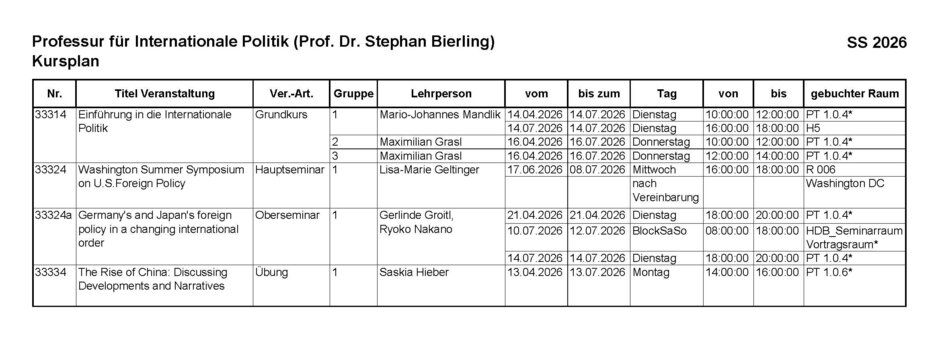
Long-term planning of teaching

Academic work
Dear students,
in view of the current situation, I would like to point out that ALL work performed in our courses (oral and written work such as term papers, essays, position papers, handouts for divisions, etc.) must be prepared independently and meet academic standards. Specifically, this means that, for example, handouts for divisions may not simply be copied or pieced together from the Internet or you can let the AI do the work. If copied sentences and thoughts are not labelled as such, this is plagiarism, regardless of whether they have signed a declaration of plagiarism (as is the case in term papers or theses) or not.
Prof. Dr Stephan Bierling, Sept 1, 2025
Tips for writing academic term papers
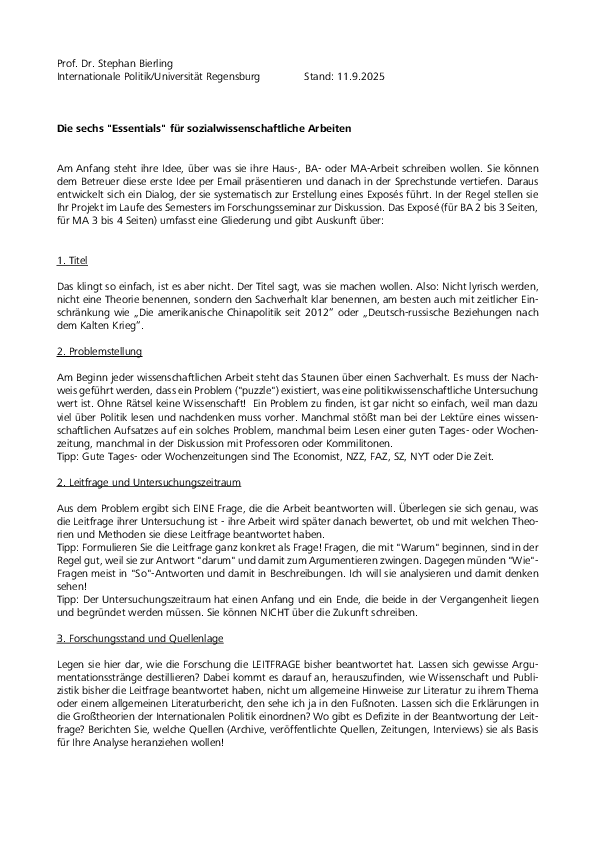
6 tips for good presentations
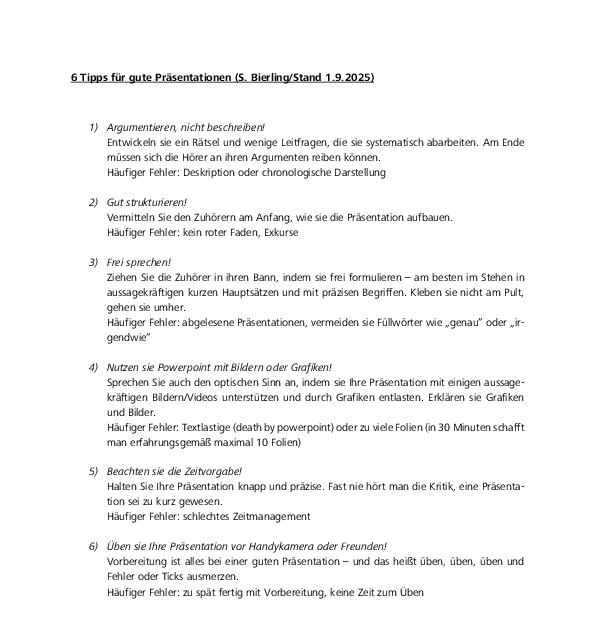
Preparation of a BA or MA thesis
Please note the following formal criteria when writing your thesis:
- Length: 30 pages (Bachelor), 60 pages (Master) text (+/- 10%), each without literature and appendix
- Font: Times New Romance; font size 12
- Line spacing: 1.5
- Footnotes: Font size 10; Times New Roman; single-spaced.
- Margin: left 3 cm; right 2.5 cm
- Documents, sources and literature obtained from the Internet must be submitted as a file or printout on request.
How to write a scientific thesis
It all starts with your idea of what you want to write your BA, MA or Master's thesis on. You can present this idea to your supervisor during consultation hours or by email. This will lead to a dialogue that will systematically lead you to the creation of an exposé. As a rule, you present your project for discussion in the research seminar during the semester. The exposé (for BA 1-2 pages, for MA 2-3 pages, for Magister 3-4 pages) provides information about
1) Problem definition
At the beginning of every academic work there is a question about a fact. It must be demonstrated that a problem ("puzzle") exists, which is worthy of political science investigation. Why do you think your topic is relevant? Finding a problem is not that easy because you have to read and think a lot about politics beforehand. Sometimes you come across such a problem when reading an academic article, sometimes when reading a good daily or weekly newspaper, sometimes in discussions with professors or fellow students.
2) Key question
The problem gives rise to a question that the thesis aims to answer. What does the paper want to find out? Think carefully about what the key question of your research is - your work will later be assessed according to whether and with which instruments you have answered this key question. Tip: Formulate the key question very specifically as a question! Only then can you differentiate it. What is your research period? Why did you choose this particular time period? Questions that begin with "why" are usually good because they force you to answer "therefore" and thus to argue. In contrast, "how" questions usually lead to "so" answers and thus to descriptions. I want to see you analyse and think!
3) State of research
Explain here how research has answered the key question so far. Can certain lines of argument be distilled? Give a detailed account of the state of discussion in the secondary literature (books and essays)! Where are there deficits in the literature? Please note: Here you should not list books and essays according to the motto ("the thick book was particularly helpful"), but you should explain what answers the research gives to your key question.
Report which sources (archives, published sources, newspapers, interviews) you want to use as a basis for your analysis!
4) Research design
Now comes the most difficult part of the whole assignment. Now you have to decide which theoretical approach you want to work with. In concrete terms, this means that you must use your knowledge of the theories to decide which of them can be used to derive a hypothesis as an answer to the key question. This hypothesis must necessarily result from the chosen theory. It is "tested" in the course of the work, i.e. it is checked whether it can organise the facts sensibly and stringently. If it succeeds in doing so, the hypothesis and thus also the theory has proven itself; if it does not succeed or only partially succeeds, it is considered to be completely or partially falsified. Nietzsche once said, "Science is the ordering of the confusion of things through hypotheses". This theory-based approach also distinguishes your work from policy papers, such as those written by the German Institute for International and Security Affairs.
After developing the hypothesis, you have to consider how you want to test it, specifically: should the work be qualitative or quantitative? Why?
Experience has shown that points 1 to 4 should not account for more than 20 to 30 per cent of the total scope of the thesis, but they are crucial to its success because they define the framework within which you move in the empirical part. This is the part where creativity and reflection are important.
5) Empirical investigation
This is the part where diligence and experience are important, which is why this part usually accounts for around 60 to 70 per cent of the work. Here you have to sift through the material and analyse it systematically. This can be archive material, publicly accessible sources, autobiographies, books, essays and journalistic works. The structure of the material determines your research design and the chosen method.
It is important that you repeatedly interlink the empiricism with your guiding question and hypothesis so that the relevance of the research design is recognisable. Chapters about which you could write "digressions" or similar do not belong in the thesis. You do not have to tell the reader everything you need to know to write the paper. Concentration and condensation of the material is an added value that you provide for the science.
Presenting an outline helps a lot here.
6) Results
Answer the key question posed at the beginning! How do your results differ from previous research findings? With the hypothesis, you have already formulated an idea of what the result of your work should be. However, scientific openness means that you can also realise that the hypothesis could not answer your question satisfactorily or only partially. At the end, discuss the usefulness of the theory and hypothesis. Discuss your results in a broader political science context! What does your study basically tell us about the functioning of a political system or international politics? As social scientists, we are looking for rules ..
Samples for term papers, BA and Master's theses
You can view a selection of particularly successful term papers, BA and Master's theses in the IP on Grips with the password #IP18us. The selection is regularly updated.