
The teaching research project University Study Bavarian Election 2018 (USBW18) was carried out as a cooperative study by three Bavarian universities (LMU Munich, University of Passau and University of Regensburg). This project brought together innovative research, teaching and practice. The central scientific objective is the valid theoretical and methodological determination of swing voter flows in multi-party systems. At the same time, established and newer explanations of voting behaviour are empirically tested in further survey modules.
Summer semester 2018: Teaching research project using the example of the 2018 state election in Bavaria
In the teaching research project, students were given an introduction to the theoretical foundations of empirical psephology, swing vote research and voter migration analysis. The advantages and disadvantages of the common methods of voter migration analysis (extrapolation of exit polls and surveys based on individual data, ecological inference based on aggregate data) were discussed in detail and then the hybrid model of the Iterative Proportional Fitting method (IPF) according to Klima et al. 2017 was presented. This methodological introduction was followed by an overview of the motives for changing votes in elections in general and in state parliament elections in particular, as well as a detailed examination of the elections in Bavaria and the question of whether the "clocks really do run differently in Bavaria" (Falter 1982, Mintzel 1987). The third part of the seminar focused on the election campaign for the state election in Bavaria on 14 October 2018. The most important issues, the candidates on offer, possible coalition options and voter preferences were discussed. On the basis of these principles and findings, the students formulated research questions in groups and worked out research designs that were to be analysed using the data they collected themselves. The complex sampling for the telephone and post-election survey (exit poll) was also the subject of the seminar. In the last two sessions, the seminar participants were trained to act as team captains. Each exit poll team consisted of a captain and two interviewers. The Regensburg students then conducted the post-election surveys in 25 polling stations in the city of Regensburg and selected municipalities in the Upper Palatinate and Lower Bavaria on 14 October 2018.
PROF. WALTER-ROGG with Regensburg students who took part in the USBW18 teaching research project and conducted the exit poll surveys in Regensburg and other cities and municipalities in the Upper Palatinate.
In ten randomly drawn Regensburg constituencies, over 70 per cent of voters (N = 3,052) took part in the post-election survey. Based on these results, we can trace the voter flows for the city of Regensburg between the 2013 and 2018 state elections and between the 2017 Bundestag Elections and the 2018 state elections. The following figure shows the voter migration between the 2013 state election and the 2018 state election in Regensburg. It shows the net gains and losses of the parties. The graphs on the sides each show the proportion of net losses (left) or gains (right) in relation to the total net voter movements (y-axis) and in relation to the party's total electorate (x-axis).
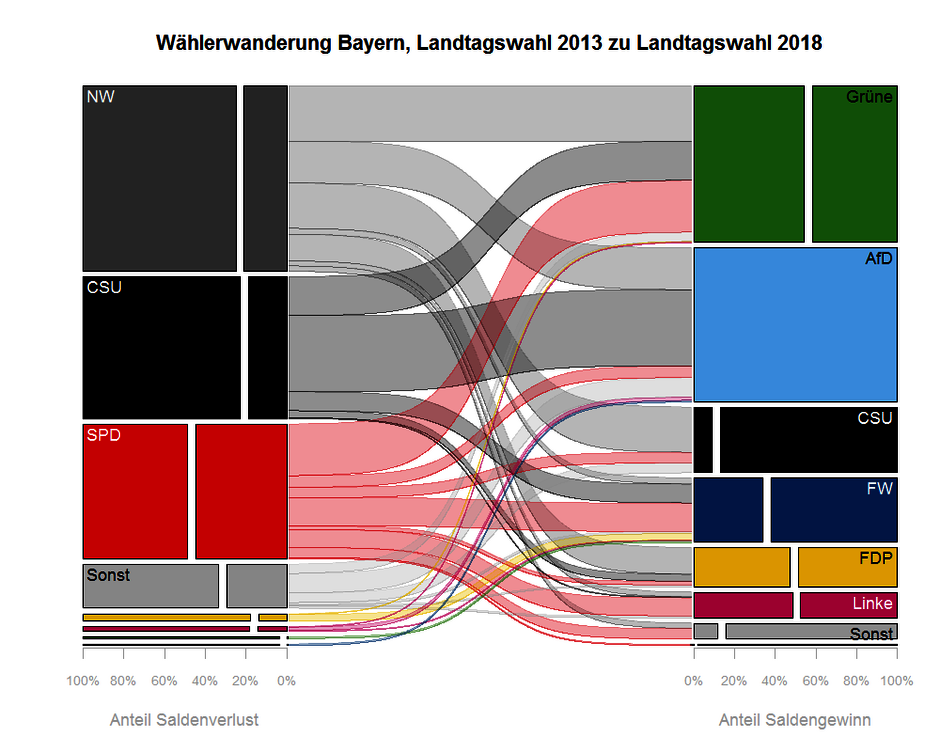
- The CSU is losing voters to all parties. 10.8% of CSU voters in 2013 voted for the Greens in 2018, 10.3% for the AfD, 7.4% for the FW and 6.8% for the FDP.
- However, the Christian Socials also managed to win the votes of FDP and Free Voters (20.6% and 18% respectively).
- The Greens were able to gain voters from all political camps. Most of all from the SPD (29.7%) and the FDP (22.7%), but also from the Left (18.1%) and the Free Voters (18%).
- Of all the parties contesting the 2018 state elections, the Greens were able to mobilise the most non-voters (29.2%). However, the AfD (18.9%) and the CSU (16.5%) also achieved this to a considerable extent.
- The most loyal voters in the city of Regensburg are the Greens: more than three quarters of voters (76.7%) already voted for this party in 2013. The party loyalty of CSU and Left Party voters (60% and 58.2% respectively) is also relatively high, albeit at a considerable distance.
- By contrast, SPD voters are very willing to switch parties: only 36.1% voted for this party in 2018 and 2013. The retention rates for the Free Voters (37.3%) and the FDP (38.6%) are almost as low.
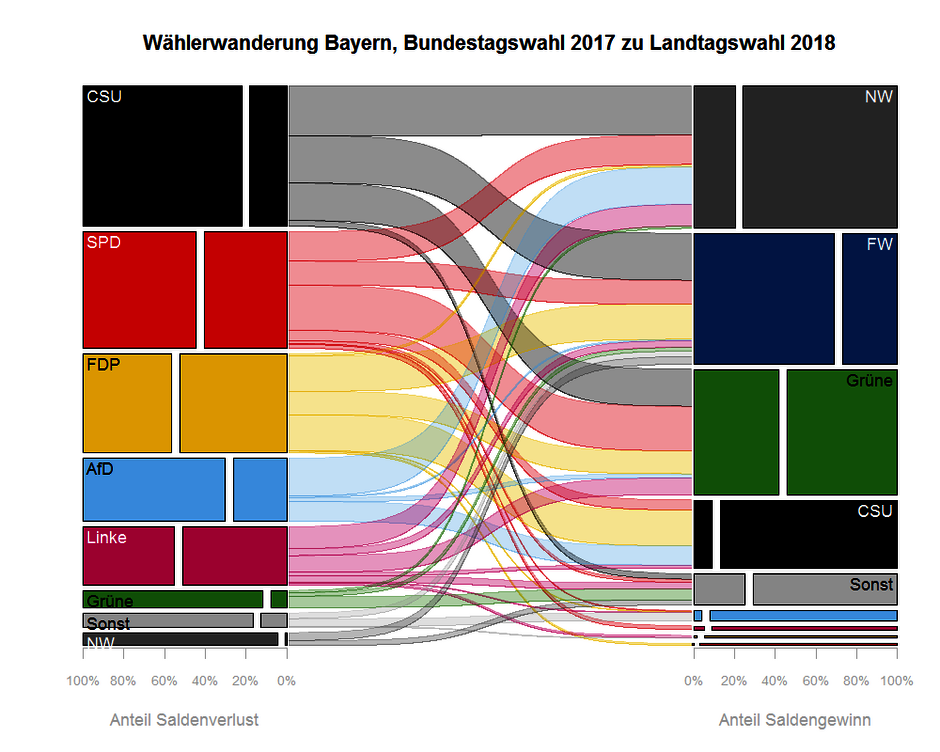
The next figure shows the voter migration between the 2017 Bundestag Elections and the 2018 state elections in Regensburg. It shows the net gains and losses of the parties. The diagrams on the sides each show the proportion of net losses (left) or gains (right) in relation to the total net voter movements (y-axis) and in relation to the party's total electorate (x-axis). Three Regensburg parties have very loyal voters: 72.5% of Green voters in the 2017 Bundestag Elections also voted for this party in the 2018 state elections in Bavaria. This proportion is slightly lower for the AfD and CSU, but still very high (70.1% and 67.7% respectively). Compared to the 2017 Bundestag Elections, the FDP in particular lost voters in the 2018 state elections. Only just over a quarter (26.1%) of FDP voters in 2017 also voted for this party in 2018. For the SPD and the Left Party, this proportion was 40.4% and 41.% respectively. The figure for the Free Voters was 50.4%.
Winter semester 2018/19: The mixed-method approach using the example of the teaching research project on the LTW 2018 in Bavaria
In winter semester 2018/19, students had the opportunity to realise their own research projects based on the mixed-method data from the USBW18 study and to write seminar papers or qualification theses. The relevance of the research was based on the disruptive changes to the party system in Germany over the last decade. The main focus was on the question of what influence voter migration had on the result of the 2018 state election in Bavaria. Bavaria was a very interesting special case here, as the CSU had tried to distance itself from its sister party, the CDU, on refugee policy in previous years. If this was successful, the AfD should have made smaller gains in the 2018 state elections than in the 2017 Bundestag Elections. The teaching research project on the state elections in Bavaria carried out in summer 2018 enabled students to conduct a wide range of research. For example, they were able to link the individual data of the USBW18 study with the aggregate data of the Bavarian municipalities as well as with the official election results for the 2013/2018 state election and the 2017 federal election in order to carry out multi-level analyses, for example. Or carry out a media analysis using the online database Lexis Nexis or evaluate the content of digital communication between political elites and citizens. The aim of the practice-oriented seminar was to develop research questions with regard to voting behaviour in Bavaria and to answer them by combining different data information in a meaningful way. After a brief introduction to the mixed-method approach and the description of the data collected, the participants formed small groups to work on individual topics and present their initial analyses. The topics, such as voter migration, motives for switching, urban-rural differences or interdependent voting behaviour between federal and state levels, were based on the current state of empirical psephology research, although some students also used explorative research approaches.
The following research papers emerged from the practical seminar:
1. Comparing the issue agendas of parties and voters - An analysis with MAXQDA

2. Asylum policy as a reason for change in the 2018 Bavarian state elections - analysing voter migration from the CSU to the Greens
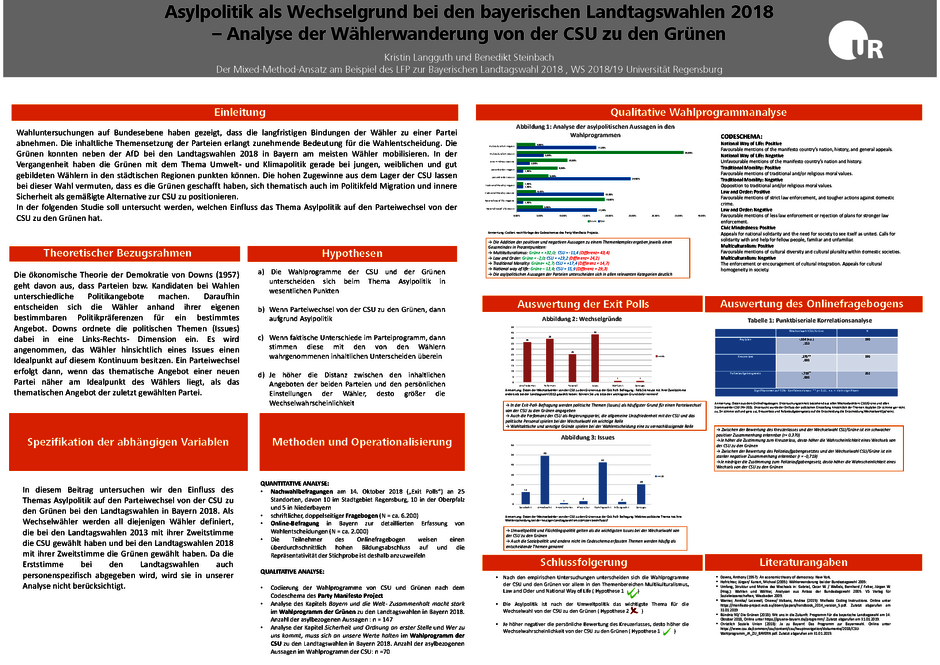
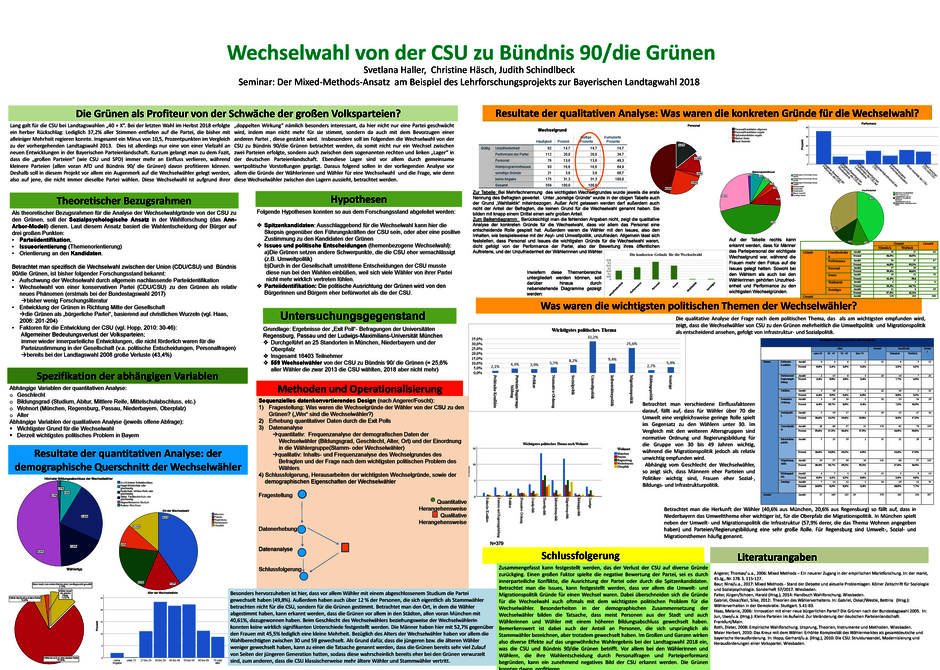
3. Switch from the CSU to Bündnis 90/Die Grünen
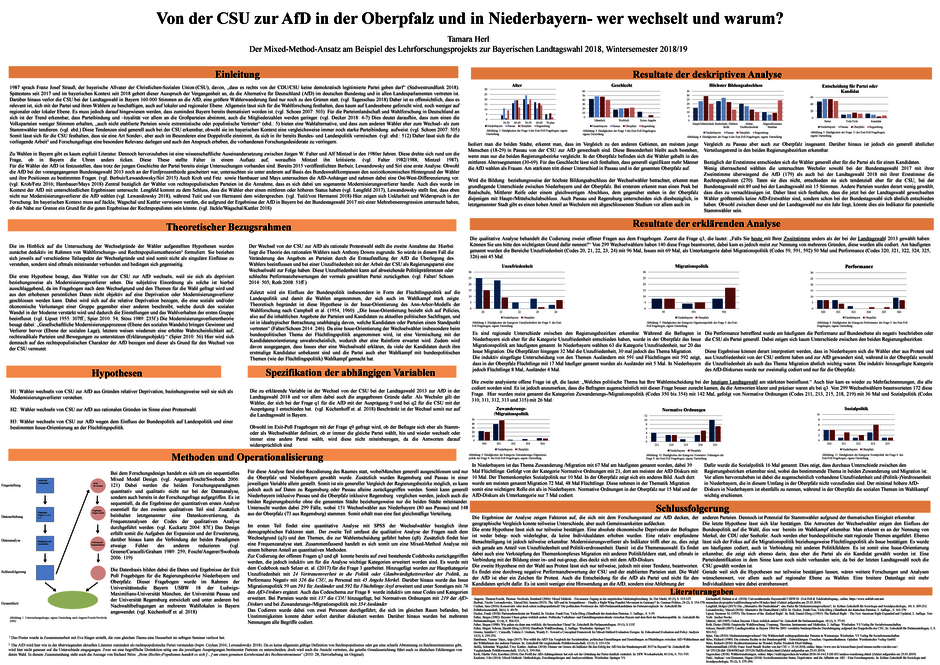
4. From the CSU to the AfD in the Upper Palatinate and Lower Bavaria - who is switching and why
MA thesis:
- Deprivation, Protest and Refugees: A Mixed-Methods-Analysis of the Reasons for AfD Voters and the AfD's Issue Setting in the 2018 Bavarian Election
- Between protest and right-wing ideology - analysis of AfD voters in Bavaria in the 2018 state election
- Exit poll, election programme and Twitter: comparison of the issue agendas of parties and voters in the 2018 Bavarian state elections
BA work:
- The influence of federal politics on the 2018 state election campaign in Bavaria - An investigation of political communication on Twitter
- The importance of topics in the Bavarian state election 2018
Seminar papers:
- How did the generation with the most votes vote? An analysis of the voting behaviour of baby boomers in comparison with Generation Y. A mixed-method approach to the 2018 Bavarian state election.
- Between protest and right-wing ideology - Development of a research design to analyse AfD voters in Bavaria in the 2018 state election
- Issue voting in the 2018 Bavarian state elections - A mixed-method analysis of voter migration from the CSU to the GREENS
- The electoral success of Alliance 90/The Greens in the 2018 Bavarian state election
- Comparison of the issue agendas of parties and voters in the 2018 Bavarian state elections
- Is the equality of women and men a criterion for the Regensburg (voters) in their decision to vote in the 2018 state election in Bavaria?
- Voter behaviour in Regensburg. An analysis based on the 2018 Bavarian state election
- An analysis of the AfD on right-wing populist content in the context of migration on Twitter