
Metropolitan Citizenship - What do citizens think about their metropolitan region?
In cooperation with researchers from five countries (Sweden, Switzerland, the Netherlands, Spain and Poland), this project analyses political identification in European metropolitan regions. Based on a survey among citizens of the Stuttgart metropolitan region, we analyse the existence of political identification and satisfaction with the performance of this regional level in the multi-level political system of the Federal Republic of Germany. The results show that the inhabitants know little about the institutional structures of the regional level, but that a considerable number of inhabitants feel connected to their metropolitan region. A majority of citizens support the far-reaching, supra-regional joint work of cities and municipalities and are satisfied with the output dimension of regional policy. We use logistic regressions to determine the effects of personal resources, cognitive territorial orientations and contextual factors on attitudes towards the metropolitan level. This shows that the factors education, perceived quality of life, mobility and political identification with one's own municipality have the strongest impact on the development of political identification with the metropolitan level. This exploratory study thus provides initial indications of a common bond with the Stuttgart metropolitan region.
The most important results of this joint project were presented in 2014 at the international UAA/EURA conference "Citizenship in City-regions and the City Futures III" and published in 2017 in the special issue "Comparing Local Citizenship in City-regions" (Journal of Urban Affairs 40/1, ed. Anders Lidström/Linze Schaap):
Walter-Rogg, Melanie. 2017. What about metropolitan citizenship? Attitudinal attachment of residents to their city-region. Journal of Urban Affairs, 40(1), 130-148.

Major urban development projects in the Federal Republic of Germany - a democratic challenge for elites and civil society
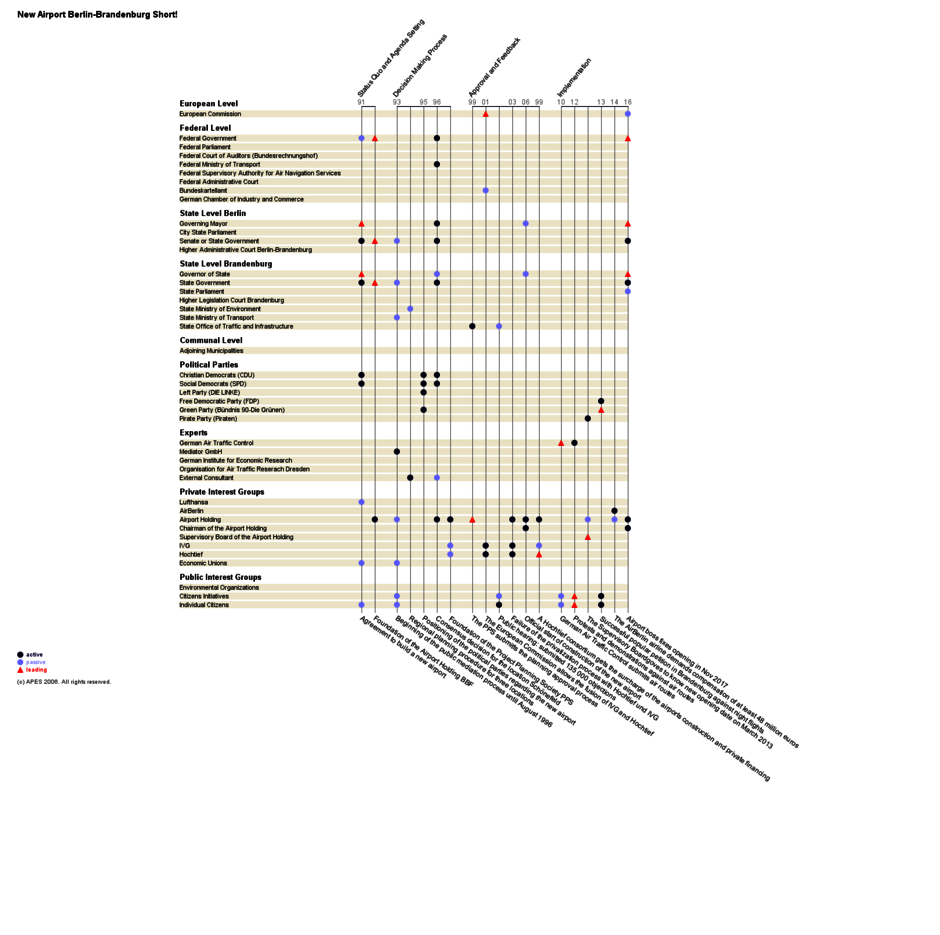
For some time now, urban and regional research has focussed on the conflicts and difficulties of major construction projects and infrastructure measures. In Germany, one of the best-known and most controversial projects was the redesign of Stuttgart's main railway station as part of the Stuttgart 21 project, but numerous other new buildings and conversions have also met with popular discontent, such as the construction of the Elbphilharmonie concert hall in Hamburg, the new Berlin airport and the planned expansion of Munich airport. The most frequent accusations levelled at politicians are: costs are too high, delays are too long and too little consideration is given to citizens' interests. Major infrastructure projects have now become an enormous challenge for elites and civil society alike. The research project will use a qualitative analysis to identify which actors have had a decisive influence in which phases of major construction projects. The comparison of two airport projects (the expansion of Frankfurt Airport and the construction of the new Berlin-Brandenburg Airport) should lead to the formulation of different conditions for success. The analysis is theoretically based on the DIAREE concept, which refers to both input legitimacy (deliberation, inclusiveness, accountability) and output legitimacy (responsiveness, efficiency, effectiveness). In the empirical analysis, the programme APES (Actor-Process-Event Scheme) is used, which enables the investigation and visualisation of the respective actor constellations and their resources during a political decision-making process. The most important results are summarised in the following paper:
Melanie Walter-Rogg, Veronika Zeichinger and Jasper Hamberg. 2015. Big Urban Renewal Projects in Germany - A Democratic Challenge for Elites and the Civil Society
Actor-process-event diagram for the construction of Berlin Airport
Electoral behaviour and political legitimacy in metropolitan regions
Electoral behaviour and political legitimacy in metropolitan regions
From 2002 to 2013, Prof Walter-Rogg was a member of the international research group "International Metropolitan Observatory (IMO)". Based on the results in the USA and Canada, researchers from 18 countries investigated in the first IMO phase whether suburbanisation processes similar to those in North America with similar implications for political attitudes and political behaviour can be identified in other countries. An initial survey of suburbanisation processes in the Federal Republic of Germany and an initial evaluation of existing national survey data showed that similar consequences of suburbanisation can be observed in the attitudes and behaviour of citizens, particularly in western Germany. However, it was also apparent that a database at municipal level would have to be generated for a more precise analysis of the political context, as the available data contained too few cases or information to work out intraregional structures and differences. These results for the Federal Republic of Germany were published in 2005 under the title "Metropolitan Areas and Political Impact in Germany" in the edited volume by Prof Vincent Hoffmann-Martinot and Prof Jefferey Sellers:
Walter-Rogg, Melanie. 2005. Metropolitan Areas and Political Impact in Germany. In: Sellers, J./Hoffmann-Martinot, V. (eds.): Metropolitanisation and Political Change. Urban and Regional Research International Vol. 6. Wiesbaden: Verlag für Sozialwissenschaften, 87-117.

In the second IMO project phase (2005-2007), the research group analysed the political and administrative reforms of the metropolitan regions in the participating countries. The German project focuses on the Stuttgart metropolitan region, the economic and political centre of the state of Baden-Württemberg in south-west Germany. Following the passing of a law to strengthen co-operation in the Stuttgart region by the Baden-Württemberg parliament, fundamental reforms were carried out in 1994 to form the Stuttgart metropolitan region. The law replaced the previous structures for inter-municipal co-operation with the creation of a new type of public-law institution, the "Verbandregion Stuttgart". This regional institution was given extensive independence through its own budget, a directly elected regional assembly and responsibilities in the areas of planning, housing, economic development and communication infrastructure. The case study analyses the political-administrative process of developing and implementing the reform in the Stuttgart region with regard to the chosen strategy and the evaluation and acceptance of the actors involved. The most important results were published in 2007 in the second IMO volume Governing Metropolises: Profiles of Issues and Experiments on Four Continents, edited by the Canadians Prof. Jean-Pierre Collin and Dr Mélanie Robertson:
Walter-Rogg, M./Sojer, M. 2007: Metropolitan Governance Reform in Germany. In: Collin, Jean-Pierre/Robertson, Mélanie (eds.): Governing Metropolises: Profiles of Issues and Experiments on Four Continents. Québec: Presses de l'Université Laval. 283-315.

Reforming municipal institutions in a metropolitan centre involves a variety of local political and civil society interests and can lead to relatively radical changes in government organisations. A reform's success and acceptance, and the speed at which new bodies are established clearly depend on the manner in which the reform is justified, designed, and implemented. This monograph, which looks at post-reform situations, will attempt to outline the reform development and implementation process at the political and administrative levels, while keeping in mind the following questions:
What role have local elected officials and residents been given in preparing reforms?
What was the government strategy?
Who was responsible for the institutional or organisational design of the new bodies?
Have implementation methods had an impact on acceptance of the reform and the speed of organizational integration?
What kind of political and organizational fallout resulted, and how was it managed?
In the third IMO project phase (2008-2013), Prof Walter-Rogg took over the editorship of the third volume of results together with Prof Jefferey Sellers (University of California, L.A.), Prof Daniel Kübler (University of Zurich) and Dr Alan Walks (University of Toronto). A database of information from eleven states was generated to investigate whether national fault lines determine competition and party structures at each political level or whether differences in regional voting behaviour exist within and between metropolitan regions. The research group came to the conclusion that the metropolitanisation of politics represents a new challenge for national party systems and democratic traditions. The central assumption was that the dynamics emanating from a person's residential environment point to a re-territorialisation of ideologies, civic engagement and party preferences that leads to a reconfiguration of politics in modern states. This re-territorialisation is not to be found in the traditional centre-periphery line of conflict between agrarian and industrialised states, but in new lines of conflict in and between metropolitan regions. New voter mobilisation strategies of political parties must take these changed realities into account, i.e. take into account the specific interests of different regional voter segments. The results of the international research group were published in 2013 after several years of exchange in workshops in Stuttgart, Bordeaux and Montréal. The joint book "Political Ecology of the Metropolis" was nominated by Columbia University Press for the "Best Book Award from the European Politics and Society Section" of the American Political Science Association (APSA).

Hanspeter Kriesi, Stein Rokkan Chair for Comparative Politics, European University Institute, 2013: "Based on a painstaking empirical analysis of no less than eleven country cases, this study documents the pervasiveness and importance of the reterritorialisation of politics in a globalised world. This return of territory is not patterned along cleavages as we know them, but based on new territorialised contrasts within and between metropolitan areas. The thought-provoking study draws our attention to the challenge the metropolitanisation of politics poses to national parties and democratic traditions."
Jefferey M. Sellers, Daniel Kübler, Melanie Walter-Rogg and R. Alan Walks. 2013. The Political Ecology of the Metropolis. Metropolitan Sources of Electoral Behaviour in Eleven Countries. Colchester: ECPR Press.
Walter-Rogg, Melanie. 2013. Does Political Ecology matter? Voting Behaviour in German Metropolitan Areas. In: The Political Ecology of the Metropolis. Metropolitan Sources of Electoral Behaviour in Eleven Countries. Colchester: ECPR Press. With Jefferey M. Sellers, Daniel Kübler and R. Alan Walks, 227-266.
Walter-Rogg, Melanie 2013 Conclusion - Metropolitan Sources of Political Behaviour , with Jefferey M. Sellers, Daniel Kübler, R. Alan Walks, Philippe Rochat, 419-478.
Our results for the Federal Republic of Germany show that it is primarily local voting behaviour and to a lesser extent national voting behaviour that is influenced by structural, regional factors and the narrower context of metropolitan regions. However, the multi-level analyses carried out do not allow any statements to be made about individual explanatory variables for voter turnout or voting behaviour in German metropolitan regions or their various settlement zones (core city, richer, poorer, densely or sparsely populated surrounding municipalities). It is therefore necessary in the next step of the project to record individual voting behaviour and its possible determinants in metropolitan regions. This database then allows the calculation of multivariate multi-level models that take individual, local and regional factors into account in order to investigate their relative importance in explaining voting behaviour in modern societies. In this context, we also want to analyse the extent to which the new regional governance models are accepted by citizens.
Metropolitan governance across federal or state borders
For many years, Prof Walter-Rogg has been involved in local policy research and, since 2002, increasingly with the topic of "metropolitan governance", always from an international comparative perspective. The term "metropolitan governance" is used to examine the political control models with which the responsible actors react to the suburbanisation processes in large agglomerations or metropolitan regions in order to fulfil their duties and tasks in important regional policy fields. The term governance is intended to express the fact that control and regulation are not only exercised by the state, but also by non-state actors. While Prof. Walter-Rogg began by investigating which political governance models can be observed in regional cooperation and how these vary, in future the focus will increasingly be on regional cooperation in federal systems and across several nations. In this context, there has been cooperation with the Forum of Federations in Ottawa (Canada) since 2010. in 2013, Prof Walter-Rogg published a research paper on the two metropolitan regions of Hamburg and Central Germany: