
University Study Bavarian Election 2018 (USBW18)
This project uses new statistical methods to determine voter migration in the 2018 state elections in Bavaria. The interdisciplinary and cross-university joint project USBW18 consists of representatives from the disciplines of political science (election and opinion research, party research), statistics and communication science from the universities of LMU Munich, Regensburg and Passau:
Ludwig-Maximilians-Universität München
Helmut Küchenhoff, Paul W. Thurner, André Klima, Ingrid Mauerer
University of Regensburg
Melanie Walter-Rogg, Tassilo Heinrich
University of Passau
Thomas Knieper, Harry Haupt, Stefan Mang, Joachim Schnurbus
The aim of the project is to provide a scientifically transparent estimate of voter migration in an area state and to systematically combine several data sources (exit polls, telephone interviews, aggregate data of official election results at municipal and constituency level). The mixed-method approach of the University Study Bavarian Election 2018 (USBW18) comprises several data acquisitions. The representative telephone survey for Bavaria was conducted by the Centre for Market Research at the University of Passau and students from LMU Munich, while 200 students from the three universities were involved in the post-election surveys.
Data modules of the USBW18 study:
1. Bavaria-wide telephone survey (CATI)
a. Pre-election survey (4,500 interviews)
b. Post-election survey (3,500 interviews)
2. Randomised exit poll survey in three cities with varying degrees of urbanity (Munich, Passau and Regensburg) as well as other municipalities in the Upper Palatinate and Lower Bavaria. A total of N = 17,200 interviews were conducted.
a. Munich (6,500 interviews)
b. Passau and Passau district (4,500 interviews)
c. Regensburg and other municipalities in the Upper Palatinate and Lower Bavaria (6,200 interviews).
3. Bavaria-wide online post-election survey (N = 1,835).
The Bavaria-wide telephone survey and the exit polls within the USBW18 study are based on short, two-page questionnaires that primarily ask about the intended or actual voting decision and the past voting decision (recall question). The survey form is largely based on the approach used by Infratest dimap and the Forschungsgruppe Wahlen, or the German Longitudinal Election Study (GLES). As the Bavarian electoral system adds up the first and second votes and these are therefore of identical importance in determining party shares, we have differentiated between the first and second vote in the current election decision.
Based on theoretical preliminary considerations from the fields of political science and communication science, the USBW18 study focussed on certain aspects. For example, the reasons for a change of vote were surveyed in the form of an open question. Furthermore, the allocation of second votes in the 2017 Bundestag Elections was recorded with the help of a recall question. The online post-election survey integrates identical questions from the telephone and exit poll survey into a much more comprehensive questionnaire of 33 questions on voting behaviour, the assessment of candidates, the election campaign, coalition preferences and other political attitudes.
An initial estimate of voter migration for the two state elections in 2013 and 2018 for the whole of Bavaria uses the results of the CATI pre-election survey, taking into account the actual results from the administrative districts (= constituencies). In the first step, voter migration is determined separately for the administrative districts. Possible distortions due to an insufficient number of telephone interviews in the large cities as a result of the survey are equalised using so-called post-stratification weights. The estimated voter migration is then adjusted to the actual marginal distributions separately for each administrative district using the Iterative Proportional Fitting (IPF) method (cf. Klima et al. 2017: 120). The overall result for Bavaria is thus the weighted average of the individual administrative districts based on the number of eligible voters.
The estimated voter migration for Bavaria shows that the flows away from the CSU feed the Greens and the FW to a fairly similar extent and the AfD to a greater extent. However, the CSU can at least somewhat dampen these massive outflows by mobilising non-voters. This diversification of outflows to programmatically very different parties shows the internal centrifugal forces that this party has had to endure. This applies to refugee policy as well as the increasingly virulent contrast between economic boom and environmental policy in Bavaria and especially in Munich. The Social Democratic Party appears to be in free fall. Its already low share in Bavaria is being halved once again. Voters are migrating massively to the Greens and the CSU, but also to the Free Voters and the AfD, and not voting at all. The Greens are actually the big beneficiaries of the voter movements. They are attracting large numbers of CSU and SPD voters and are also mobilising many former non-voters to the polls. This is therefore an enormous and effective mobilisation effort during the campaign. This is certainly due to the remarkably dynamic and authentic candidates - on the one hand. However, it is also important that the Greens did not prioritise tax increases for high earners this time, as they did in 2013, but instead combined a skilful 'greening' of the concept of homeland with an uncompromising stance on the issue of immigration, and represented it very unitedly. The AfD, which contested a state election in Bavaria for the first time in 2018, achieved a double-digit result. The flows show that its electorate is primarily made up of former CSU and Other voters as well as non-voters.
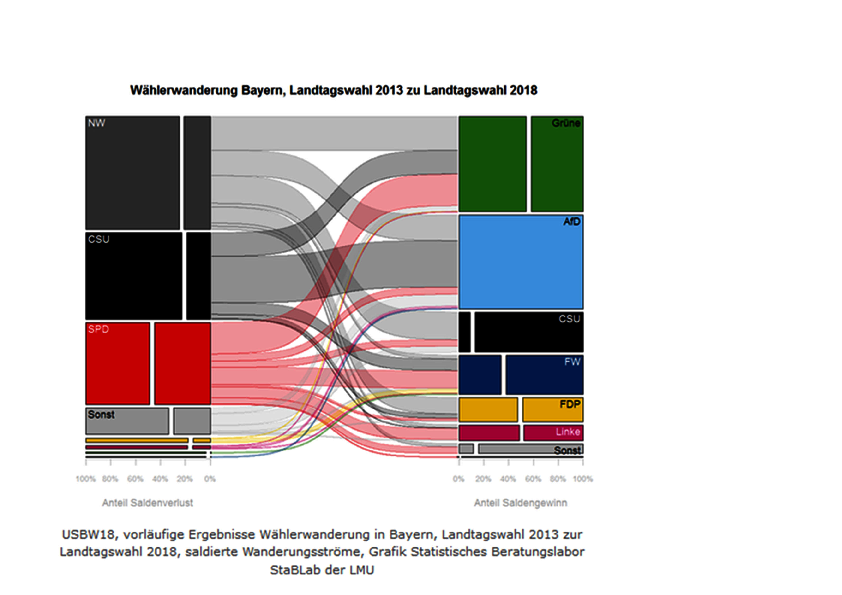
The political debate surrounding the 2018 state elections in Bavaria centred primarily on the landslide losses of the CSU and SPD as well as the large gains made by the Greens and the AfD. This discussion should also take into account the initial situation since the 2017 Bundestag Elections in Bavaria. This is important for a strategic assessment of the state election results, as the high CSU losses in the Bundestag Elections in Bavaria and the exceptionally high AfD results for western Germany led to the replacement of Minister President Seehofer in the meantime. In this respect, the assessment of the CSU losses, the SPD losses, as well as the Green and AfD gains, must take the 2017 Bundestag Elections as an additional benchmark. For this reason, the USBW 18 study also included a recall question for the 2017 Bundestag Elections - specifically for the second vote - in the questionnaire. Although the results are based on a different calculation of first and second votes, it is worth comparing the party shares in the 2017 Bundestag Elections and the 2018 state elections. Interestingly, the aggregate shows that the CSU hardly lost any votes and that the AfD did not make any gains, but actually lost votes. The high successes of the Greens and the FW are accompanied by significant losses for the SPD, the FDP and the Left.
The data basis of the USBW18 study allows this aspect of the election to be analysed directly. For this purpose, the intended second votes cast in the 2018 state election are compared with the recollection of the second votes cast in the 2017 Bundestag Elections. Only this procedure allows an estimate of individual voter migration decisions. It can be seen that the CSU lost less against this yardstick (compared to the losses between the 2013 state election and the 2018 state election). The Free Voters (FW) and the Greens in particular benefited from this; there were also relevant losses to non-voters. The CSU's losses were partially offset by gains from the FDP and the AfD. Although the SPD's high losses are a dominant theme in the Bundestag Elections, it is clear that the FDP and the Left Party lost a larger percentage of their electorate compared to the Bundestag Elections. In comparison, the AfD's losses are lower, but it was also unable to maintain its federal election result. All net migration flows are shown in the following figure:

The joint publication of all participating researchers appeared in the Politische Vierteljahresschrift in 2022:
Paul W. Thurner, André Klima, Helmut Küchenhoff, Ingrid Mauerer, Stefan Mang, Melanie Walter-Rogg, Tassilo Heinrich, Thomas Knieper and Joachim Schnurbus. 2022. Micromotives of Vote Switchers and Macrotransitions. Politische Vierteljahresschrift Vol. 63, No. 4, 663-684. together
Press releases USBW 2018
- University study Bayernwahl 2018 presents results (external link, opens in a new window)
- Analysis of the 2018 state election (external link, opens in a new window)
- Study on the 2018 state election - Süddeutsche (external link, opens in a new window)
- Study on the state election - Welt (external link, opens in a new window)
Voting behaviour and political culture in Bavaria
The state election in the Free State of Bavaria (Freistaat Bayern) on 14 October 2018 confirmed the trend that has already been observed in other federal states and at a national level over the past decade: the party system in the Federal Republic of Germany is becoming more differentiated. The Bavarian Greens were extremely successful with their election campaign slogan "We stand for a cosmopolitan, colourful and safe Bavaria for all and fight for freedom and recognition, respect and acceptance for all people" (www.gruene-bayern.de/positionen/a-z/sozialen-zusammenhalt-staerken/). On a positive note, this means that even in CSU-dominated Bavaria, state politics is becoming more colourful, giving voters more choice when it comes to representing their interests. At the same time, there is growing criticism that the first-time appearance of the Alternative for Germany (AfD) could also pose a threat to democracy in the southernmost federal state. In fact, the election results showed a considerable loss of core voters for the established parties CSU and SPD, a satisfactory result for the Free Voters (FW) and the Liberals (FDP), a respectable success for the Alternative for Germany (AfD) and a record high for the Greens. The Bavarian Greens achieved 17.6 per cent of the vote, an increase of nine percentage points compared to the 2013 state elections. This was quite surprising in this traditionally conservative state, where the Greens have never received more than 9.4 per cent of the vote in the past 40 years (LTW 2008).
Based on the university study USBW18, this project examines voting behaviour and political culture in Bavaria with regard to the research strands "political geography", "political sociology" and "media and election campaigns". On the one hand, structural developments in the state of Bavaria are compared with developments in voting behaviour, regional voting behaviour in Bavaria is analysed and, in particular, small parties and their electoral success in Bavaria are examined. We are also interested in the connection between issue voting and alternate voting, vote splitting and strategic voting in the state election and the influence of various factors such as campaigning, the range of candidates, issues or specific characteristics such as gender, age or education on voting behaviour in the 2018 state election in Bavaria. Finally, we analysed which topics determined the election campaign and what influence the coverage in traditional and social media had on the election campaign.
The results of this project are summarised in the following publication:
Walter-Rogg, Melanie and Tassilo Heinrich. 2023. The 2018 state election in Bavaria. Analyses of voting behaviour and political culture in the Free State. Wiesbaden: Springer VS. Together with Tassilo Heinrich. doi.org/10.1007/978-3-658-41392-7.

Voting behaviour in the 2017 Bundestag Elections
The project by Ann Kathrin-Reinl and Melanie Walter-Rogg examines whether the secondary election theory developed by Reif and Schmitt in 1980 lost its explanatory power for voting behaviour in the German multi-level system in times of Europe-wide crises. European and national political issues as well as sub- and supranational voting behaviour could have gained influence in national voting decisions due to supranational crises. Using a combination of GLES data collected immediately before the 2017 Bundestag Elections, we analyse whether an increasing interdependence of political levels can be observed. The results show that the 2017 Bundestag Elections can still be categorised as a main election. At the same time, however, a relevance of European and state political events for voting intentions in the 2017 Bundestag Elections can also be observed. Consequently, we argue in favour of expanding the approach of the secondary election theory and taking into account increasingly interdependent voting behaviour in the multi-level political system of the Federal Republic in future studies.
The results of this project are summarised in the following publication:
Reinl, AK., Walter-Rogg, M. (2019). Interdependent voting behaviour? An analysis of the impact of Europe-wide crises on voting intention in the 2017 Bundestag Elections. In: Korte, KR., Schoofs, J. (eds) Die Bundestag Elections 2017. Springer VS, Wiesbaden. doi. org/10.1007/978-3-658-25050-8_6 (external link, opens in a new window)
