

Final theses
The chair supervises final theses in psychology (Bachelor and Master) as well as admission theses in the teacher training programs.
If you are interested in empirical or methodologically orientated theses, please contact Prof. Sven Hilbert. For admission theses and theses on school-related or health psychology issues, please contact Jonas Hauck.
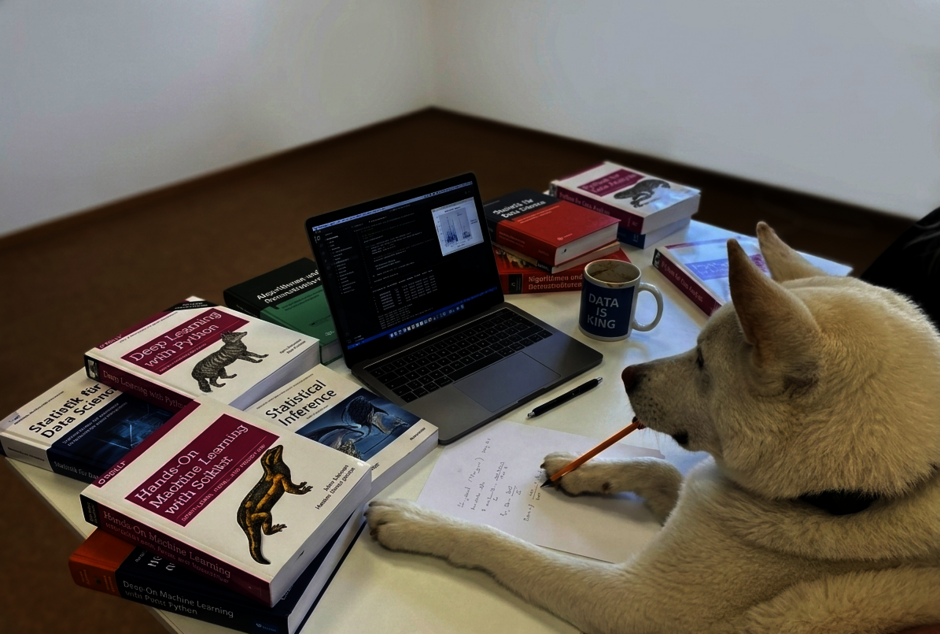
Lectures

Our statistics training programme is designed as a consecutive curriculum: Each course builds on the content of the previous one and systematically expands the methodological repertoire. The Bachelor's courses lay the foundations for a solid understanding of statistics. In the Master's programme, we deepen this knowledge with modern methods of latent modelling and machine learning.
Lectures Bachelor
Statistics I for Human Sciences
The introduction to quantitative research: We start with descriptive statistics and graphical data analysis, introduce the t-test as the first inferential statistical approach and move on to simple and multiple linear regression including dummy coding. An accompanying focus is on good scientific practice.
Module Psychology B.Sc. Psy-BSc-M01.1
Module Education B.A. M02.1
Module Applied Kinesiology B.A. EDU-BA-M10.1
always in the winter semester - GRIPS WiSe25/26 (external link, opens in a new window) - SPUR WiSe25/26 (external link, opens in a new window)
Statistics II for Human Sciences
Building on Statistics I, we delve deeper into regression analysis: regression diagnostics, interaction effects, standardisation and centring. We then broaden our view of the general linear model (GLM), logistic regression and variance analyses in their various forms - single-factor, multi-factor, repeated measures and mixed ANOVA.
Module Psychology B.Sc. Psy-BSc-M01.2
Module Education B.A. M02.2
Module Applied Kinesiology B.A. EDU-BA-M10.2
always in the summer semester - GRIPS SoSe2026 (external link, opens in a new window) - SPUR SoSe2026 (external link, opens in a new window)
Lectures Master
Advanced Statistics I
Two central model classes of modern quantitative research: On the one hand, latent modelling - such as confirmatory factor analysis and structural equation models - to statistically depict constructs that cannot be directly observed. On the other hand, mixed linear models for hierarchical and longitudinal data structures.
Module Psychological Science M.Sc. PSY-MPS-101.1
Module Psychology BKP M.Sc. PSY-BKP-02.1
always in the winter semester - GRIPS WiSe25/26 (external link, opens in a new window) - SPUR WiSe25/26 (MPS) (external link, opens in a new window)- SPUR WiSe25/26 (BKP) (external link, opens in a new window)
Advanced Statistics II
Introduction to the mindset and methods of machine learning: from classic methods such as decision trees to ensemble methods (random forests, boosting) and support vector machines to neural networks. We also cover the EM algorithm for missing values, clustering methods and systematic parameter tuning.
Module Psychological Science M.Sc. PSY-MPS-101.2
always in the summer semester - GRIPS SoSe2026 (external link, opens in a new window) - SPUR SoSe 2026 (external link, opens in a new window)
Statistical programming with R
In addition to the lectures, we offer practice-oriented courses in which the statistical methods learnt are implemented in the R programming language. The courses build on each other, are offered every semester and are voluntary - but can be credited as elective courses in many degree programmes. The courses are held in German and/or English as required.

Introduction to R
Getting started with R: Students learn the basics of R programming from the ground up - from installing the development environment to importing and preparing data sets through to their first analyses. A special focus is placed on data visualisation: How can distributions, correlations and group differences be displayed graphically? The course is aimed at students without programming experience and creates the basis for all further R courses.
Compact course after the end of the lecture period (every semester) - SPUR SoSe2026 (external link, opens in a new window)
R for Advanced Students
Building on the basics, we dive deeper into the tidyverse ecosystem - a powerful package of R libraries for consistent and readable data analysis. Students learn to efficiently implement complex data preparation with dplyr and tidyr and to create publication-ready graphics with ggplot2. In addition, statistical modelling is carried out in R, thus bridging the gap between lecture content and independent data analysis.
Compact course after the end of the lecture (every semester) - SPUR SoSe2026 (external link, opens in a new window)
Applied Machine Learning with R
This course accompanies the lecture Advanced Statistics II and teaches the practical implementation of machine learning methods in R. The focus is on the tidymodels framework, which offers a uniform and reproducible workflow for the entire modelling pipeline - from data preprocessing (recipes) to model training and cross-validation to systematic parameter tuning. Students work with real data sets and learn to compare and select different algorithms.
Compact course after the end of the lecture period (every semester) - SPUR SoSe2026 (external link, opens in a new window)