

The project gave rise to the evaluated WRITE series of events, which combines traditional workshop formats with one year of intensive support in the research and publication process. It is aimed at Master's students, doctoral candidates and postdoctoral researchers who are aiming for an academic career.
A central feature of the format is the interdisciplinary and international collaboration in small teams, which is accompanied by close supervision from experts. In this way, early career researchers receive targeted support throughout the entire research process. The aim is to promote high-quality publications in peer-reviewed journals as well as sustainable networking beyond the duration of the project, from which both young researchers and the entire scientific community benefit. Thanks to its modular structure, WRITE is flexibly transferable to different target groups and institutional frameworks and contributes to the sustainable improvement of scientific practice through its application-orientated focus.
 fauxels/ pexels
WRITE can strengthen the quality of academic work on the following levels:
- Promotion of young scientists: Participants deepen their scientific expertise and benefit from national and international networking, which increases the visibility of excellent young scientists.
- Strengthening the scientific community: The community benefits from well-trained young scientists and high-quality English-language publications.
- Increasing the attractiveness of institutions: The integration of the evaluated concept can contribute to profile building and increase the attractiveness of an institution in the field of methodologically sound scientific education.
Structure of the event series
As part of the WRITE series of events, teams are formed consisting of one expert and three to four junior researchers who work on a specific research topic over the course of two semesters. Over the course of the project, the teams go through five modules that build on each other and provide both general content on scientific practice and targeted support for the teams in the further development of their research project.
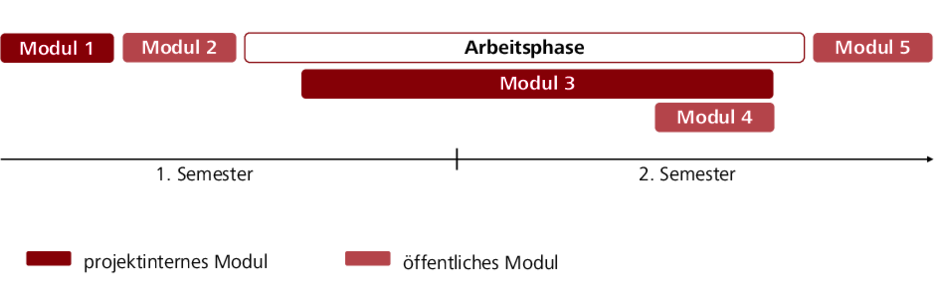
General topics, such as presentations on specific statistical analysis options, are taught in public modules (2, 4). Content with specific relevance to the research projects within the teams is discussed in the internal project modules (1, 3). They are practice-orientated so that the team members can immediately put their newly acquired knowledge into practice and thus consolidate it.
Details on the modules
Module 1: Introduction
The team members first get to know each other during Introductory Events for New Students. The expert introduces the theoretical principles of the underlying research project. If necessary, the object of investigation, for example a data set, is presented and a provisional working title is formulated.
Module 2: Workshop
The workshop should take place shortly after the Introductory Events for New Students and is divided into two parts:
In the first part, the expert presents statistical analysis methods that are relevant to the research project in a public lecture. This lecture can be advertised both within the university and externally and made accessible to a wider public, for example in a hybrid format.
In the subsequent project-internal working part, the object of investigation is jointly analysed and initial research questions are concretised. In addition, the team members agree on the rhythm of regular meetings with the expert as well as the next work steps and responsibilities within the team. It should also be clarified which channels the team members will use to exchange information. Particularly in the case of international collaboration with an expert not based in Germany, challenges arise in the coordination of teamwork, for example due to different time zones.
Module 3: Scientific writing
Parallel to the project work, skills in scientific writing in English are taught in regular sessions. The teams apply the newly acquired skills directly by working on the publication for their research project step by step. They are supported by the experts through digital feedback sessions.
As part of this module, the integration of existing internal university services - such as writing counselling - can be useful. The sessions can be held both in person and digitally.
Details on the content of Module 3 can be found here (opens in a new window). (This PDF is not accessible). For further documents, you can contact Nina Wunder or Maria Hofrichter by e-mail.
Module 4: Science communication
A workshop on science communication takes place in the second semester. The focus is on topics such as open science, press relations, social media and the comprehensible preparation of scientific content for a broader public. The workshop prepares students in particular for the presentation of project results as part of the practical day (Module 5).
As the content of the module applies to all research areas, it is suitable for implementation as a hybrid event format.
Details on the content of Module 4 can be found here (opens in a new window). (This PDF is not accessible). For further documents, please contact Nina Wunder or Maria Hofrichter by e-mail.
Module 5: Presentation of the results
The Degree programme concludes with a practical day on which the project teams present their results. The previously acquired skills in science communication can be applied and deepened. Interested parties from related disciplines are invited to this event in order to facilitate a professional exchange and a joint discussion of the results. The event also serves to generate ideas for future research work and to network with each other. Findings can be utilised by the team members as input for the preparation of their publication.
On Degree, participants receive a certificate of successful participation in the WRITE event series.
Requirements for project management
Monitoring the progress of the project
- Acquisition of experts and young scientists
- Managing the coordination processes with all parties involved
- Ensuring the flow of information between all participants
- Continuous monitoring of the project goals
Conception and realisation of the event series
- Creation/adaptation of the module content
- Consultation with the invited experts on the content orientation, the selection of the research subject and the sequence of the modules
- Realisation of the five modules
Networking & advertising
- Internal and external promotion of the event/information events and offers for the public (lectures by experts, final presentation)
- Contact point for interested parties and participants with questions and problems
Timetable for download (opens in a new window). (This PDF is not accessible)
WRITE at the University of Regensburg
The WRITE event series was developed and evaluated in the context of empirical educational sciences at the University of Regensburg. Various internal university structures such as the RUL Research College and the Centre for University and Academic Teaching (CUAT) provided support. The project was successfully carried out twice during the funding period (2023-2025). A total of four working groups worked under the guidance of four renowned international experts on research projects in the fields of
- generative artificial intelligence in higher education
- Measurement invariance in the field of educational sciences
- Risk communication in medicine
- longitudinal analysis of mathematical competences
Publications and conference contributions
The following article is available as a preprint:
Howard, S. K., Tondeur, J., Neubert, C., Hauck, J., & Böhme, R. (2025) The AIMED model: Creating opportunities for AI in Higher Education. EdArXiv, https://doi.org/10.35542/osf.io/pzk9t_v1
Another article with the working title "Quantity before Quality? - Why Qualitative Statements in Risk Communication Do Not Provide a Solution" is currently under internal review and is due to be submitted to the journal Health Communication in spring 2026. Publications in the journals Beiträge zum Mathematikunterricht (BzMU) and Beiträge zur Lehrerinnen- und Lehrerbildung (BzL) are also in preparation.
Research results were also presented at the 2025 annual congress of the Swiss Society for Educational Research (SGBF) and at the annual conference of the Gesellschaft für Mathematik (GDM) in March 2026.
Quality assurance/ evaluation
The series of events was evaluated using a standardised procedure in order to check its effectiveness and further develop the content in a targeted manner. Further information on the evaluation concept can be found on the KOLEG2 project website.