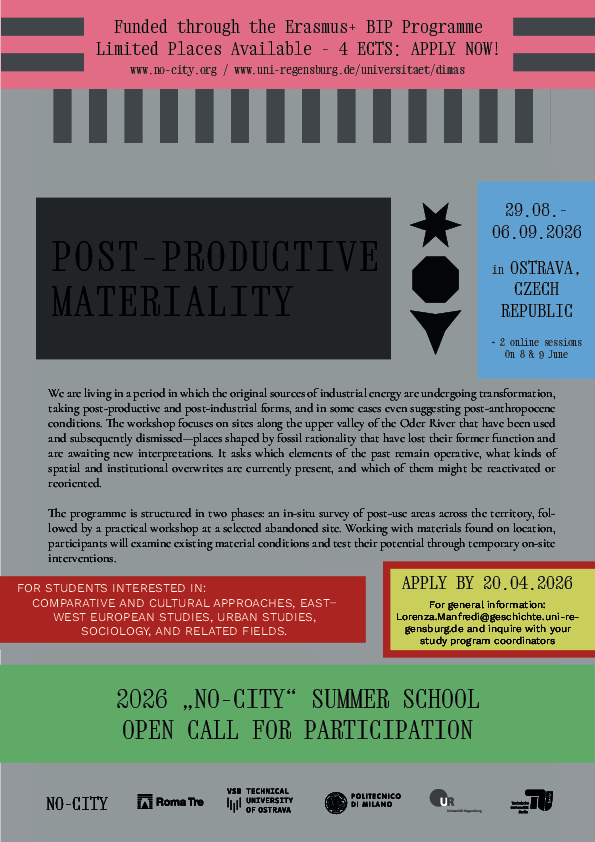

The summer school will take place in the region of Ostrava and its surroundings, known as the "Moravian Gate." The name refers to the role of this area in the valley between two mountain ranges as a connecting and dividing line—a connection that has linked northern and southern Europe since prehistoric times via the Amber Road, while also being the location of the European watershed between the Baltic and Black Seas. In the 19th century, this territory was one of the focal points of the industrial revolution, mainly through industries linked to black coal mining. The area is part of the same Croissant Fossile as the Charleroi site in Belgium, which was addressed last year. The Moravian Gate region includes areas that are more rural and agricultural in character as well, but towards Ostrava, the influence of industry on the formation of the current landscape becomes increasingly dense, until in the vicinity of Ostrava itself, the landscape is predominantly industrial, extractivist and now even post-industrial. The area was largely shaped by production, first agricultural, then mining and industrial. The landscape has been almost entirely shaped and adapted by humans so that their production could bring the wider surroundings and eventually almost the entire planet into the period we now call the Anthropocene.
We are now in a period when the original source of this industrial energy is undergoing a transformation that takes many forms, including post-productive, post-industrial, and, in extreme cases through weakening of human influence on the shaping of this landscape, even post-anthropocene. The workshop will focus on places that have been used but are no longer in use. What form of new urbanity emerges from the "terrain vague"? What is its adequate form and materiality? What is their source, if it is no longer agriculture or industry? What from the past remains relevant to the current situation, and where is it necessary to come up with new ideas?
The workshop will take the form of an in-situ survey of the entire territory and its various forms of post-use areas. In the second phase, a practical workshop will be held at one selected abandoned site using materials found there, or materials found during the fi eld survey. The aim will be to examine the material conditions and their potential on site and try to give them a concrete form of temporary interventions created on site.
When: 29.08.-06.09.2026
Where: Ostrava, Czech Republic
For general information about the summer school, please contact Lorenza.Manfredi(at)geschichte.uni-regensburg.de (opens your email program) or Barbara.Wimmer-Bulin(at)ur.de (opens your email program)