

B.A. programs
Navigation
Here you can find the first-semester introductory presentation (opens in a new window). (This PDF is not accessible)(October 6, 2026).
At the Department of English and American Studies, we offer three B.A. programs:
- B.A. English Linguistics (Englische Sprachwissenschaft)
- B.A. British Studies (Anglistik)
- B.A. American Studies (Amerikanistik)
You can choose one of these three subjects as either your B.A. major (1. Hauptfach), your second major (2. Hauptfach), or your minor (Nebenfach). Please note that the subjects listed above cannot be combined, i.e. you cannot choose more than one of them.
For more information on the content and structure of each program, please click on the titles of the three programs above.
Please note:
Due to the very high number of students in the B.A. and teacher training programs at the Department of English and American Studies, students may not be able to complete their studies within the standard period of study (Regelstudienzeit)! Waiting times for the admission to many classes are to be expected.
A very good knowledge of English (see below) is essential to actively and successfully participate in all courses in the required manner.
Gallery



Organizing Your Studies
Here you will find all relevant information concerning the organization of your B.A. studies at the Department of English and American Studies (DEAS).
First-Semester Students
Introductory Meetings
First-semester students (incl. students coming from other universities and students changing their study programs):
All relevant information for beginning your studies, including a time table listing all introductory information meetings for all majors and minors will be provided on the website of the Central Department for Course Counseling. (external link, opens in a new window)
B.A. American Studies (Amerikanistik), B.A. British Studies (Anglistik), B.A. English Linguistics (Englische Sprachwissenschaft):
- Tuesday, October 6: 12-13 in H 6 (UR walking, maps --> campus map and room finder)
Please find the entire schedule, listing all introductory meetings of majors and minors (opens in a new window). (This PDF is not accessible) in the B.A. program here.
Recommended Courses for Your First Semester
You will find an overview of all compulsory courses in the B.A. programs, according to the currently valid examination regulations (BPO) and study recommendations here.
These lists show the basic structure of your studies in British Studies, American Studies, and English Linguistics, which you should supplement with non-mandatory courses according to your interests and needs (e. g. with regard to exam/thesis preparation). Generally, we recommend taking some of the following courses in the first semester:
- B.A. major British Studies (B.A.-Fach/zweites Hauptfach)
- 35865 General Language Course 1
- 35701 Theory and Structure
- 35752 British Literary History
- 35750 Culture & Society: UK
- 35760 Introduction to Literary and Cultural Studies
- B.A. minor British Studies (Nebenfach)
- 35865 General Language Course 1
- 35752 Culture & Society: UK
- 35760 Introduction to Literary and Cultural Studies
- B.A. major English Linguistics (B.A.-Fach/zweites Hauptfach)
- 35865 General Language Course 1
- 35701 Theory and Structure
- 35750 Culture & Society: UK, or: Culture & Society: USA (not offered in winter semester 2026/27)
- 35760 Introduction to Literary and Cultural Studies
- B.A. minor English Linguistics (Nebenfach):
- 35865 General Language Course 1
- 35701 Theory and Structure
- B.A. major American Studies (B.A.-Fach/zweites Hauptfach)
- 35860 General Language Course A
- 35701 Theory and Structure (before or in the same semester as Phonetics and Phonology)
- (optional) 35702 Phonetics and Phonology (after or in the same semester as Theory and Structure)
- 35815 Introduction to English and American Literary Studies
- 35750 Culture & Society: UK
- 35800 Introduction to American Studies
- (optional) 35801 American Literary History or 35752 British Literary History
- B.A. minor American Studies (Nebenfach)
- 35860 General Language Course A
- 35750 Culture & Society: UK
- 35800 Introduction to American Studies
- 35815 Introduction to English and American Literary Studies
Other combinations are possible. However, students should try to successfully complete the core modules Linguistics, Language, Literary Studies, and Cultural Studies within approximately three to four semesters. The dates of the courses offered each semester can be found in the detailed course catalog on SPUR. Please contact the degree program coordinators if you have any questions.
At the university, there are a number of other course types (such as lectures, seminars, and advanced seminars). The following list provides you with a brief overview (opens in a new window). (This PDF is not accessible)of these.
You can find further information regarding the structure of your study program and the organization of your studies at B.A. English Linguistics, B.A. British Studies or B.A. American Studies.
General Information about Studying for a Bachelor's Degree at the UR
General information about studying for a Bachelor's degree at the University of Regensburg, and major and minors from A-Z is found here.
There is a number of compulsory classes that you have to take in the course of your studies. These classes vary depending on your study program. Which compulsory courses you have to attend is precisely stated in the module descriptions for your study program.
An overview of all compulsory courses is found in the “Which courses am I supposed to take?”-section of the B.A. English Linguistics, B.A. British Studies and B.A. American Studies.
These overviews have been compiled with great care; however, only the original text of the examination regulations is legally binding. A thorough read of the examination regulations is highly recommended in the interest of a well-organized course of studies.
Coordination Office for Credit Points (Koordinierungsstelle Leistungspunkte)
General information on modularization, the electives (B.A.-Wahlbereich), and the Freely Combinable Minor (Frei kombinierbares Nebenfach, FKN) can be found on the homepage of the Coordination Office for Credit Points.
Program Structure
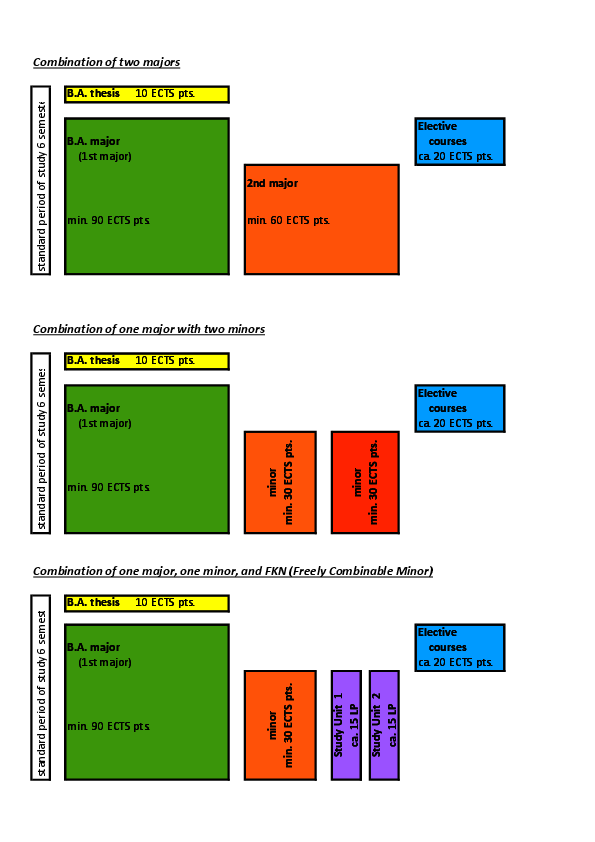
This diagram shows the program structure in the joint B.A. program.
An overview of the options for combining majors and minors is found here.
General Information about ECTS (Credit Points)
For the B.A. programs, students must earn 180 ECTS (credit points/ CP) (see à program structure of the individual B.A. program). Thus, to complete the B.A. study program within the standard period of study (six semesters), students should earn approximately 30 credit points each semester.
This means that after the second semester of study, if the majors and minors are evenly distributed, students should have completed courses earning them the following minimum of credit points:
| B.A. major: | appr. 30 ECTS (CP) (out of 90) |
| 2nd major: | appr. 20 ECTS (CP) (out of 60) |
| minor: | appr. 10 ECTS (CP) (out of 30) |
| total (all subjects): | appr. 60 ECTS (CP) (out of 180) |
Foreign Language Skills
Students in the B.A. programs in English Linguistics, American Studies, and British Studies will need to show some proof of foreign language skills in addition to English by the time they apply for admission fo their final thesis at the Examinations Office. Details about the foreign language requirements can be found in the Examinations Regulations of your study program.
Additional foreign language skills may be acquired during the course of study. For example, the Center of Language and Communication (ZSK) offers a variety of language courses at their Department for Foreign Language Training. Language courses are also offered by other departments at UR. You can find an overview here.
When you apply for admission to your final thesis at the Examinations Office, you will need to show proof of your foreign language skills, for example with your high school leaving certificate or a certificate issued by the ZSK.
How many years of foreign language training at school correspond to which CEFR level can be found here (external link, opens in a new window).
N.B.: students in B.A. English Linguistics or B.A. British Studies starting in or after summer semester 2026 are exempt from this rule.
Pronunciation Exam (Ausspracheprüfung)
General
All students (B.A. and Lehramt) are required to have their phonetic (pronunciation) skills tested to complete their core module language practice (Basismodul Sprachpraxis). This pronunciation test should usually be taken either after GLC A or after Composition or after GLC B at the very latest. Students may take the course "Exercises in English Pronunciation" to prepare for the pronunciation test. Those who do not pass the pronunciation test must enroll in the course "Exercises in English Pronunciation" and pass the test before they can proceed to GLC C and other courses in the intermediate module language practice (Vertiefungsmodul Sprachpraxis). Also, the course "Exercises in English Pronunciation" is a compulsory component for Lehramt Grundschule students who take English as a Didaktikfach.
Others are welcome to take the course on a voluntary basis to improve their spoken English!
You really should take every opportunity to speak and listen to English. Some suggestions include seeing a play performed by the English theater group, RUPs, watching movies and TV series at home, listening to audio books, podcasts, etc.
Registering for and taking the exam
The exams take place at the end of term, during the first lecture-free week.
Students must register for the exam both on SPUR and on FlexNow so that they can take part in the pronunciation exam! Taking the pronunciation exam is not possible if you register only on SPUR or only on FlexNow!
Registration runs until the end of the regular registration period in FlexNow. SPUR registration runs the week after FlexNow registration ends. Find both registration periods here.
When registering on SPUR, you can choose between different groups and thus
specify a preferred time slot (Monday/Tuesday, morning/afternoon) for the
examination.
a) Registration on SPUR:
*where: core module Language Practice (Basismodul Sprachpraxis): 35890
Pronunciation Exam.
*who: all B.A. and teacher training students except those studying English as
a “Didaktikfach” for “Lehramt Grundschule” (see above).
b) Registration on FlexNow:
*where: core module Language Practice (Basismodul Sprachpraxis) -->
Pronunciation exam
*who:
- ALL students in the B.A. study programs, students in the teacher training
programs with English as “Unterrichtsfach” (Grundschule, Mittelschule,
Realschule), students who study English as a “Didaktikfach” for “Lehramt
Mittelschule”, students who study English for “Lehramt Gymnasium”.
- exempt: students who study English as a “Didaktikfach” for “Lehramt
Grundschule” (see above).
Please make sure you are in a room with a stable internet connection for the exam!
Contact
Degree Program Coordination
- E-mail address: studienorg.iaa(at)sprachlit.uni-regensburg.de (opens your email program)
- Tel: 0941 943-3667 (starts a telephone call, if your device allows this)
- Location: PT, 3.2.62
-
Important information:
Susanne Gürtner, M.A. (Tuesday–Friday)
Gabriele Mödl, M.A. (Monday–Thursday)
Melissa Deiß, M.A., student assistant
**************
We offer in-person office hours in PT 3.2.62. There is no need to make an appointment in advance.
Monday: 10 am–12 pm (no office hours on Monday, November 9)
Tuesday: 10 am–12 pm
Wednesday: 10:30 am–12:30 pm
Thursday: 10 am–12 pm
**************
For questions concerning your M.A. application, please contact Application.MasterDEAS@ur.de.