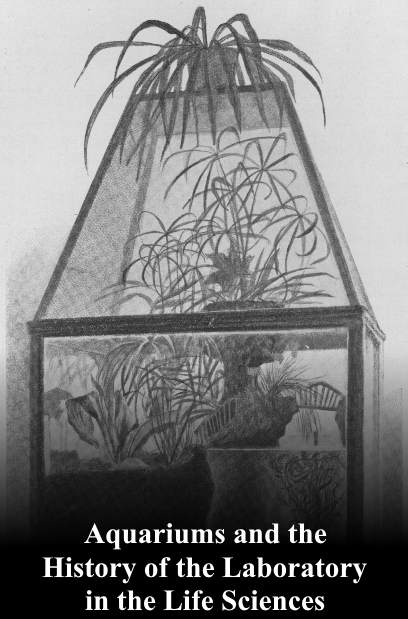
Aquariums and the History of the Laboratory in the Life Sciences
Project by Dr Christian Reiß
The laboratory is the iconic space of science in general and of scientific research, with its experimental systems, in particular. As the pre-eminent venue for the production of scientific knowledge, the investigation of epistemic phenomena and the production of technical objects, the laboratory has been the focus of historians, philosophers and anthropologists of science.
This project presents a history of the laboratory in German zoology during the second half of the 19th century. In contrast to physics and chemistry, but also to physiology and anatomy, the zoological laboratory was as much concerned with providing what were considered to be natural living conditions for the animals as it was designed for scientific research. With its focus on questions of evolution, development and heredity, the zoological laboratory is fundamentally attuned to the relationship between organism and environment and is essentially designed to provide conditions for the undisturbed development and behaviour of the species under investigation. Thus, I argue, the zoological laboratory is as closely linked to the zoological and botanical gardens as it is to laboratories in physics and chemistry.
By combining spatial approaches to the history of science with a focus on scientific practices and human–animal relations, the laboratory in the life sciences is conceptualised as a techno-natural assemblage. It is viewed as a research space as much as it is understood as a space inhabited by human and non-human actors, all of whom contribute to its co-construction as a hybrid space between nature and technology.
Related projects
The Mexican Axolotl and the Early History of Laboratory Animals, 1600–present
Julius Schaxel and the History of Developmental and Theoretical Biology
Cinematographic Methods in the History of Embryology
Publications
Reiß, Christian (2020): The Axolotl. A Laboratory Animal in the Home Aquarium, 1864–1914, Göttingen: Wallstein.
Reiß, Christian (2017): The Biologische Versuchsanstalt as a Techno-natural Assemblage: Artificial Environments, Animal Husbandry, and the Challenges of Experimental Biology, in: Müller, Gerd B. (ed.): Vivarium. Experimental, Quantitative, and Theoretical Biology at Vienna’s Biologische Versuchsanstalt, Boston: MIT Press, pp. 115–132.
Reiß, Christian and Mareike Vennen (2014): Muddy Waters. The Aquarium as a Space for (Proto)Ecological Knowledge, 1850–1877, in: Espahangizi, Kijan and Barbara Orland (eds.): Substances in Motion. Essays on a History of Science of the Material World, Berlin: Diaphanes, pp. 121–142.
Reiß, Christian (2012): Gateway, Instrument, Environment: The Aquarium as a Hybrid Space between Animal Fancying and Experimental Zoology, NTM Journal for the History of Science, Technology and Medicine 24, pp. 309–336.
Reiß, Christian (2012): How Zoology Learnt to Feed. The Feeding of Animals in 19th-Century Zoology, *Reports on the History of Science* 35, pp. 286–299.