Drawing in the History of Observation: Seeing, Sketching and Knowing
Project by Dr Omar W. Nasim
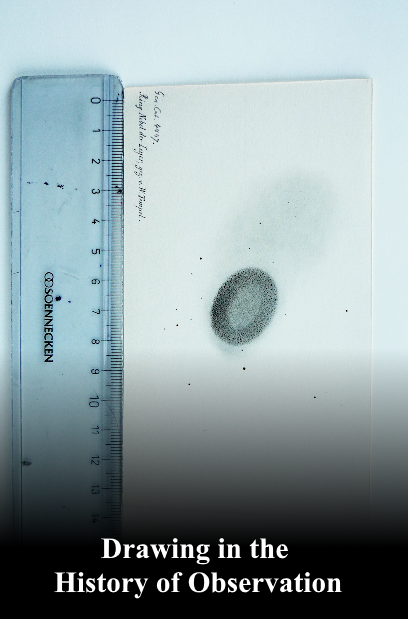
Hand-drawn illustrations by scientists are among the most ubiquitous forms of visual representation in the history of science. They have been used to diagram ideas, visualise possibilities and illustrate scientific texts. My interest, however, has centred on the ways in which sketching techniques have been used in conjunction with scientific observation. Through a close historical and archival examination of hand-drawn sketches of deep-sky objects found in the notebooks of nineteenth-century astronomers, I demonstrate that these mutable and repeated drawings actually contributed to the astronomer’s observational work at the telescope – the drawings sharpened the senses. This has meant that, rather than examining published prints of drawings, I have turned to unpublished, preliminary sketches which not only reflect the tentative nature of astronomical data collection but also the materiality of pencil, paper and gesture. I have termed these ‘working images’ and have situated them within the procedures of organised paperwork. Thus, by looking behind the scenes of scientific work, we begin to see the intensity of observational practices and the ways in which hand-drawn sketches made real contributions to our understanding of challenging astronomical objects such as nebulae and star clusters.
Publications:
*Observing by Hand: Sketching the Nebulae in the Nineteenth Century* ( Chicago: University of Chicago Press, 2013)
• Winner of the History of Science Society’s Pfizer Book Prize for an outstanding scholarly book in the field over the past three years, 2016
• Winner of the CHOICE Outstanding Academic Title Awards from CHOICE magazine
“Extending the Gaze: The Temporality of Astronomical Paperwork,” in *Science in Context*, 2013, 26: 247–277.
Rheinsprung 11: On the Handedness of Drawing, co-edited with Hana Gründler, Toni Hildebrandt and Wolfram Pichler, Virtual Issue No. 3, 2012.
“On Scribbles in Space,” in *On Scribbling: Graphisms between Writing, Image, Text and Sign*, eds. Christian Driesen et al. (Zurich/Berlin: Diaphanes, 2012), pp. 71–90.
“Observing by Hand,” in *Rheinsprung* 11: “On the Manual Nature of Drawing, ” eds. Hana Gründler, Toni Hildebrandt, Omar Nasim and Wolfram Pichler, Virtual Issue, 2012, 66–74.
“Drawing as a Means of ‘Familiarisation’ for Exploring the Nebulae in the Lord Rosse Project,” in Noting, Sketching. Writing and Drawing as Methods of Design, eds. Karin Krauthausen and Omar Nasim (Zurich/Berlin: Diaphanes, 2010), pp. 159–88.
“Observation, Working-Images, and Procedure: the ‘Great Spiral’ in Lord Rosse’s Astronomical Record Books and Beyond,” in*British Journal for the History of Science*, 2010, 43: 353–389.
“On Seeing an Image of a Spiral Nebula: From Whewell to Flammarion,” in *Nuncius: Journal of the History of Science*, 2009, 24: 393–414.
“Observations by Hand: Astronomical Nebula Sketches in the 19th Century,” in Preserving Data: Writing and Drawing as Methods of Record-Keeping, ed. Christoph Hoffmann (Zurich/Berlin: Diaphanes Verlag, 2008) pp. 21–46.
“Observations, Descriptions, and Drawings of Nebulae: A Sketch,” in Max Planck Institute for the History of Science Pre-Print Series, No. 345, Berlin: 2008.