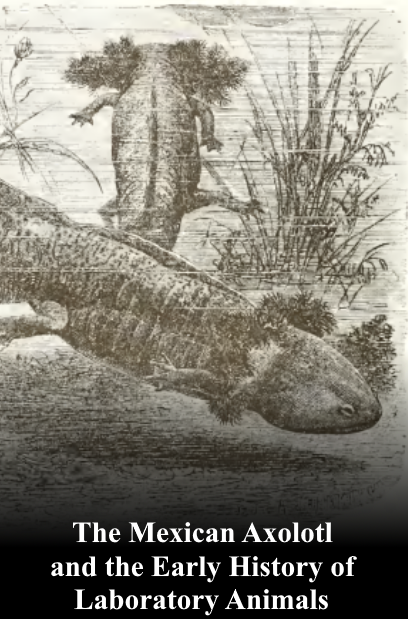
The Mexican Axolotl and the Early History of Laboratory Animals, 1600–the present day
Project by Dr Christian Reiss
Laboratory animals have been an integral part of biomedical research since the 19th century. Epistemologically, they serve as models for fundamental life processes or stand in for humans. On a practical level, they form part of the experimental set-ups designed to investigate subjects in the laboratory. But they are also co-inhabitants of these spaces and have multiple and complex relationships with the people working there.
The Mexican axolotl (Ambystoma mexicanum) is one such laboratory animal. Its history offers a unique opportunity to trace the long-term history of a species’ journey into the laboratory. The project combines a focus on the practices of animal husbandry and laboratory research with approaches from human-animal studies. The result is a long-durée perspective on the species’ history, spanning from the first reports in the earliest natural history books on the Americas from the 17th century, to the first preserved specimens collected by Alexander von Humboldt around 1800, right up to the arrival and proliferation of the first live axolotls across Europe in the second half of the 19th century.
This project examines the history of these various contexts and the historical processes linking them. It specifically investigates the spread of live axolotls across Europe from 1864 onwards. Using approaches from the history of science and landscape ecology, it traces the establishment of a European axolotl population. This mapping forms the basis for understanding how developments in the sciences and the emerging aquarium hobby in popular culture facilitated this spread, and how the easy availability of axolotls influenced scientific practices.
Related projects
Aquariums and the History of the Laboratory in the Life Sciences
Julius Schaxel and the History of Developmental and Theoretical Biology
Publications
Reiß, Christian (2020): The Axolotl. A Laboratory Animal in the Home Aquarium, 1864–1914, Göttingen: Wallstein.
Reiß, Christian; Uwe Hoßfeld and Lennart Olsson (2016): The Mexican Axolotl as a Laboratory Animal Through the Ages, BIOspektrum 22 (6), pp. 660–661.
Reiß, Christian; Lennart Olsson and Uwe Hoßfeld (2015): The History of the Oldest Self-Sustaining Laboratory Animal: 150 Years of Axolotl Research, Journal of Experimental Zoology 324(5), pp. 393–404.
Reiß, Christian; Uwe Hoßfeld and Lennart Olsson (2014): Between the Laboratory and the Aquarium, or: How an Amphibian Conquered the World. 150 Years of the Axolotl, Biologie in unserer Zeit 44, pp. 188–195.
Reiß, Christian (2014): August Weismann’s Early Evolutionary Research: Experiment and Theory in an Artificial Natural Environment, Rudolstadt Natural History Papers 20, pp. 11–29.
Reiß, Christian (2012): Gateway, Instrument, Environment: The Aquarium as a Hybrid Space between Animal Fancying and Experimental Zoology, NTM Journal for the History of Science, Technology and Medicine 24, pp. 309–336.
Reiß, Christian (2012): How Zoology Learnt to Feed Animals. Animal Nutrition in 19th-Century Zoology, Reports on the History of Science 35, pp. 286–299.
Reiß, Christian (2011): Axolotl, in: Department III of the Max Planck Institute for the History of Science (eds.): A Natural History for the 21st Century. In Honour of Hans-Jörg Rheinberger, Berlin: Self-published, pp. 132–134.