
PhD project by Katharina Bick
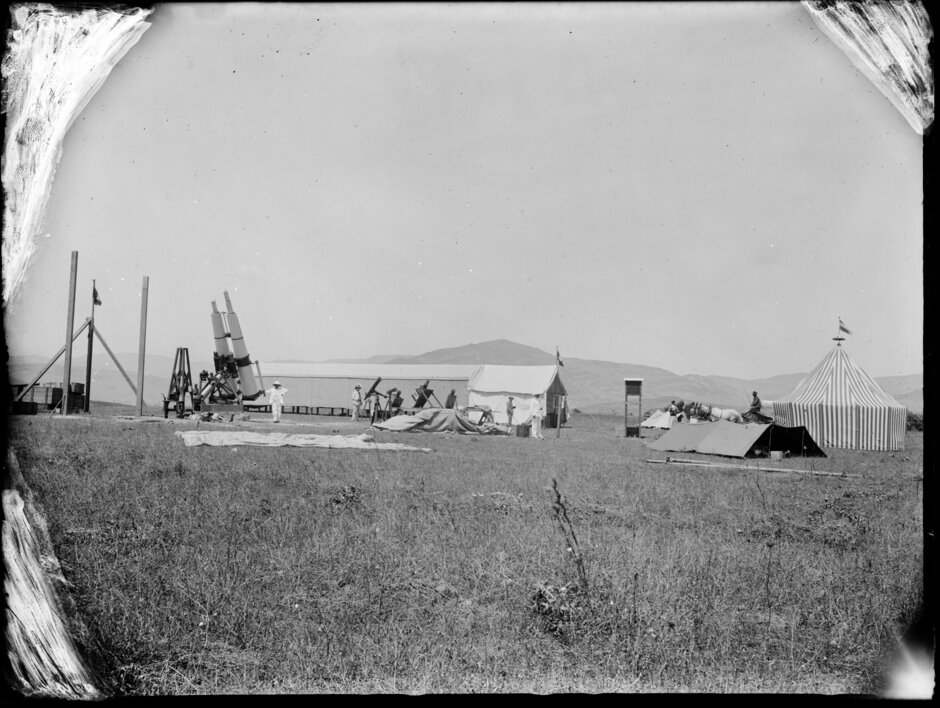
The gradual introduction of photography into astronomy in the late19th and early20th centuries fundamentally changed working practices at observatories. The DFG-funded project “Astronomy’s Glass Archive: Photographic Practices at the Observatory, 1850–1950” examines this development. Astronomical photography, however, was not only practised at the observatory, but also in the field, by astronomers on expedition. In my doctoral research, which forms part of the DFG project, I will examine how German astronomers took photography with them abroad when they undertook expeditions to observe total solar eclipses or a transit of Venus.1 (external link, opens in a new window)
My focus is on the practices and materials involved in astronomical glass-plate photography under field conditions: How were photographic materials produced, selected or purchased by expedition staff? How did astronomers determine the technical details of the photographic process? How did they create, in their temporary camps, the environment necessary for photographic work to yield satisfactory results? How did they transport all the necessary equipment to their destinations and set up their camps? Which photographic processes exactly did they use, and how were the exposure and development of the plates organised? What happened after the expeditions returned, when the work of measuring and analysing the plates began?
My study is based on astrophotographic expeditions conducted by German institutions during the period of the German Empire, from 1871 to 1918. These include solar eclipse expeditions carried out by the observatories in Hamburg, Göttingen and Potsdam, and the centrally organised expeditions to observe the transit of Venus in 1874. Published reports, extensive archival sources and, in some cases, photographic plates from these expeditions have survived.
As well as reconstructing the technical aspects of astrophotographic work, this study will provide insights into the connection between scientific work and colonialism/imperialism. It will demonstrate how resources and infrastructure linked to European colonialism/imperialism were essential to the day-to-day work of the expeditions, and highlight transimperial connections. My project also seeks to map the distribution of agency between the astronomers, who sought to impose their will on the technology of photography, and the photographic material, which imposed certain restrictions. Furthermore, I will demonstrate that photographic work continued long after the images had been developed: plates were measured; the data obtained was analysed mathematically; and the results were presented in the form of tables, charts or written descriptions, whilst reproductions of photographic images play a remarkably minor role in the publications.
FOOTNOTE/EXPLANATION:
Solar eclipses have a narrow path of totality, from which the outer parts of the Sun’s atmosphere become visible. A transit of Venus occurs when Venus overtakes the Earth in its orbit and passes close to the line of sight between the Earth and the Sun, becoming visible as a small black dot in front of the Sun. Observations from different locations can be combined to determine the distance between the Sun and the Earth in absolute terms.
See also the DFG Project (external link, opens in a new window)