
Synthesis of ribosomal RNA and regulation of RNA polymerase I transcription in the context of chromatin in S. cerevisiae
The biogenesis of eukaryotic ribosomes begins with the synthesis of ribosomal (r)RNAs by RNA polymerases (Pol) I and III. While Pol III transcribes the 5S rRNA gene, Pol I transcribes a large precursor molecule comprising the sequences of the remaining three rRNAs in a nuclear subcompartment, the nucleolus. Pol I transcription and ribosome maturation are tightly coupled, as ribosome biogenesis factors and ribosomal proteins are already assembled with the nascent rRNA during transcription.
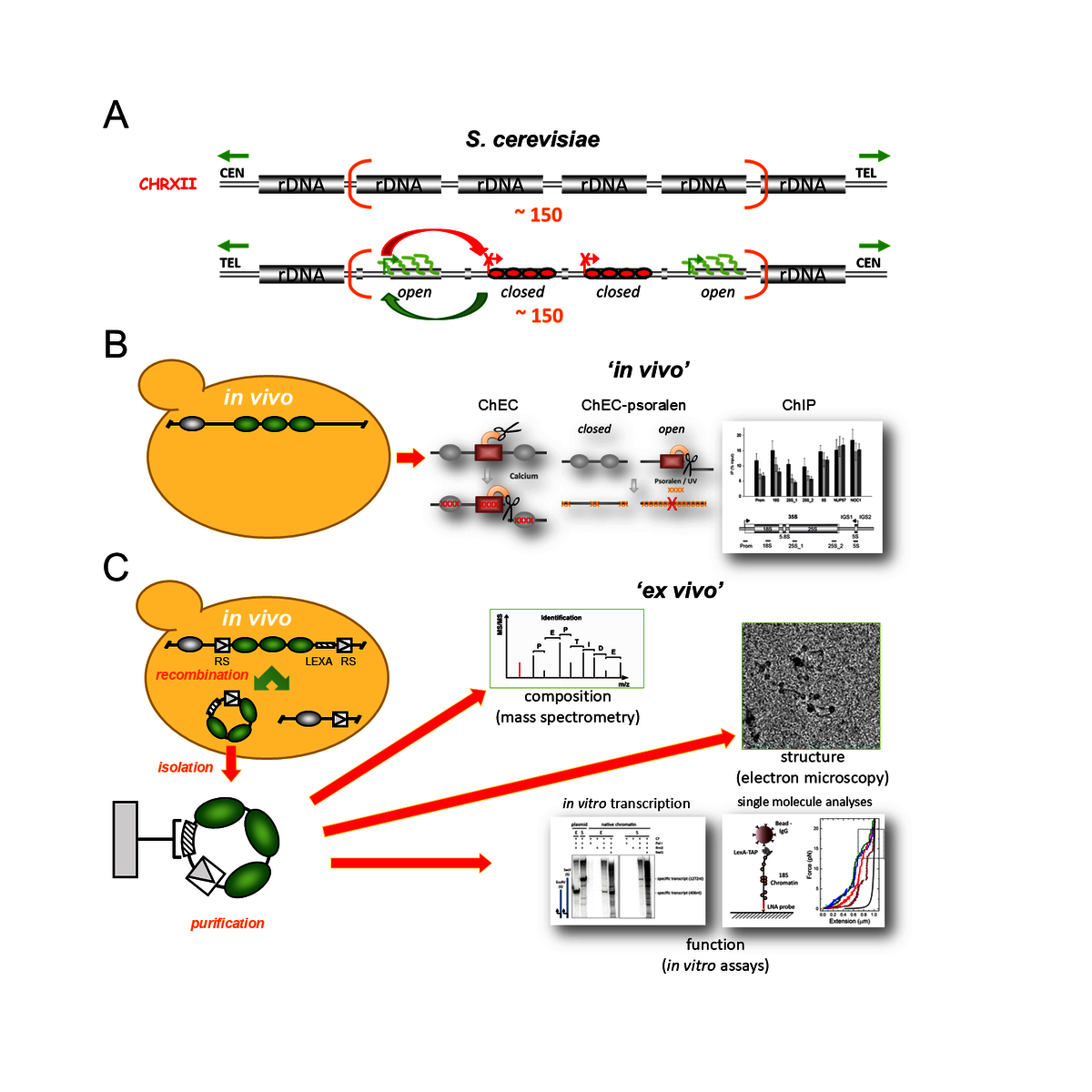
Although Pol I transcribes only one genomic locus, the enzyme is responsible for over 60 % of cellular RNA synthesis in exponentially growing S. cerevisiae cells(hereafter referred to as yeast). This is achieved by a strong promoter with a stably bound preinitiation complex (PIC) and by multimerisation of the rRNA genes at one or more sites in eukaryotic genomics (Figure A). Even in dividing cells, not all rRNA genes are transcribed, but coexist in at least two different chromatin states. While transcriptionally inactive rRNA genes are incorporated into nucleosomes and are in a so-called "closed" chromatin state, actively transcribed rRNA genes are present in a nucleosome-poor "open" chromatin state. rRNA genes can switch between the two chromatin states depending on the physiological state of the cell.
Our research aims to identify the molecular mechanisms underlying these chromatin transitions. Ultimately, we want to contribute to the understanding of the interplay between the chromatin structure of rRNA genes, Pol I transcription and early ribosome maturation. together with the Engel and Milkereit research groups, we are trying to gain a better understanding of these complex processes. To this end, we use and develop techniques that allow us to study the chromatin structure of rRNA genes and Pol I transcription both in vivo (Figure B) and in the native chromatin context ex vitro (Figure C).