

Professor Dr Peter Hegemann (Berlin) has been awarded the 2026 Nobel Prize in Medicine, jointly with his colleagues Professor Dr Georg Nagel (Würzburg) and the US researcher Karl Deisseroth (Stanford).
The Nobel laureate conducted research and taught at the University of Regensburg (UR) from 1993 to 2004 as Professor of Biochemistry, and his work on the molecular photobiology of Chlamydomonas laid the foundations for the subsequent discovery of channelrhodopsins. To this day, the Nobel laureate maintains close ties with the University of Regensburg and its members.
‘It fills all of us at UR with great joy and a sense of pride that our research environment in Regensburg contributed to the Nobel laureate’s scientific work,’ says UR President Professor Dr Udo Hebel. ‘At the same time, we are very grateful to Professor Hegemann for his ongoing connection with and collaboration on research projects at our university, even after his move to Humboldt University.’
Particularly noteworthy is Peter Hegemann’s continuous and influential commitment to the Regensburg Center for Ultrafast Nanoscopy (RUN). Peter Hegemann has been involved with the RUN since its establishment and foundation as a member of the ScientificAdvisory Board. From the very beginning, he has advised on the strategic direction of this globally unique interdisciplinary research centre at the interface of physics, chemistry and biology with scientific foresight.
As a scientific partner, Peter Hegemann is directly involved in the RUN’s collaborative projects and also in the DFG Research Training Group GRK 2905 (“Ultrafast Nanoscopy – from single-particle dynamics to cooperative processes”) based there. Hegemann’s pioneering work on the ultrafast photodynamics of photoreceptors serves as a key biological example and as a source of inspiration for the early-career researchers in the RUN team in Regensburg.
The Nobel Committee recognised the work of the three researchers for discoveries that led to optogenetics , a method that makes it possible to switch the activity of individual nerve cells in a living brain on or off. This method is now used in laboratories worldwide to unravel the mysteries of the brain. According to the Nobel Committee in Stockholm, optogenetics demonstrates “how nerve cells in the brain form memories, emotions and behaviours”.
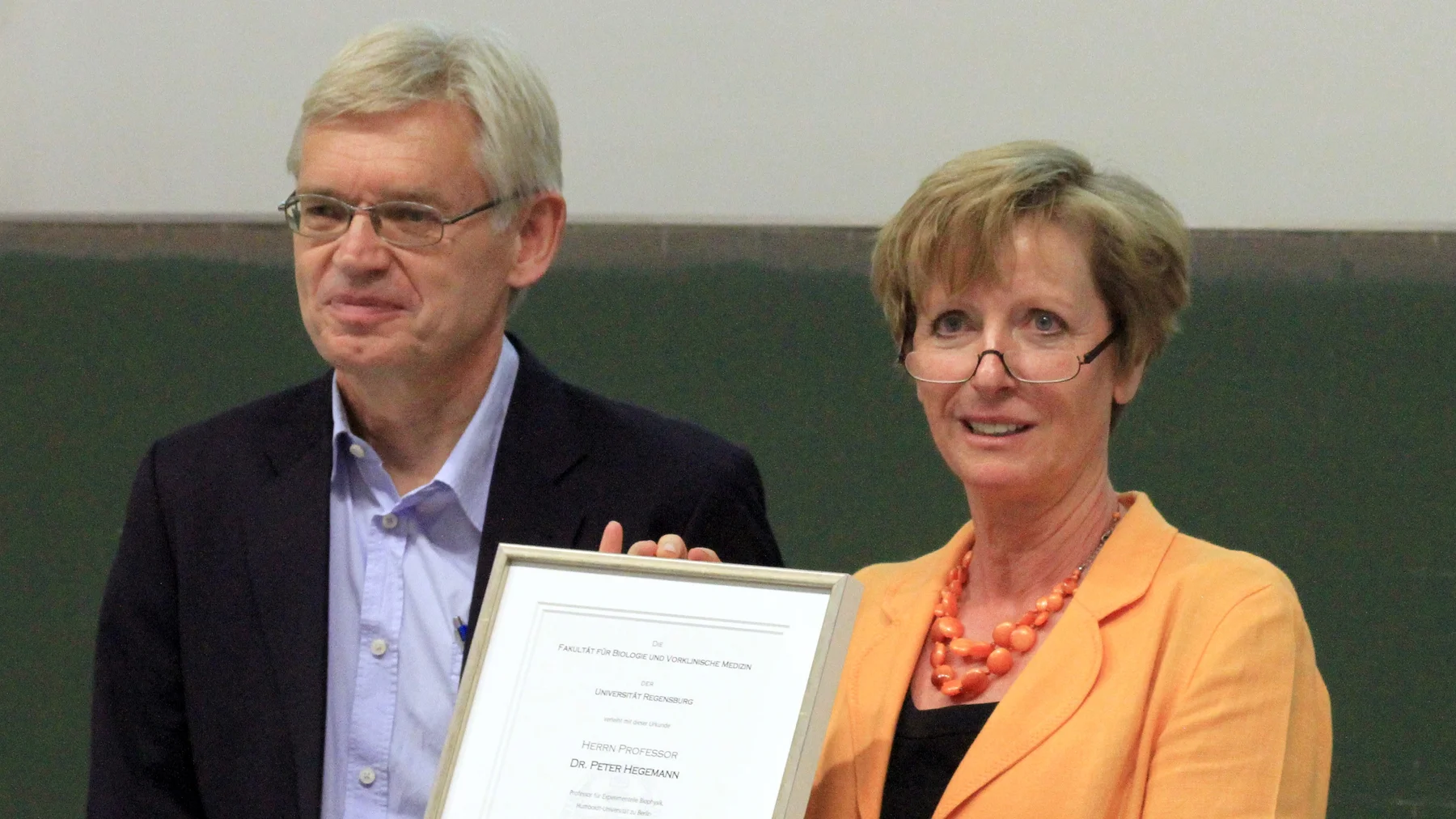
Peter Hegemann continues to conduct research to this day alongside colleagues at the University of Regensburg (UR). The Faculty of Biology and Pre-clinical Medicine at the University of Regensburg awarded him an honorary doctorate in June 2019. There is great joy and enthusiasm amongst all those who know and hold Hegemann in high regard.
‘We offer our heartfelt congratulations on being awarded the 2026 Nobel Prize in Physiology or Medicine’, says Professor Dr Christine Ziegler, a member of the RUN Executive Board and Vice-Dean of the Faculty of Biology and Pre-clinical Medicine. ‘This highest scientific honour, which Peter Hegemann is receiving alongside Georg Nagel and Karl Deisseroth for their groundbreaking discoveries of light-controlled ion channels and the establishment of optogenetics, is more than well deserved. Through his research, Peter Hegemann has fundamentally transformed the classical paradigm of visual signal transduction’.
Wide-ranging interdisciplinary collaboration
Over the years, Peter Hegemann has always maintained close ties with Regensburg. According to the UR faculties, his research is deeply rooted in several Regensburg chairs and institutes.
As spokesperson for the DFG Research Training Group GRK 640, Peter Hegemann brought together research groups from Biology (including Prof. Dr Günter Hauska, PD Dr Jürgen Stolz, Prof. Dr Stephan Schneuwly), chemistry (including Prof. Dr Bernhard Dick, Prof. Dr Jörg Daub, Prof. Dr Burkhard König, Prof. Dr Claudia Steinem, Prof. Dr Otto Wolfbeis) and physics (Prof. Dr Alfons Penzkofer), which had a lasting impact on interdisciplinary light and photoreceptor research at the University of Regensburg.
In numerous joint publications, for example, Peter Hegemann, in collaboration with the Regensburg departments of Physical Chemistry and Biophysics, investigated the primary photophysical processes, quantum yields and lifetimes of excited states of flavin-based photoreceptor domains using time-resolved laser spectroscopy.
Peter Hegemann is currently also involved in joint research projects with early-career researchers from the fields of chemistry and biophysics, which are dedicated to further fundamental research into photoreceptor proteins.
In close collaboration with the Regensburg Biophysics and Structural Biology departments, Peter Hegemann has also investigated new, fascinating rhodopsin species using the Regensburg cryo-electron microscopy facility, in order to elucidate their three-dimensional channel architecture and catalytic switching mechanisms in detail.
Further information
About Prof. Dr Peter Hegemann — Experimental Biophysics (external link, opens in a new window)
About the RUN (external link, opens in a new window) at the University of Regensburg
About the Faculties of Biology and Pre-clinical Medicine (external link, opens in a new window), and Chemistry and Pharmacy (external link, opens in a new window)

Contacts
Communications and Marketing
University of Regensburg
Email: presse@ur.de