

RNA therapeutics open up new possibilities for the targeted and precise treatment of diseases. To ensure that RNA molecules remain stable in the body and can reliably exert their effects, they undergo specific chemical modifications. However, such modifications to the RNA backbone also occur naturally. This was discovered by Professor Schraga Schwartz (external link, opens in a new window) of the Weizmann Institute of Science (Rehovot, Israel) and Professor Dr. Dina Grohmann (external link, opens in a new window) of the University of Regensburg. Their research findings have now been published in the journal Cell under the title Phosphate backbone epitranscriptomics: Discovery of natural RNA phosphorothioates and their writer machinery (external link, opens in a new window).
The researchers demonstrate for the first time that hyperthermophilic archaea carry a particularly high number of modifications in their cellular RNAs. Unlike organisms that live at moderate temperatures, these heat-loving microorganisms undergo numerous RNA modifications that vary depending on environmental conditions.
Using the extensive strain collection of the German Archaea Center at the University of Regensburg and the UR research group’s expertise in cultivation and RNA analysis, RNA molecules from various extremophilic archaea were isolated under controlled conditions and analyzed by the Schwartz team.
The research teams led by Schwartz and Grohmann are thus opening up new perspectives for understanding RNA stability under extreme conditions; their findings could be useful in biotechnology for the further development of RNA-based therapeutics.
Professor Dr. Dina Grohmann puts this extraordinary discovery into context: 'Archaea had already developed this chemical form of RNA stabilization before we made it usable for medical applications in the age of RNA therapeutics'. With a wink, she adds: ‘As it is so often the case, archaea are one step ahead of us’.
What Are RNA Modifications?
RNA consists of a chain of nucleotides, each of which is composed of the sugar ribose, a phosphate group, and one of the four bases: adenine, guanine, cytosine, or uracil. An RNA modification is a targeted chemical alteration of individual building blocks or the phosphate-sugar backbone. Among other things, it can influence the stability, cellular uptake, and immunological tolerance of RNA.
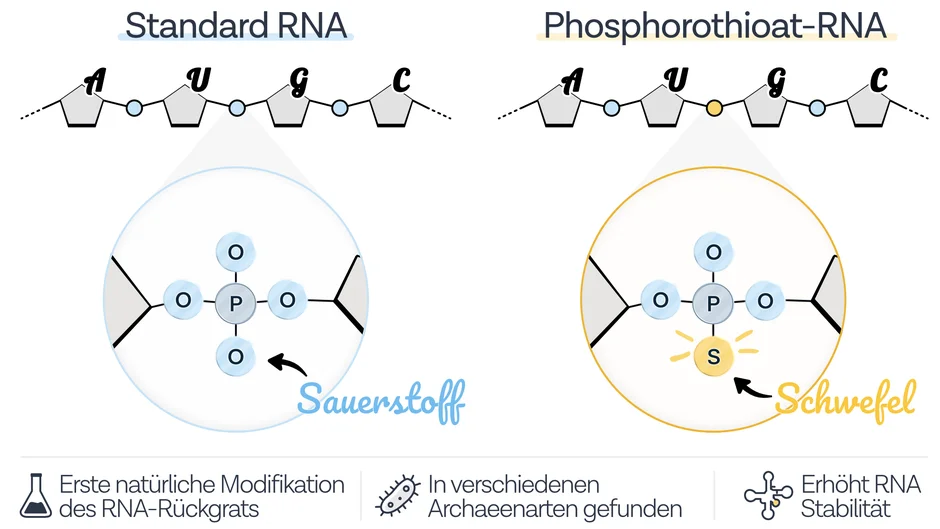
In RNA therapeutics, for example, modified nucleosides, 2′-O-methyl and 2′-O-methoxyethyl groups, as well as phosphorothioate modifications, are used for this purpose. In the latter, a non-bridging oxygen atom in the phosphate backbone is replaced by a sulfur atom (see figure). This allows therapeutic RNA molecules to be better protected against degradation by nucleases. Many other modifications, including 2′-O-methylation and pseudouridine, also occur naturally in cellular RNAs, where they influence structure, stability, and function.
Original publication:
Phosphate backbone epitranscriptomics: Discovery of natural RNA phosphorothioates and their writer machinery: Cell
DOI: 10.1016/j.cell.2026.08.034 (external link, opens in a new window)
Contacts
Prof. Dr. Dina Grohmann
Chair of Microbiology
Faculty of Biology and Preclinical Medicine
University of Regensburg
Mailto: dina.grohmann@ur.de