

We are pleased to announce a new publication by Ira Hannappel, Annika L. Hass, Florian Hartig, together with an international team of colleagues: “Local management at low- to moderate-intensity benefits wild bees in European calcareous grasslands while landscape conservation effects vary”, published open access in Journal of Applied Ecology on 28 September 2026.
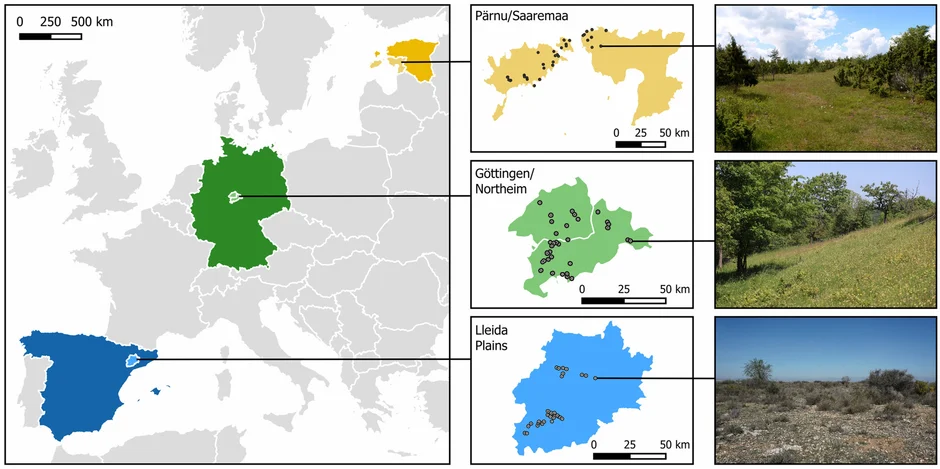
Calcareous grasslands are key habitats for endangered and specialised wild bees, but they have declined strongly in area and quality. Over two years, the team surveyed 96 calcareous grasslands in Estonia, Germany and Spain, recording 6,716 wild bees of 235 species together with the flowering resources at each site. These were related to a local land use index ranging from long-term abandonment to intensive grazing, and to the surrounding cover of calcareous grassland and of agri-environment schemes (AES), using Bayesian hierarchical models developed with the advice of Florian Hartig.
Wild bee abundance and richness declined at both ends of the local gradient and peaked under low- to moderate-intensity management, largely mediated by the flower supply. More calcareous grassland in the surrounding landscape benefited bees in Estonia and Germany, while the effect of AES depended on the scheme type and the landscape context. Agri-environment schemes can therefore complement, but not replace, the conservation and restoration of calcareous grasslands: effective planning needs to combine local and landscape measures and adapt them to the regional context.
Read the full article: doi.org/10.1111/1365-2664.70580 (external link, opens in a new window)
Contacts
Prof. Dr. Florian Hartig
Theoretical Ecology and Ecological Data Science Group
Homepage see here