

We are pleased to announce a new publication by Florian Hartig, together with Allen H. Hurlbert (University of North Carolina at Chapel Hill) and an international team of collaborators: “Evaluating the Robustness of Process-Pattern Links Using Phylogenies - Insights from a Comparison of Eight Simulation Models”, published in Systematic Biology on 10 July 2026.
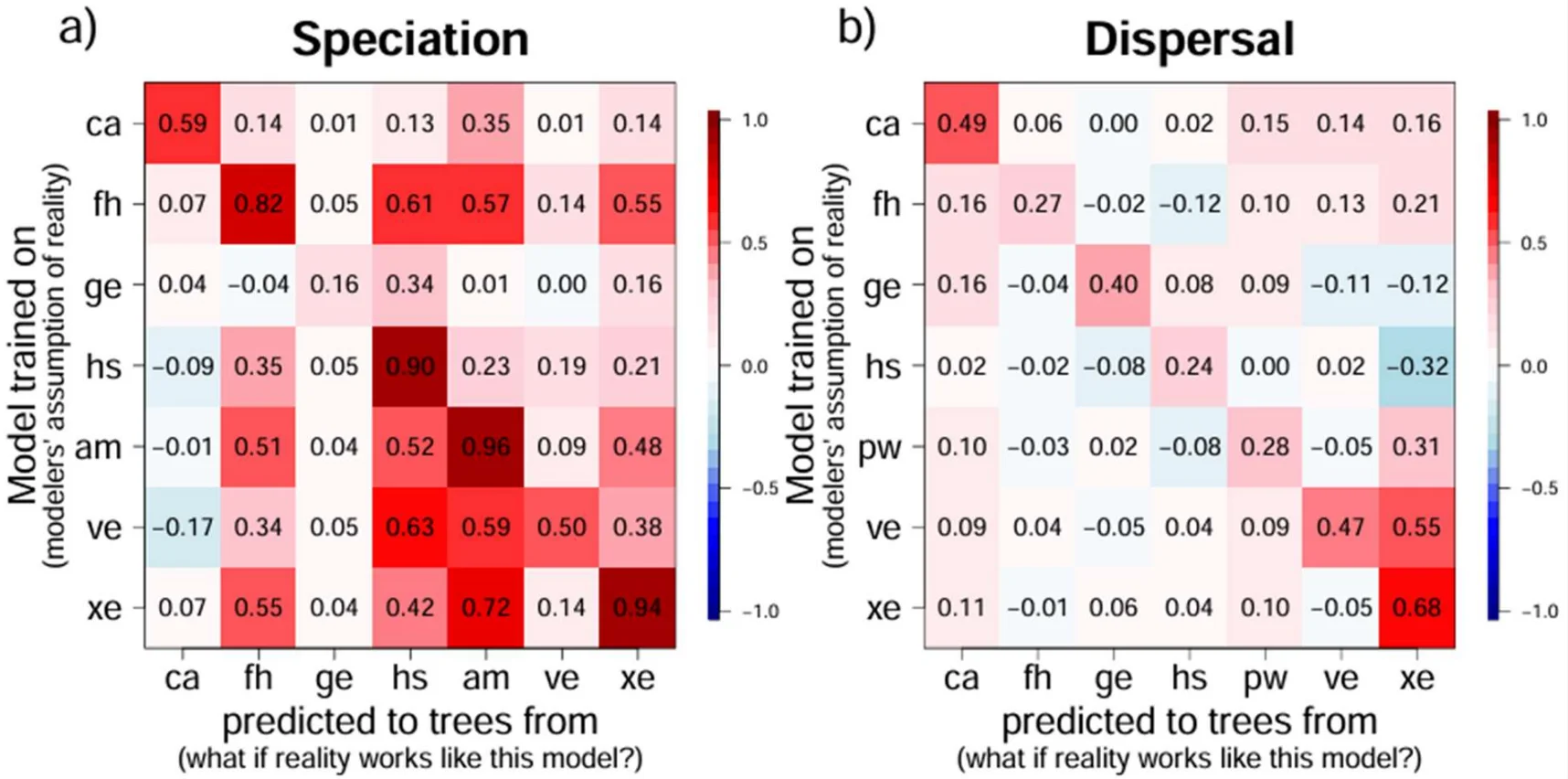
Macroevolutionary research often assumes that the shape of a phylogenetic tree carries a signature of the ecological and evolutionary processes that created it, and mechanistic simulation models are increasingly used to decode that signature. The new study asks how much such conclusions depend on the particular model at hand. To find out, the team ran eight independently developed eco-evolutionary simulation models and tracked how 52 metrics of tree shape responded when the strength of five basic processes was varied: competition, dispersal, environmental filtering, niche conservatism and speciation.
The models largely agreed on the imprint of dispersal and speciation, but none of the metrics turned out to be a unique fingerprint of a single process, which limits their usefulness as quick diagnostic shortcuts. Statistical inference of the processes worked well as long as the data-generating model was known, yet it did not transfer reliably between models. The authors therefore conclude that inferences from phylogenetic patterns to eco-evolutionary processes remain sensitive to the structural and mechanistic choices made inside a model - an argument for treating model structure itself as a source of uncertainty in macroevolutionary analyses.
The paper is the product of a broader community effort to compare macroevolutionary simulation models, bringing together researchers from Germany, the United Kingdom, the Netherlands, Sweden, the Czech Republic and the USA. Florian Hartig and Allen H. Hurlbert contributed equally as senior authors.
Read the full article: doi.org/10.1093/sysbio/syag050
Contacts
Prof. Dr. Florian Hartig
Theoretical Ecology and Ecological Data Science Group
Homepage see here