

INFER - An intelligent feedback system for observing videotaped teaching situations
 © Copilot
Project management: Prof Dr Kathleen Stürmer & Dr Till Fütterer (external link, opens in a new window) (University of Tübingen)
Collaborators: Helena Huger & Rebecca Rester, Franziska Gazar (University of Tübingen), Felina Leng (University of Tübingen)
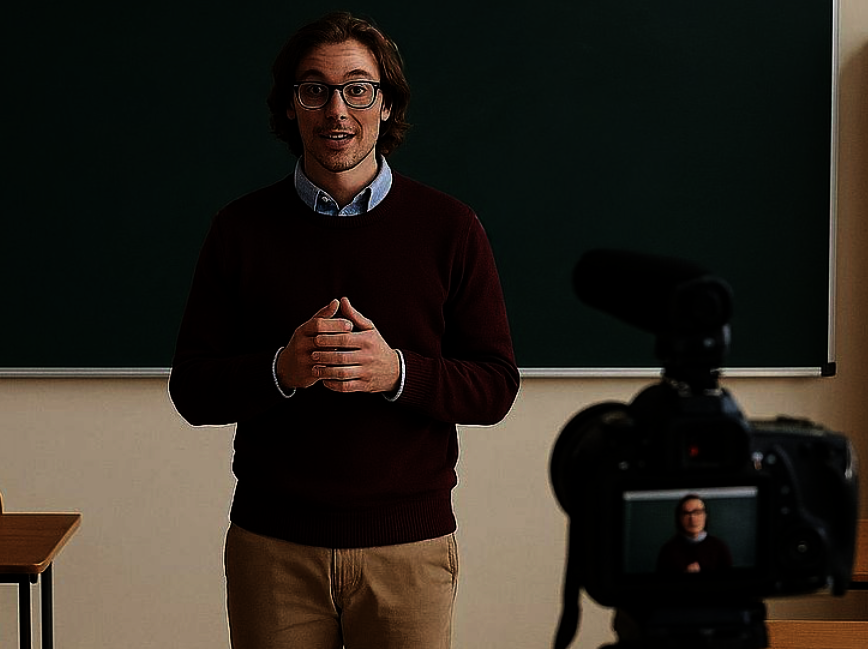
Our goal: In the INFER project, we are developing and testing an intelligent feedback system for the professional vision of teaching by student teachers and teaching staff. Using methods of natural language processing (NLP) and machine learning (ML), the system provides immediate feedback on the perception of teaching quality that people have noted down in written reflection texts.
The ability to observe lessons based on knowledge and to reflect on them in writing is a central component of professional development and therefore an important key to high-quality teacher training. Analysing videotaped lessons makes it possible to link professional knowledge about teaching quality with authentic representations of practice.
Since the systematic evaluation of written reflection texts is very resource-intensive and thus prevents prompt feedback to students and teachers, innovative solutions are needed that validly and reliably measure and promote professional competence.
Funding: Seed funding from the University of Tübingen and UNC-Chapel Hill (EUR 10,000, 2025 - 2026), Freiraum 2026 (EUR 300,000, 2026 - 2028 )
National partners: Prof Dr Richard Göllner (external link, opens in a new window) (University of Potsdam)
International partners: Dr Ha Nguyen (external link, opens in a new window) (University of North Carolina at Chapel Hill)
Further links: University of Tübingen (external link, opens in a new window)
Quick Read: Fütterer, T., Stürmer, K., & Göllner, R. (2024). Assessing teachers' noticing from written reflections. In M. Blikstad-Balas & I. Staal Jenset (Eds.), Improving teaching practices: How can we use videos to foster professional learning and classroom change? Routledge. doi. org/10.4324/9781003427414-12 (external link, opens in a new window)
Professional learning and expertise across domains
 © Helen Jossberger
Staff members: Dr Helen Jossberger, Melanie Troll, and Vanessa Davids
Supervisors: Prof Dr Dr hc Hans Gruber, Dr Helen Jossberger & Prof Dr Kathleen Stürmer
Cooperation partners: Prof Dr Els Boshuizen & Prof Dr Christian Stroszczynski
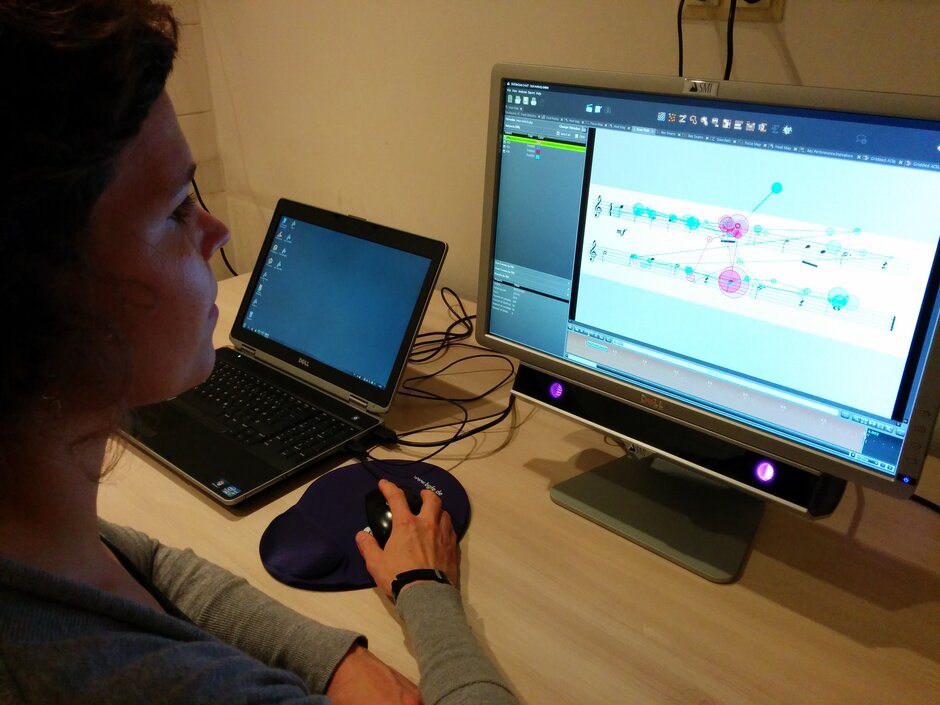
Our goal: In this project, we investigate how (future) professionals from different domains (e.g., medicine, art, music) develop and continuously improve their skills in their field of specialisation through deliberate practice, intensive engagement, and support. The focus is on analysing cognitive, metacognitive, and social processes, which we measure using various qualitative and quantitative methods. A deeper understanding of expertise makes it possible to support professional development in training and professional practice.
Especially in domains where visual information plays an important role, professionals need skills that enable them to analyse complex material quickly and reliably and to interpret it correctly. In the field of medicine, for example, we are investigating visual information processing of X-ray images and how physicians make diagnostic decisions with the help of eye tracking. In the field of art, too, perceptual processes are crucial for recognising works of art, but also for our own creative work. As part of the project, we analyse differentiated spatial perception with the help of eye tracking and also look at the developmental trajectories of artists in a longitudinal study design. We are interested in professional careers in the arts and those phases that are particularly relevant for learning and professional development (e.g., social networks, feedback, practice processes, experience of autonomy and public credibility). For this purpose, we use qualitative methods (e.g., interviews, observations) as methodological approaches.
Quick Read: Jossberger, H., Huovinen, E., Ritter, M., & Gruber, H. (2025). Conductors' views on individual practice activities. Psychology of Music, 53(3), 321-336. doi. org/10.1177/03057356241311817 (external link, opens in a new window)
ReView in Rescue - Development and implementation of video-based debriefings in the training of volunteer rescue workers
 © Stefan Schreder
Staff members: Stefan A. Schreder (M.A.)
Supervisors: Prof Dr Dr hc Hans Gruber & Dr Helen Jossberger
Cooperation partners: Prof Dr Kathleen Stürmer & Prof Dr Matthias Jacob (Mountain Rescue Bavaria)
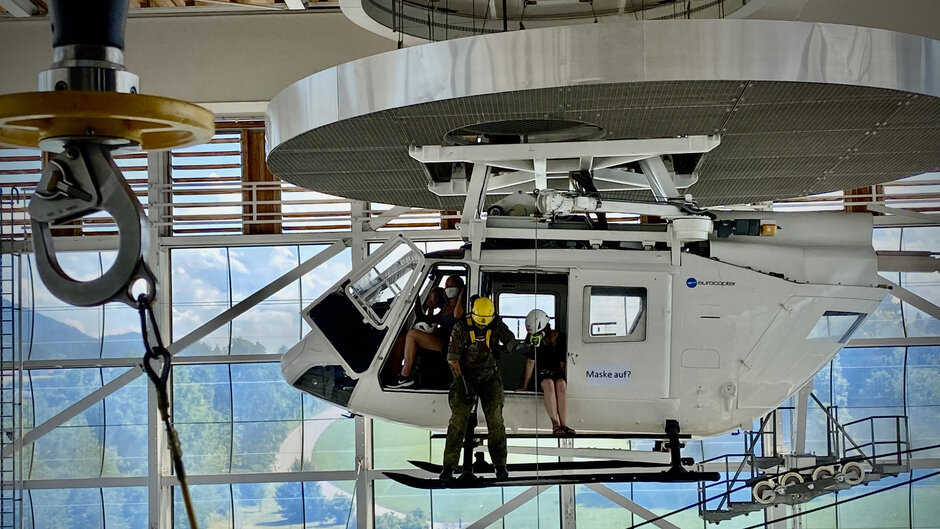
Our goal: In the ReView in Rescue project, we are further developing debriefings in simulation-based mountain rescue training based on educational research. The project is motivated by the question of how reflection processes after complex mission simulations can be designed in such a way that they are effective for learning and match the conditions of volunteer work.
Simulation training makes it possible to practise professional situations safely and realistically. However, the central learning phase takes place in the debriefing, in which experiences are reflected, and future actions are shaped. Particularly in mountain rescue services, high technical demands are combined with limited time resources and different levels of experience within the team of mountain rescuers.
The project examines both the competences of mountain rescuers and their experiences with different debriefing formats. In a collaborative design-based research approach, a didactic framework for video-based debriefings is developed that fits the specific requirements of mountain rescue services. The project combines findings from education with the practical requirements of volunteer rescue workers and is therefore located at the direct interface between science and practical professional training.
Quick Read: Schreder, S. A., Jossberger, H., & Gruber, H. (2025) Mountain rescuers' experiences with video-assisted and verbal debriefings: a qualitative study. Instructional Science, 53, 1759-1780. doi.org/10.1007/s11251-025-09716-9