
The prize is awarded annually to students of the University of Regensburg who recently completed an M.A., L.LM. or State Exam degree and produced a final thesis addressing themes relevant to the broader field of area studies. The winners of the prize, awarded for the sixth time, will be formally honoured on 19 November 2026 as part of the Leibniz ScienceCampus Annual Members’ Meeting.
For the current seventh call for applications, the Leibniz ScienceCampus welcomes applications from students (or nominations by their supervisors) who submitted a master’s thesis or equivalent final thesis at the University of Regensburg in 2025 or 2026.
Latin American Domestic Workers and Their Lives in Madrid
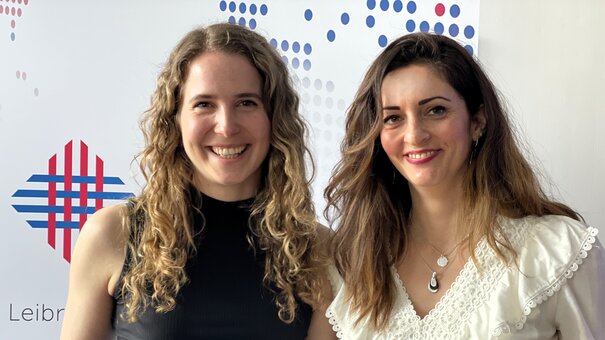
In the sixth edition of the Regensburg Area Studies Prize, first place, and an award of 400 EUR, goes to Lena Marie Lange (image) graduate of the degree in Interkulturelle Europastudien (Intercultural European Studies), which she took at UR and Complutense in Madrid. She submitted her prize-winning master’s thesis Collective Care among Latin American domestic workers in Madrid in 2025.
Grounded in a feminist ethics of care, her Master’s thesis explores how Latin American domestic workers in Madrid create and sustain affective networks and systems of mutual support among themselves. Hence, the thesis approaches the sector of domestic work in Spain from an angle that remains underexplored in academic literature: rather than focusing on domestic workers’ role as caregivers for others, it centres on the ways in which they care for one another. Her research thus pays particular attention to everyday practices of mutual support emerging in contexts marked by precarity, exhaustion, and a lack of institutional recognition.
Her study was supervised by Prof. Dr. Anne Brüske (UR, DIMAS) and Apl. Prof. Dr. Hubert Pöppel (UR, Romance Studies). In her review, Brüske emphasised the innovative empirical and conceptual contribution to research in the field of Global Care Chains as well as the successful implementation of a research methodology that is empathetic without compromising its scientific rigor.
 Foto: Lena Marie Lange
Polish Care Workers in Germany
The two second prizes, worth 200 EUR each, go to Lara Berge and Claudia Hempel.
Claudia Hempel, graduate of the degree programme Ost-West-Studien (East-West Studies), also explored care workers in her thesis Überlagernde Diskriminierungen?! Die Auswirkungen von intersektionalen Stereotypen auf die Lebens- und Arbeitsrealitäten von Opiekunki, polnischen Betreuungskräften in der ‚24h-Pflege‘ in Deutschland, supervised by Prof. Dr. Ger Duijzings and Prof. Dr. Sabine Koller.
In her master’s thesis, Claudia Hempel examines the living and working realities of Opiekunki, drawing on qualitative interviews with Polish care workers providing so-called 24-hour care, and analyses how historically established stereotypes, political frameworks and structural market mechanisms shape these conditions. The study discusses the political frameworks relating to migration, care and gender, historical migration routes, and the cultural construction of female care work, the role of placement agencies and finally, the individual experiences of the women interviewed.
Ger Duijzings calls the study a superb example of engaged research that emanates a constant subdued ‘anger’ about existing prejudices and injustices, praising its originality as well as the astuteness of the analysis.
 Foto: Tandem
Colonial Social Practices in German South West Africa
As part of her master’s degree in History - European Societies in Transformation, completed in 2025, Lara Berge conducted a study on the topic Imperial Encounters: Zur Rolle kolonialer Körper- und Geschlechterbilder bei der Etablierung kolonialer Sozialpraktiken am Beispiel autobiographischer Reisebeschreibungen deutscher Siedlerinnen in Deutsch-Südwestafrika um 1900, supervised by Prof. Dr. Natali Stegmann and Prof. Dr. Anne Brüske.
Examining the German colonial period from a gender and body history perspective, her thesis analysed colonial discourses present in four autobiographical travel accounts by German female settlers in German South West Africa around 1900, drawing on approaches from travel research, postcolonial studies and intersectionality. Berge’s study shows how the construction of colonial body and gender images was shaped by both bourgeois values and actual social and spatial segregation, thereby co-constructing “Black otherness” while simultaneously consolidating colonial power structures. Her study decodes European colonial representations while rendering visible the agency of the colonised population.
The supervisors were especially impressed with Berge’s preparation of the corpora and the extensive links made to existing research. Natali Stegmann noted that the analysis not only filled a research gap, but also contributed to a field of study that has so far been neglected at the University of Regensburg.
 Foto: Anna-Elena Schueler
Further information
Contacts
Dr. Paul Vickers
Manager
Leibniz ScienceCampus
University of Regensburg
Sedanstraße 1
Mailto: paul.vickers@ur.de