

Key information and contact details
Privatdozent
Dr iur. habil.
Mag. iur. (Univ.)
Dipl. Verww. (FH)
Teaching qualification:
Criminal Law, Criminal Procedure, Medical Criminal Law, History of Criminal Law, Philosophy of Law and Theory of Law
- Acting Chair at the University of Heidelberg
- Privatdozent and lecturer at the FernUniversität in Hagen
- Assistant Professor at the University of Regensburg (currently on leave)
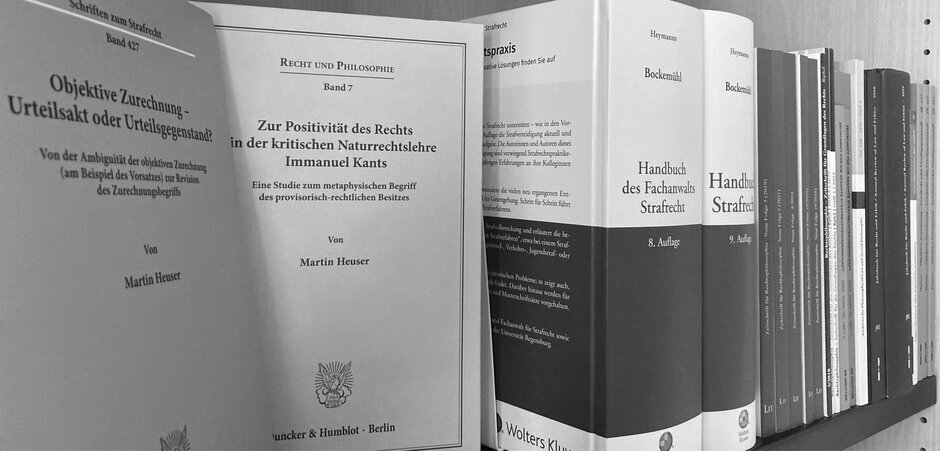
New release (18 June 2026)
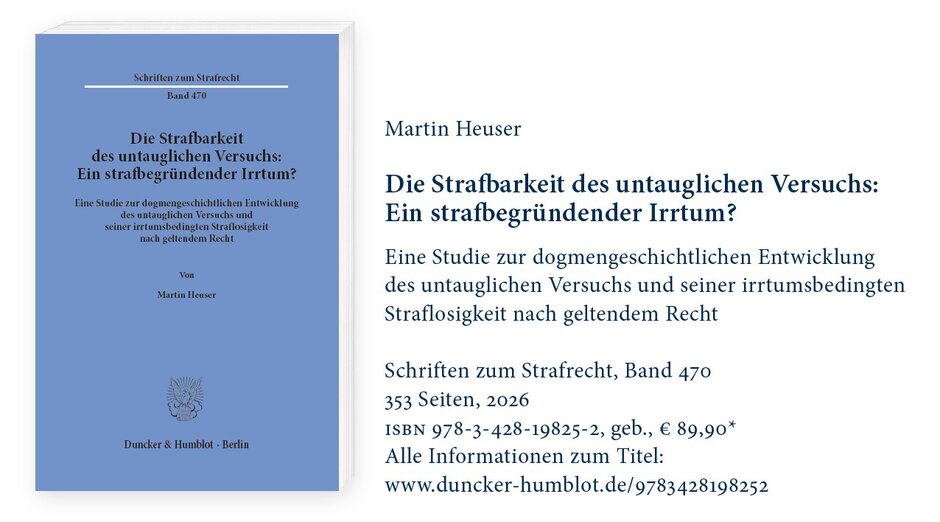
Criminal law, history of criminal law, philosophy of law
News
- Current monograph: The Concept of Criminal Law Attribution. From the beginnings to the present day: Preliminary studies towards a ‘revision of the criminal judgement’ (manuscript of the habilitation thesis, approx. 1,000 standard pages/600 book pages, 2026, publication in preparation).
- Current article: The active intent to carry out the act in a criminal attempt. On the practical development of Michael Köhler’s doctrine of the non-punishability of an ineffective attempt, in: Klesczewski/v. Freier (eds.), Memorial Volume for Michael Köhler, Criminal Law Vol. 472, Duncker & Humblot, Berlin 2026, pp. 183 ff.
- Recent lecture: “Can the truth be a lie? Or: Can a correct medical certificate be an incorrect one (Section 278 of the German Criminal Code)?”, Hagen Distance Learning University, habilitation lecture, February 2026 (= ZStW 138 (2026), pp. 193 ff.).
- Current seminar announcement: Error and Delusion in Criminal Law, seminar at the University of Heidelberg, Summer Semester 2026.
Academic CV

I. Professional experience
April 2026–September 2026
Acting Professor, University of Heidelberg
Chair of Criminology
10/2024–03/2025 & 10/2025–03/2026
Lecturer, Hagen Distance Learning University
Chair of Criminal Law, History of Criminal Law and Philosophy of Law
April 2024–September 2024
Acting Professor, University of Konstanz
Chair of Criminal Law, Criminal Procedure, Comparative Criminal Law, Medical Criminal Law & Legal Theory
April 2023–September 2023
Temporaryprofessorship, Leipzig University
Chair of Criminal Law, Criminal Procedure, International Criminal Law, Comparative Criminal Law & Philosophy of Law
April 2014–present
Assistant Professor, University of Regensburg
Chair of Criminal Law, Criminal Procedure, International Criminal Law & Philosophy of Law
(on leave: 04/2023–09/2023, 04/2024–09/2024, 04/2026–09/2026)
II. Academic Qualifications
February 2026
Habilitation (Hagen Distance Learning University), supervisor: Prof. Dr Stephan Stübinger
- Habilitation thesis: “The Concept of Criminal Law Attribution”
- Habilitation lecture: “Can the truth be a lie? Or: Can a correct medical certificate be an incorrect one (Section 278 of the German Criminal Code)?”
- Venia Legendi: Criminal law, criminal procedure, medical criminal law, history of criminal law, philosophy of law and theory of law.
November 2020
Second State Examination (Higher Regional Court of Nuremberg)
10/2018–11/2020
Legal traineeship (including placements at, amongst others, the law firm Bockemühl & Fischer in Regensburg)
February 2019 and August 2019
PhD (University of Bonn), supervisor: Prof. Dr Rainer Zaczyk
“On the Positivity of Law in Immanuel Kant’s Critical Theory of Natural Law”
March 2014
First Law Examination (Higher Regional Court of Cologne)
April 2009–March 2014
Studied law (University of Bonn), NRW scholarship holder
April 2006–March 2009
Studied Public Administration (Federal University of Applied Sciences, Brühl, Rhineland)
March 2006
General university entrance qualification
Academic publications
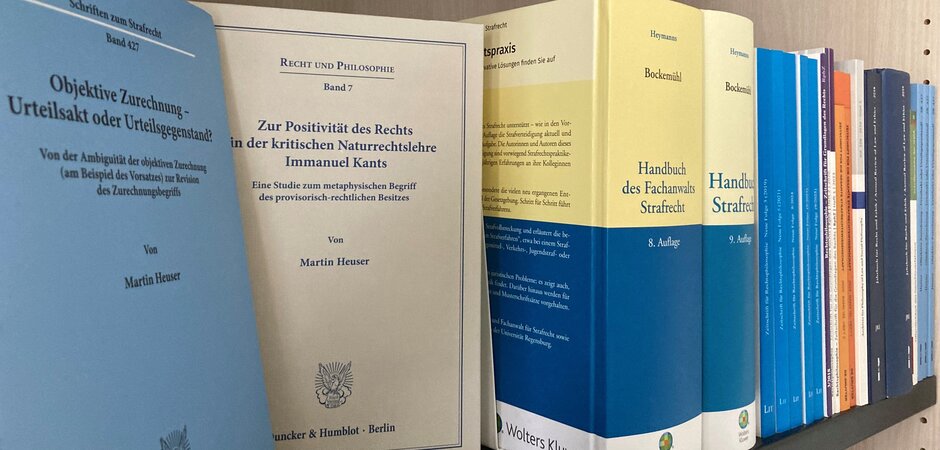
I. Monographs
1. Martin Heuser: On the Positivity of Law in Immanuel Kant’s Critical Theory of Natural Law. A study on the metaphysical concept of provisional legal possession, (Law and Fundamental Philosophical Issues in Theology, Vol. 7), Duncker & Humblot, Berlin 2020 (external link, opens in a new window), 706 pp., hardback and as an e-book (doctoral thesis).
Excerpt (external link, opens in a new window)
Product leaflet (external link, opens in a new window)
- Funded by the VG WORT Science Promotion Fund
- Reviews by ▫ E. Zelizňaková, *Studia Philosophia Kantiana* 2/2020, pp. 99 ff.; ▫ G. Geismann, *Kant-Studien* 112 (2021), pp. 484 ff.; ▫ ibid., *Jahrbuch für Recht und Ethik* 29 (2021), pp. 189 ff.; ▫ S. Møller, Zeitschrift für Philosophy of Law NF 5 (2021), pp. 187 ff.; ▫ S. Schick, Jahrbuch für Recht und Ethik 28 (2020), pp. 85 ff.; ▫ W. Pauly, *Der Staat* 60 (2021), pp. 677 ff.; ▫ W. Staudinger, *Zeitschrift für Int. Strafrechtsw.* 2022, pp. 385 ff.
- Comments on the book:
- “This Bonn-based legal doctoral thesis is a testament to immense diligence and an impressive volume and variety of secondary literature on RL that has been taken into account. For those prepared to endure the toil of reading […], it could well serve as a […] sharpening stone. [...] The book serves [...] as it were as both a starting point and a point of contrast for setting out and justifying one’s own understanding of the principles of Kantian legal theory.” (Georg Geismann)
- “Heuser attempts to understand Kant’s metaphysical conception of law through the conceptually necessary identity of a free will with his law-giving general will, with the aim of resolving the tension between subjectivist natural law and legal positivism, which lacks a legal subject.” (Sofie Møller)
- “The necessity of Kant’s line of reasoning is defended rigorously and with great interpretative effort, which makes for a thoroughly eye-opening read.” (Stefan Schick)
- "The author goes far beyond the usual scope of a doctoral thesis. He does so, however, [...] in terms of content as well. [...] Ultimately, such comprehensive approaches are usually found in a habilitation thesis rather than – as presented by the author – in a doctoral thesis.” (Wolfgang Staudinger)
2. Martin Heuser: Objective Attribution – Act of Judgement or Object of Judgement? From the Ambiguity of Objective Attribution (using the example of intent) to a Revision of the Concept of Attribution, (Schriften zur Kriminalrecht, Vol. 427), Duncker & Humblot, Berlin 2024 (external link, opens in a new window), 113 pp., hardback and as an e-book.
Excerpt (external link, opens in a new window)
Product leaflet (external link, opens in a new window)
- Reviews by ▫ G. Stefanopoulou, Neue Strafrechtswissenschaft 1/2025, pp. 81 ff.
- Comments on the book:
- “Heuser’s work is [...] a sophisticated dogmatic treatise of the classical kind, that is to say, a work characterised by a high level of abstraction and depth of analysis.” (Georgia Stefanopoulou)
3. Martin Heuser: The Criminal Liability of an Incomplete Attempt: An Error Justifying Punishment? A Study on the Historical Development of the Doctrine of the Incomplete Attempt and its Error-Based Exemption from Punishment under Current Law (in: Schriften zum criminal law, Vol. 470, Duncker & Humblot, Berlin 2026 (external link, opens in a new window), 353 pp., hardback and as an e-book).
Excerpt (external link, opens in a new window)
Product leaflet (external link, opens in a new window)
4. Martin Heuser: The Concept of Criminal Law Attribution. From the beginnings to the present day: Preliminary studies towards a ‘revision of the criminal judgement’ (manuscript of the habilitation thesis, approx. 1,000 standard pages/600 book pages, 2025/2026).
II. Contributions to specialist anthologies
1. Martin Heuser: Compensation for criminal prosecution measures,
- a) – Chapter 34 (adapted from the contribution by R. Hohmann), in: Bockemühl (ed.): Handbook for Specialist Lawyers in Criminal Law, Carl Heymanns, Cologne: 8th ed. 2021, pp. 1743–1756;
- b) – Chapter 36, in: Bockemühl (ed.): Handbook of Criminal Law, Carl Heymanns, Cologne: 9th ed. 2024, pp. 1803–1816.
2. Martin Heuser: Attribution, in: Cordes et al. (eds.): Concise Dictionary of German Legal History (HRG), Erich Schmidt, Berlin: 2nd ed. (external link, opens in a new window), to be published in print with the 44th instalment, Vol. VI 2028, (in preparation).
III. Contributions to Criminal Law and Criminal Procedure
1. Martin Heuser: Reasonable Public Access to Court Proceedings (Section 169 GVG). A form of scrutiny critical of public access to ensure transparency, in: Hessian Bar Association (ed.): From the Oversight of the Court to Satisfying Society’s Need for Information – Is There a Change in the Function of the ‘Public Nature of Court Proceedings’ (Section 169 GVG)?, 2014, Publications Series of the Hessian Bar Association, Volume 5, pp. 71–104.
2. Martin Heuser: ‘Aberratio ictus’ as ‘error in persona vel objecto’ within the scope of Section 16(1) of the German Criminal Code (StGB) (?), Notes on the conceptualisation and distinguishability of criminal law doctrines of error, in: Zeitschrift für das Juristische Studium (ZJS) 2019, pp. 181–192. (external link, opens in a new window)
3. Martin Heuser: On the Supreme Court’s relativisation of the absolute ground for appeal under Section 338(6) of the Code of Criminal Procedure (StPO), with a note on the Federal Court of Justice (BGH) decision of 9 May 2019, 4 StR 605/18, in: Supreme Court Case Law in Criminal Law (HRRS) 2019, pp. 392–399. (external link, opens in a new window)
4. Martin Heuser: Error in persona in cases of joint criminal liability. Also a commentary on the Federal Court of Justice (BGH) judgement of 1 August 2018, 3 StR 651/17, in: Zeitschrift für das Juristische Studium (ZJS) 2019, pp. 529–537. (external link, opens in a new window)
5. Martin Heuser: The theory of unrestricted culpability in cases of error regarding the elements of a lawful act. On the lawful application of the avoidability clause in section 17, sentence 1, of the German Criminal Code (StGB), in: Zeitschrift für die gesamte Strafrechtswissenschaft (ZStW) 132 (2020), pp. 330–366. (external link, opens in a new window)
6. Martin Heuser: The Criminal Law of Lockdown and Contact Restrictions in Times of the Pandemic, in: Strafverteidiger (StV) 2020, pp. 426–430. (external link, opens in a new window)
7. Martin Heuser/Jan Bockemühl: ‘The rule of law requires a clear view of the face’: Masks in the main hearing?, in: Journal of Criminal Policy (KriPoZ) 2020, pp. 342–348. (external link, opens in a new window)
8. Jan Bockemühl/Martin Heuser: Plea bargaining without the defendant’s consent. Commentary on the Federal Court of Justice (BGH), order of 23 July 2019, 1 StR 169/19, in: Strafverteidiger (StV) 2021, pp. 8–10. (external link, opens in a new window)
9. Martin Heuser/Jan Bockemühl: From an openly practised plea bargain to the quashing of a judgment on the grounds of substantive misrepresentation: Legal affairs concerning procedural objections to informal plea bargaining. Also a commentary on the Federal Court of Justice (BGH), order of 9 October 2019, 1 StR 545/18, in: Strafverteidiger (StV) 2021, pp. 63–70. (external link, opens in a new window)
10. Martin Heuser: The imposition of sanctions under the general clause of Section 28(1), first sentence, of the Infection Protection Act (IfSG). On the lack of specificity of the blanket provision within the meaning of Article 103(2) of the Basic Law (GG), in: Höchstrichterliche Rechtsprechung im Kriminalrecht (HRRS) 2021, pp. 63–86. (external link, opens in a new window)
11. Martin Heuser: An Attempt at Qualifying the Outcome. Commentary on the Federal Court of Justice (BGH), judgment of 12 August 2021 – 3 StR 415/20, in: Strafverteidiger Forum (StraFo) 2022, pp. 331–334.
12. Martin Heuser: The criminal liability of an attempt with a result-based qualification. On the similarities and differences of the attempt with a result-based qualification, in: Zeitschrift für die gesamte Strafrechtswissenschaft (ZStW) 135 (2023), pp. 6–23 (external link, opens in a new window).
13. Martin Heuser: On the Relationship between the Doctrines of Wrongfulness and Attribution. Also a review of Pepe Schladitz, ‘Normtheoretische Grundlagen der Lehre von der objektiven Zurechnung’, in: Zeitschrift für Internationale Strafrechtswissenschaft (ZfIStw) 2024, pp. 83–92 (external link, opens in a new window).
see below: V.5. (review article)
14. Martin Heuser: A futile attempt at criminal law reform? On the apparent criminal liability of an unsuccessful attempt under Sections 22 and 23(3) of the German Criminal Code (StGB), in: Journal of International Criminal Law (ZfIStw) 2025, pp. 286–298 (external link, opens in a new window).
15. Martin Heuser: On the distinction between valid and invalid attempts – are valid attempts exempt from punishment? Response to Herzberg (duplik to a replik on III. 14.), in: Journal of International Criminal Law (ZfIStw) 2025, pp. 690–695 (external link, opens in a new window).
16. Martin Heuser: On the Unity of Criminal Attribution and Sentencing within the Concept of Attribution. Preliminary studies on the concept of culpability for sentencing (Section 46(1), first sentence, of the German Criminal Code (StGB)), (to be published in an anthology by Duncker & Humblot, Berlin 2026).
17. Martin Heuser: The active intent to carry out the act in a criminal attempt. On the practical development of Michael Köhler’s doctrine of the impunity of an ineffective attempt, in: Klesczewski/v. Freier (eds.), Memorial Volume for Michael Köhler, Schriften zum criminal law Vol. 472, Duncker & Humblot, Berlin 2026, pp. 183–198.
18. Martin Heuser: Can the truth be a lie? Or: Can a correct medical certificate be an incorrect one (section 278 of the German Criminal Code)? On the (non-)enforceability under document-related criminal law of medical examination obligations, in: Zeitschrift für die gesamte Strafrechtswissenschaft (ZStW) 138 (2026), pp. 193–242 (external link, opens in a new window).
19. Martin Heuser: The futile attempt (at) criminal law reform. An investigation into so-called ‘reverse error’ in the materials on the Major Criminal Law Reform (to be published in an anthology by Mohr Siebeck, Tübingen).
20. Martin Heuser: Unity and Difference between ‘Wrongdoing’ and ‘Guilt’ in the Attribution of Criminal Offences. A Proposal for a Compromise in the Dispute over their Relative Status, in preparation.
IV. Contributions to the Philosophy of Law / Conceptual History / Recent History of Criminal Law
1. Martin Heuser: “One may call the awareness of this fundamental law a factum of reason”. A historical-conceptual study of the use of the concept of ‘factum’ in Kant’s *Critique of Practical Reason*, in: *Jahrbuch für Recht und Ethik* (JRE) 26 (2018), pp. 343–427 (external link, opens in a new window).
2. Martin Heuser: The metaphysical concept of provisional legal possession. On its definition and dialectic in § 9 of Immanuel Kant’s Theory of Law, in: Philosophy of Law (RphZ) 2018, pp. 240–255. (external link, opens in a new window)
3. Martin Heuser: The Metaphysical Definition of the Synthetic Concept of Original Acquisition. A study on the deduction of the concept in § 17 of Immanuel Kant’s *Doctrine of Law*, in: *Zeitschrift für Philosophie der Rechtswissenschaft* (ZRPh) 2019, pp. 121–142.
4. Martin Heuser: The Metaphysical Definition of the Synthetic Legal Concept of Intelligible Possession. A Study on the ‘Crazy’ Unity of § 6 in Immanuel Kant’s Doctrine of Law, in: Joerden/Schuhr (eds.), Criminal Law and Philosophy of Law: A Festschrift for Joachim Hruschka, Berlin 2019 = Yearbook for Law and Ethics (JRE) 27 (2019), pp. 85–132 (external link, opens in a new window).
5. Martin Heuser: The Concept of Attribution in Kant’s ‘philosophia practica universalis’. On the Interpretation of a Preliminary Concept in the ‘Metaphysics of Morals’, in: Archive for Legal and Social Philosophy (ARSP) 106 (2020), pp. 265–300 (external link, opens in a new window).
6. Martin Heuser: The Reception of the Natural-Law Concept of Attribution by Criminal Law Scholarship under Common Law. With particular reference to the mid-18th century (1731–1759), in: Zeitschrift für Neuere Legal History (ZNR) 44 (2022) (external link, opens in a new window), pp. 2–29.
7. Martin Heuser: Accountability and the application of the law in Achenwall’s natural law theory. On a conceptual revision between 1750 and 1755 in its conceptual context, in: Philosophy of Law (RphZ) 2023, pp. 74–87 (external link, opens in a new window).
8. Martin Heuser: Kant’s Theory of Attribution against its Conceptual-Historical Background. Preliminary studies on the ‘Origin of Critical Philosophy’ and discussions on the ‘difficulty’ of ‘how the imputability of actions is possible’, in: Journal of Philosophy of Law (ZRPh) 2024, pp. 71–93.
9. Martin Heuser: The ‘Sanctity of Law’ in Kant, in: Journal of Philosophy of Law (ZRPh) 2025, pp. 25–35.
10. Martin Heuser: Attribution and Ascription in Hans Kelsen’s Pure Theory of Law. A Legal-Theoretical Solution to an Old Problem of Natural Law?, in: Zeitschrift für Philosophie der Rechtswissenschaft (ZRPh) 2025, pp. 127–153.
V. Reviews and Critical Essays
1. Martin Heuser: “Luna Rösinger, The Accused’s Freedom from the Compulsion to Incriminate Oneself: On the Rationale Linking Freedom of Cooperation and Interference in Criminal Proceedings, 2019”, review, in: Philosophy of Law – Zeitschrift für Grundlagen des Rechts (RphZ) 2020, pp. 193–199. (external link, opens in a new window)
2. Martin Heuser: “Bernd Ludwig (ed.), Immanuel Kant: Metaphysical Foundations of the Doctrine of Law, 4th ed. 2018”, review, in: Archive for Legal and Social Philosophy (ARSP) 2021, pp. 151–156. (external link, opens in a new window)
3. Martin Heuser: “Manfred Baum/Dieter Hüning (eds.), Kant’s State of Freedom: On Julius Ebbinghaus’s Interpretation of Kant’s Doctrine of Law, 2020”, review, in: Journal of Philosophy of Law (ZRPh) 2021, pp. 177–182.
4. Martin Heuser: “Teresa Frank, The Retrial to the Disadvantage of the Accused in Criminal Proceedings: Reform Debates and Legislation since the Nineteenth Century, 2022”, review, in: Journal of Modern Legal History (ZNR) 45 (2023) (external link, opens in a new window), pp. 156–159.
5. Martin Heuser: “On the Relationship between the Doctrines of Wrongfulness and Attribution”, also a review of Pepe Schladitz, Normtheoretische Grundlagen der Lehre von der objektiven Zurechnung, in: Zeitschrift für Internationale Strafrechtswissenschaft (ZfIStw) 2024, pp. 83–92 (external link, opens in a new window).
6. Martin Heuser: “Alexander Hoeppel, *NS-Justiz und Rechtsbeugung: The Criminal Prosecution of German Judicial Crimes after 1945*, 2019”, review, in: Journal of Modern Legal History (ZNR) 47 (2025) (external link, opens in a new window), pp. 142–145.
7. Martin Heuser: “Hannah Toprak, Natural Law in the Prosecution of Nazi Crimes: An Examination of German Criminal Case Law (1945–2020), 2023”, review, in: Journal of Modern Legal History (ZNR) 47 (2025) (external link, opens in a new window), pp. 179–182.
VI. Case Studies/Written Exams
1. Martin Heuser: “Thermal Utilisation” – Advanced criminal law examination, case study, in: Jura Studium & Examen (JSE) 2023, pp. 123–128 (external link, opens in a new window).
2. Martin Heuser: “The Wrong Holster” – Introductory criminal law exam, case study, in: Journal of Legal Studies (ZJS) 2025, pp. 534–549 (external link, opens in a new window).
3. Martin Heuser: “Supervised Take-off, or Else Perish!” – Advanced criminal law exam, case analysis, to be published in: Juristische Arbeitsblätter (JA).
VII. Miscellaneous
In particular, earlier publications (2010–2013) on private law (in NJW, JR, JURA).
Scientific presentations
 Foto: UR/Axel Roitzsch
Selection:
16 May 2014
“Reasonable Public Access to Court Proceedings (Section 169 of the German Courts Act (GVG))”, lecture delivered as part of the award ceremony for the essay competition organised by the Hessian Bar Association Foundation, Frankfurt am Main
17 September 2021
“The Concept of Law in Immanuel Kant (Section B, paragraphs 2–3 of the Treatise on the Principles of the Philosophy of Mind)”, lecture delivered as part of the inaugural meeting of the academic network “Freedom and Punishment”, University of Regensburg.
29 September 2023
“Kant’s Theory of Accountability against its Conceptual-Historical Background – Preliminary Studies on the ‘Origin of Critical Philosophy’”, lecture delivered as part of the 2024 Kant Conference organised by the Journal of Philosophy of Law, University of Hagen.
14 December 2023
“Objective Attribution: Object of Judgement or Act of Judgement?”, lecture as part of the Thursday Seminar on the Philosophy of Law organised by the Chair of Criminal Law, Criminal Procedure, Foreign Criminal Law and Criminal Law Theory (Prof. Dr Luís Greco, LL.M.), Humboldt University of Berlin.
8 March 2024
“On the Unity of Criminal Attribution and Sentencing in the Concept of Attribution”, lecture as part of the conference “Liberal Criminal Theory and the Law of Sanctions”, University of Bonn.
3 September 2024
“The Punishability of an Incompetent Attempt: an Error Justifying Punishment?”, habilitation presentation at the Fernuniversität in Hagen.
28 September 2024
“The ‘Sanctity of Law’ in Kant”, lecture delivered as part of the conference “The Law of Religious Communities: The Relevance of Classical German Fundamental Philosophical Issues in Theology in the Tension between State, Law and Religion”, Leipzig University.
14 June 2025
“The Will to Act in a Criminal Attempt”, lecture as part of the commemorative event “Law and Justice” in honour of Professor Dr Michael Köhler, Aby Warburg House, Hamburg.
19 September 2025
“On a Supposed Right to Resist Based on One’s Own Judgement”, lecture as part of the interdisciplinary conference “Practices of Resistance – Forms and Justifications of the Struggle against Injustice in Philosophy, Law and Literature”, Leipzig University.
5 December 2025
“The Futile Attempt (in) Criminal Law Reform: On the so-called ‘reverse error’ in the materials relating to the Great Criminal Law Reform”, lecture as part of the criminal law conference “The Work of the Great Criminal Law Commission: A Criminal Law Perspective on the Occasion of the 50th Anniversary of the Great Criminal Law Reform”, University of Hamburg/Bucerius Law School Hamburg.
10 February 2026
“Can the truth be a lie? Or: Can a correct medical certificate be an incorrect one (Section 278 of the German Criminal Code)?”, habilitation lecture at the Fernuniversität in Hagen.
27 February 2026
“Resistance to the highest legislative authority” – “destroy[ing] the entire legal constitution”?, guest lecture as part of the legal philosophy seminar “Kant’s Constitutional Law”, organised by Luna Rösinger and Florian Sander, University of Hamburg.
Academic Research Profile

Profile
Martin Heuser conducts fundamental research into the core issues of criminal law and modern philosophy of law. In doing so, he combines methods from legal philosophy, the history of criminal law and legal dogmatics in an interdisciplinary manner to form a conceptual-historical approach that enables innovative perspectives on traditional problems and novel solutions.
A key focus is the concept of liberal imputation in criminal law, informed by the history of concepts, understood as a formal principle of knowledge underpinning a universal science of criminal law in the sense of an international grammar of criminal attribution. This research approach is set to provide new impetus for the transnational and national discussion of concepts relating to criminal offences and sentencing, for example in the field of attempted offences or the doctrine of negligence.
In addition, Martin Heuser conducts application-oriented research on this basis in both the general and specific parts of criminal law, notably also on fundamental issues of medical criminal law. Research into criminal procedure law rounds off his portfolio.
Current and future topics of his research include, amongst others:
The historical conceptual foundations of imputation from the 17th to the 21st centuries.
Models of attribution in a transnational, multi-tiered system
A re-examination of the concept of (objective) attribution in criminal law
The relationship between wrongdoing and culpability in the attribution of criminal liability
The relationship between culpability and punishment in the attribution of criminal liability
Substantiation of the concept of culpability (qualitatively and quantitatively)
Frictions within the criminal law system regarding the concept of wrongdoing (attempt and negligence)
Conceptions of autonomy in the context of medical criminal law
Requirements for disclosure as a characteristic of justifying consent
Keyareas of focus in detail
- criminal law: Substantive criminal law covering both the General and Special Parts, in particular the doctrines of act, criminal responsibility and the nature of offences, fundamental questions concerning the doctrine of objective attribution, the doctrines of error and attempt (in particular, the futile attempt), fundamental issues relating to offences defined by the result, blanket criminal legislation and the law of sentencing.
- criminal procedure: Formal criminal law, in particular main proceedings and appeal proceedings; fundamental issues concerning the public nature of the main hearing; the relativisation of absolute grounds for appeal; the organisation of the courts; plea bargaining and its distinction from inadmissible deals; criminal defence; and criminal compensation.
- Medical Criminal Law: In particular , issues of criminal responsibility in the context of organ allocation; fundamental questions and the history of legal doctrine concerning the issuance of incorrect medical certificates; and issues of sanctions under infection control law.
- Philosophy of Law: The philosophy of German Idealism, in particular practical philosophy and, more specifically, Immanuel Kant’s philosophy of law in its conceptual, systematic and methodological context and against its historical background of conceptual development, including its reception, history of reception and history of publication; furthermore, the classical doctrines of natural law since Pufendorf; and the philosophy of criminal law at the turn of the 18th to the 19th century. In addition, questions of legal theory, e.g. the ‘Pure Theory of Law’ or the syllogistic application of the law.
- Recent history of criminal law/history of legal concepts: the doctrines of imputation since Pufendorf; and, in connection with this, the historical relationship between fundamental legal and philosophical concepts, in particular the concept of freedom as causality in philosophy and (criminal) law; the concept of fact (res facti, factum, Factum, Faktum, factuality, act, actus, elements of an offence, actuality) in fundamental philosophical issues in theology and (criminal) law; the concept of attribution (imputatio) in philosophy, legal theory and criminal law; in connection with this, the general doctrines of criminal law in the 18th and 19th centuries. Furthermore, issues relating to Nazi criminal law.
Habilitation
“Samuel Pufendorf was the first to introduce the term ‘imputatio’ into law as a technical term, and, under this heading, to systematise the subjective requirements for the punishment of crimes. At the same time, he gave this new doctrine of imputation such a well-developed form that his exposition became a model for the entire natural law school right up to Feuerbach, and beyond that, the foundation for the subsequent developments building upon it. Even today, everything that is commonplace in criminal law as the doctrine of attribution or culpability rests on his shoulders, right down to the standard textbook examples.” (Richard Loening, 1903)
Subject of the habilitation thesis: ‘The Concept of Criminal Law Attribution: From the Beginnings to the Present Day’
- The origins of modern criminal law scholarship are usually attributed to the scholarly work of P.J.A. Feuerbach. His fundamental concern around the turn of the 19th century, as we might recall today, was a revision of the concept of criminal imputation. Prominent scholars of criminal law have followed this fundamental methodological concern. Köstlin, for instance, described the doctrine of imputation in his *Neue Revision* of 1845 as the “core of criminal law”. Since the 1970s, Roxin’s doctrine of objective imputation has become established and has had a lasting influence on the modern understanding of criminal offences.
- In order to assess, from a contemporary perspective, both the origins of modern criminal law scholarship and its current state, it is therefore essential to gain as comprehensive an overview as possible of the history of the concept of criminal imputation, from its early natural law origins with Pufendorf (1660) onwards. This research therefore aims to bring the history of this concept – which, in light of all this, is of central importance to the history of criminal law scholarship – back into focus. At best, it is to be hoped that the insights gained from this will provide new impetus, for example, for the modern discussion of (both national and transnational) concepts of criminal offences.
Academic teaching
Certified since March 2026:
Certificate in University Teaching from Bavarian universities (advanced level, 120 credit units)
Courses taught to date:
Introductory lecture on criminal law: General Part
▫ Summer term 2024 (1 x 6.0 SWS), University of Konstanz
Lecture on Criminal Law: Special Part – Offences against the Public
▫ Summer semester 2023 (1 x 2.0 SWS), Leipzig University
Specialised lecture on juvenile criminal law
▫ Summer term 2026 (1 x 2.0 SWS), University of Heidelberg
Specialised lecture on Prison Law
▫ Summer semester 2026 (1 x 1.0 SWS), University of Heidelberg
Revision course on the General Part of Criminal Law
▫ Winter semester 2021/2022 (1 x 3.0 SWS), University of Regensburg
▫ Winter semester 2023/2024 (1 x 3.0 SWS), University of Regensburg
Advanced Criminal Law Seminar (for students in their middle years of study)
▫ Summer semester 2023 (1 x 2.0 SWS), Leipzig University
▫ Winter semester 2025/26 (1 x 2.5 SWS), University of Regensburg
▫ Summer semester 2026 (1 x 2.0 SWS), University of Heidelberg
Criminal Law Examination Preparation Course
▫ Summer term 2023 (1 x 2.0 SWS), Leipzig University (“LEONIE”)
Criminal Law (Specialist) Seminar
▫ Summer semester 2023 (1 x 2.0 SWS), Leipzig University:
“The Concept of Criminal Law Attribution (imputatio) –
Origins, Developments, Classification of Offences, Criticism”
▫ Summer semester 2024 (1 x 2.0 SWS), University of Konstanz:
“Legal techniques for making criminal law more flexible: blanket criminal legislation & procedural agreements”
- 1st Department: “So-called blanket criminal legislation against the backdrop of the requirement for specificity (Article 103(2) of the Basic Law) – using the example of selected offences under criminal health law”,
- Department 2: “Current and fundamental issues relating to plea agreements in criminal proceedings”
▫ Winter semester 2024/2025 (1 x 2.0 SWS), Hagen Distance Learning University:
“Theoretical and dogmatic issues of criminal law attribution”
(jointly with Prof. Dr Stephan Stübinger)
▫ Winter semester 2025/2026 (1 x 2.0 SWS), Hagen Distance Learning University:
“Great Thinkers in Criminal Law”
(jointly with Prof. Dr Stephan Stübinger)
▫ Summer term 2026 (1 x 2.0 SWS), University of Heidelberg:
“Error and Delusion in Criminal Law”
A reading course in the philosophy of law
▫ Winter semester 2014/2015 (1 x 2.5 SWS), University of Regensburg:
“Causality and Freedom in Immanuel Kant’s Critique of Pure Reason”
▫ Summer semester 2015 (1 x 2.5 SWS), University of Regensburg:
“The Foundations of Law and Morality in Immanuel Kant’s Practical Philosophy of Freedom”
▫ Summer term 2016 (1 x 2.5 SWS), University of Regensburg:
“Sovereignty belongs to those who possess reason: Immanuel Kant’s Critique of Pure Reason”
(in collaboration with Prof. Dr Katrin Gierhake, LL.M.)
▫ Winter semester 2016/2017 (1 x 2.5 SWS), University of Regensburg:
“Sovereignty belongs to those who possess reason: Immanuel Kant’s Critique of Pure Reason/Critique of Practical Reason (continued)”
(in collaboration with Prof. Dr Katrin Gierhake, LL.M.)
Conversation seminar on criminal law: General Part I
▫ Summer semester 2014 (2 x 2.5 SWS), University of Regensburg
▫ Summer semester 2015 (1 x 2.5 SWS), University of Regensburg
▫ Summer semester 2016 (1 x 2.5 SWS), University of Regensburg
▫ Summer semester 2017 (2 x 2.5 SWS), University of Regensburg
▫ Summer term 2018 (2 x 2.5 SWS), University of Regensburg
▫ Summer term 2021 (1 x 2.5 SWS), University of Regensburg
▫ Summer term 2022 (2 x 2.5 SWS), University of Regensburg
▫ Summer term 2025 (2 x 2.5 SWS), University of Regensburg
Conversation seminar on General Part II of criminal law
▫ Winter semester 2014/2015 (2 x 2.5 SWS), University of Regensburg
▫ Winter semester 2015/2016 (2 x 2.5 SWS), University of Regensburg
▫ Winter semester 2016/2017 (2 x 2.5 SWS), University of Regensburg
▫ Winter semester 2017/2018 (2 x 2.5 SWS), University of Regensburg
▫ Winter semester 2021/2022 (2 x 2.5 SWS), University of Regensburg
▫ Winter semester 2022/2023 (2 x 2.5 SWS), University of Regensburg
▫ Winter semester 2024/2025 (2 x 2.5 SWS), University of Regensburg
▫ Winter semester 2025/2026 (2 x 2.5 SWS), University of Regensburg
Conversation seminar on criminal law: Special Part II
▫ Winter semester 2022/2023 (1 x 2.5 SWS), University of Regensburg