

Prof. Dr. Andreas von Manteuffel
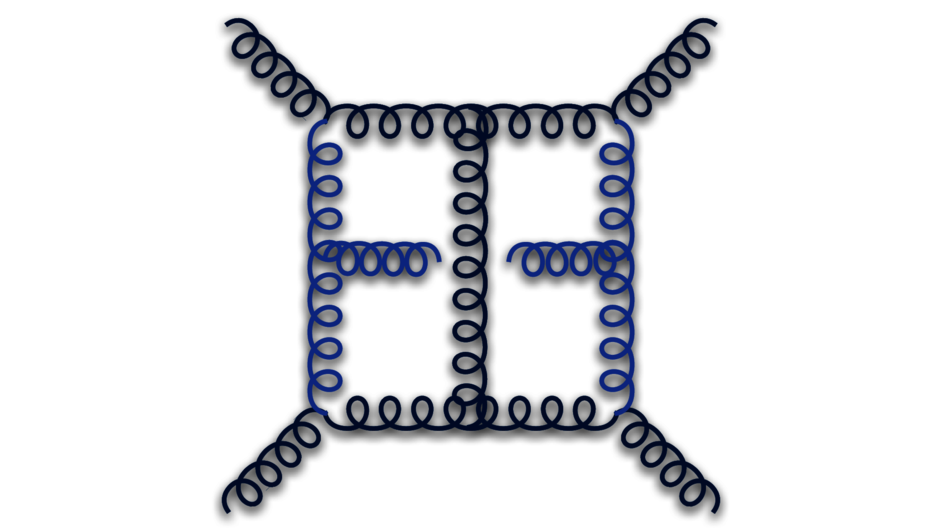
In theoretical particle physics, we explore the fundamental laws of nature and describe phenomena down to distances much smaller than the size of an atom. Our research group studies relativistic quantum field theory and provides precise theory predictions for experiments at the Large Hadron Collider and other facilities.
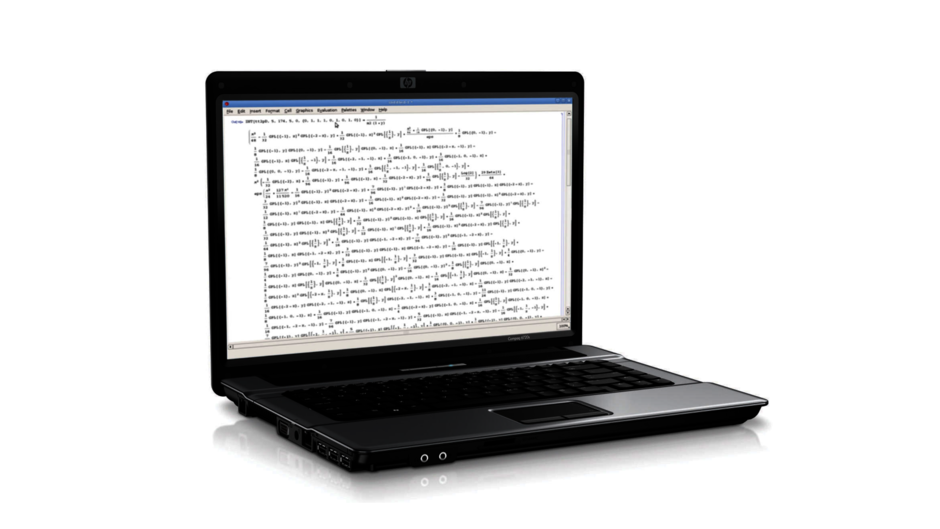
We develop calculational methods and computer algebraic tools for perturbative quantum field theory. This pushes the frontier in phenomenological predictions and improves our structural understanding of multi-loop scattering amplitudes.

Research
High energy physics aims at a description of matter and forces at a fundamental level. In the year 2012, the CERN Large Hadron Collider discovered the Higgs boson, which firmly established the Standard Model of particle physics as a quantum theory of the electro-weak and strong interactions of the constituents of matter. Despite its great quantitative success, this theory is incomplete since it does not describe gravitational interactions, dark matter and the matter-antimatter asymmetry in the Universe. Current and future collider experiments search for effects from "new physics" beyond the Standard Model, where precision measurements play an increasingly important role due to the non-observation of large discrepancies from the theory prediction.
Our research aims at enabling very precise theory predictions for collider observables, which are crucial to identify possible signals of new physics and to precisely determine the parameters of the Standard Model. We develop novel mathematical methods and computer codes that allow us to study quantum corrections at unprecedented precision. A main focus is on the calculation of multiloop scattering amplitudes with numerical or computer algebraic methods.
Please see my publications at inspirehep.net (external link, opens in a new window) or talk to me to find out more.
Teaching
Lectures at the University of Regensburg
| Semester | ID | Lecture |
|---|---|---|
| SS 2026 | 52505S | Integrated Course III: Nuclei and Elementary Particles (with Prof. Bali) |
| WS 2025 | 52202 | Theoretical Physics Ib: Electrodynamics |
| SS 2025 | 52505S | Integrated Course III: Nuclei and Elementary Particles (with Prof. Bali) |
| WS 2024 | 52213 | Theoretical Physics 1a: Mechanics |
| SS 2024 | 52505S | Integrated Course III: Nuclei and Elementary Particles (with Prof. Bali) |
| WS 2023 | 52661 | Scattering Amplitudes in Perturbative QFT |
| WS 2023 | 52660 | Computer Algebra in Physics |
Lectures at Michigan State University
| Semester | ID | Lecture |
|---|---|---|
| SS 2023 | PHY 855 | Quantum Field Theory |
| WS 2022 | PHY 820 | Classical Mechnics |
| SS 2022 | PHY 841 | Classical Electrodynamics I |
| WS 2021 | PHY 415 | Methods of Theoretical Physics |
| SS 2021 | PHY 841 | Classical Electrodynamics I |
| SS 2020 | PHY 905 | Perturbative Quantum Chromodynamics |
| WS 2019 | PHY 183 | Physics for Scientists and Egineers |
| SS 2019 | PHY 841 | Classical Electrodynamics I |
| SS 2018 | PHY 183 | Physics for Scientists and Egineers |
| WS 2017 | PHY 183 | Physics for Scientists and Egineers |
| SS 2017 | PHY 183 | Physics for Scientists and Egineers P-cubed |
Code
Some of our software contributions to high energy theory and computer algebra:
- Reduze 2 - distributed Feynman integral reduction
- MultivariateApart - multivariate partial fraction decomposition
- VVamp - integrals and amplitudes for diboson production at the LHC
- Loopedia - database for Feynman integrals