
Meeting at UR
(December 6-8)
Quantum survivors in a chaotic sea
(June 21)
Non-equilibrium quantum states formed from many particles are extremely fragile and usually do not survive for long, but "decay" rapidly: they thermalize due to chaos. In a recent publication we show that, intriguingly, there exist such survivors in ultracold atomic gases that, despite chaotic dynamics, perform hundreds of stable oscillations as a unique signature of stability and quantum coherence. The observation of such "many-body scars" opens up far-reaching implications for the occurrence and preparation of stable macroscopic quantum states.
The work has been published in Physical Review Letters (external link, opens in a new window).
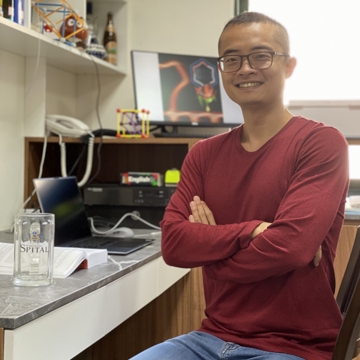
International Presidential Visiting Scholar Fellowship 2023 for Prof. Ming-Hao Liu
The executive board of the University of Regensburg awards Ming-Hao Liu (external link, opens in a new window) (National Cheng Kung University in Tainan, Taiwan) this fellowship for the year 2023. It comprises financial support for a research stay in our group during July, where he will work on Electron Optics in Graphene and on research topics related to SFB 1277. Furthermore, he will give a lecture on Electronic transport in a nutshell: from free electron gas to graphene.
Controlling Quantum Chaos: Optimal Coherent Targeting
(January 13)
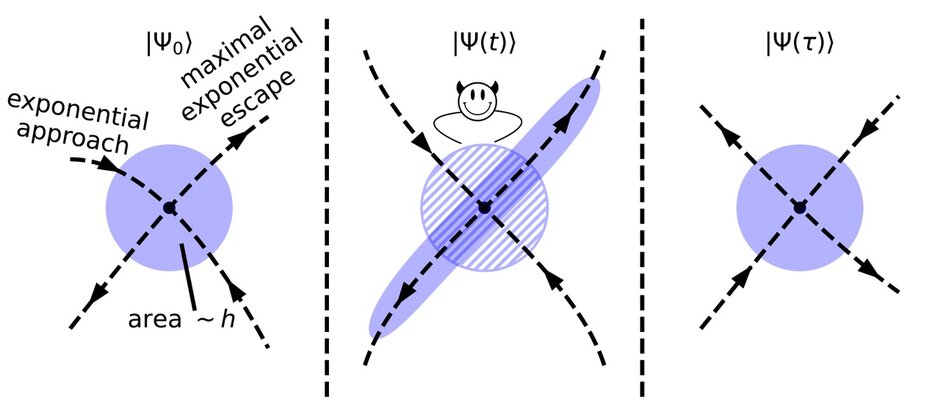
Chaotic dynamics has the propensity to be the villain of quantum device control as it leads rapidly to scrambling of quantum information and entropy production, certainly a fundamental hindrance to controlling quantum evolution. We could show that chaos, conversely, can be harnessed to control and efficiently guide the evolution of a complex quantum system toward desired states of matter, i.e. targeting. In effect, is it possible to mimic a quantum Maxwell demon to some extent.
The work has been published in Physical Review Letters (external link, opens in a new window).