

Compensated Magnets - Properties & Advanced Spintronics (COMPASS)

We are a spintronics research group focused on compensated magnetic materials, ranging from collinear and non-collinear antiferromagnets to emerging altermagnets.

Compensated magnets such as antiferromagnets and altermagnets have great technological potential because they enable ultra-fast THz spin dynamics, high robustness, and non-volatile, neuron-like switching. However, their magnetic order is hardly accessible since the alternating spin structure does not produce macroscopic magnetization. Relativistic spin-orbit effects may open up ways to electrically excite, manipulate, and even read out this order.
Research in our group clarifies the underlying microscopic mechanisms and develops energy-efficient, extremely fast, and novel logic and memory concepts based on them.

News and Highlights

  • Terahertz and DC nonlinear transport in twisted graphene and van der Waals hetero-structures

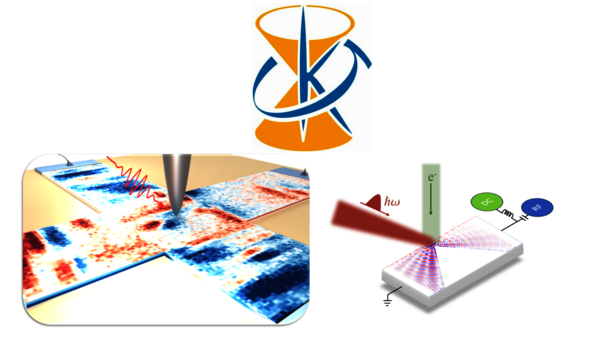
    Recently approved, our new project focus on nonlinear transport phenomena excited by terahertz radiation in twisted bilayer graphene and in 2D transition metal dichalcogenide / graphene bilayer heterostructures. Within this project, we will demonstrate that nonlinear transport can be used as a new and powerful method to access and characterize electronic and spin properties in 2D materials.


    Link to the project in grepis (external link, opens in a new window)

  • DFG-funded Cluster of Excellence “Center for Chiral Electronics” (CCE) 

    The DFG-funded Cluster of Excellence “Center for Chiral Electronics” (CCE) brings together leading researchers from physics and chemistry in Halle (Saale), Berlin, and Regensburg.  CCE will explore the unique potential of chirality in solid-state and molecular systems to develop next-generation electronic technologies.


    CCE webpage (external link, opens in a new window)

Terahertz and DC nonlinear transport in twisted graphene and van der Waals hetero-structures

Recently approved, our new project focus on nonlinear transport phenomena excited by terahertz radiation in twisted bilayer graphene and in 2D transition metal dichalcogenide / graphene bilayer heterostructures. Within this project, we will demonstrate that nonlinear transport can be used as a new and powerful method to access and characterize electronic and spin properties in 2D materials.


Link to the project in grepis (external link, opens in a new window)

DFG-funded Cluster of Excellence “Center for Chiral Electronics” (CCE) 

The DFG-funded Cluster of Excellence “Center for Chiral Electronics” (CCE) brings together leading researchers from physics and chemistry in Halle (Saale), Berlin, and Regensburg.  CCE will explore the unique potential of chirality in solid-state and molecular systems to develop next-generation electronic technologies.


CCE webpage (external link, opens in a new window)

SFB 1277 - Collaborative Research Center

We contribute to the Collaborative Research Center SFB 1277 through two projects: Project B12 investigates magnetic photocurrents in PT-symmetric antiferromagnets, while Project C02 focuses on time-resolved imaging of antiferromagnetic dynamics.


 SFB webpage (external link, opens in a new window)

Antiferromagnetic Neuromorphic Memory (external link, opens in a new window)

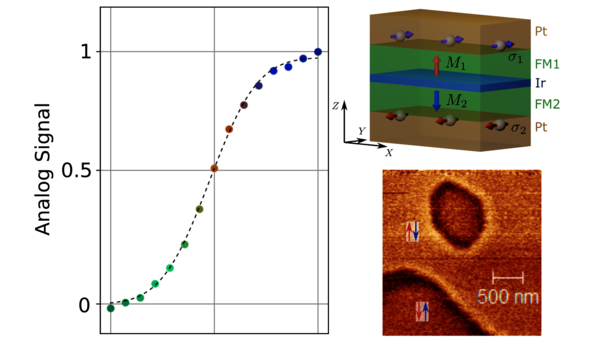
We showed the experimental realization of a nonvolatile antiferromagnetic memory mimicking an artificial synapse, in which the reconfigurable synaptic weight is encoded in the ratio between reversed antiferromagnetic domains. The non-volatile memory is “written” by spin-orbit torque-driven antiferromagnetic domain wall motion and “read” by nonlinear magnetotransport.


 https://www.nature.com/articles/s44306-024-00027-2 (external link, opens in a new window)

Ultrashort spin-orbit torque induced by femtosecond laser pulses (external link, opens in a new window)

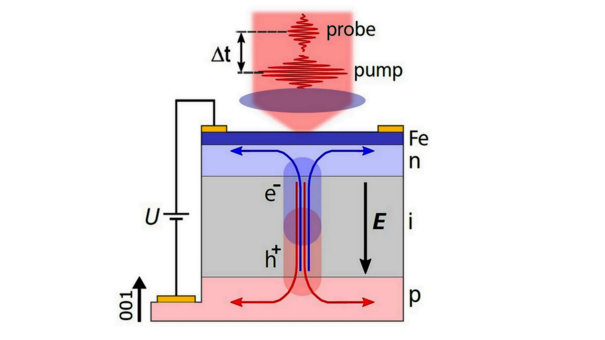
We demonstrate ultrashort spin–orbit torque pulses at an epitaxial Fe/GaAs interface by converting femtosecond laser pulses into high-amplitude current pulses in a biased p-i-n photodiode. This approach enables sub-picosecond current generation, offering a powerful platform to study ultrafast excitation and switching of magnetic order in metallic antiferromagnets.


https://www.nature.com/articles/s41598-022-24808-z (external link, opens in a new window)

To top