

News about the B.Sc. in Business Administration
No news available.
Events related to the B.Sc. in Business Administration
No news available.
Module Overview, Module Catalog, and Examination Regulations
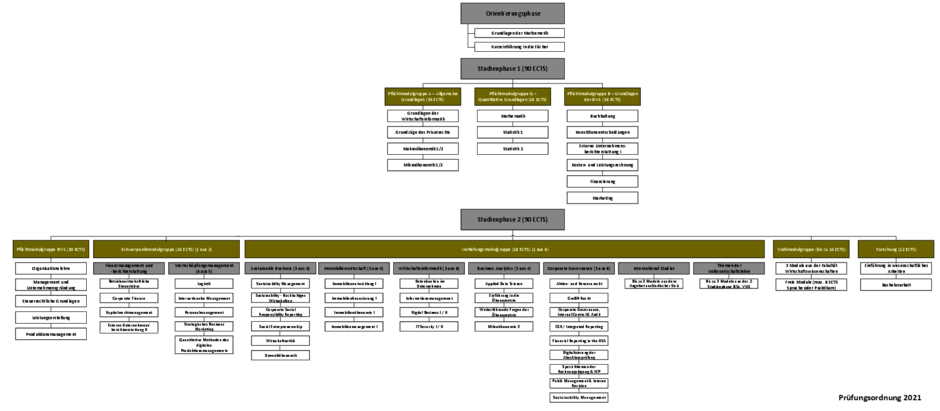
You can find a detailed study plan with recommendations on which modules to take in each semester in the online module catalog. (external link, opens in a new window)
- Program Objectives (opens in a new window). (This PDF is not accessible)
- Online Portals
- Online Course Catalog (external link, opens in a new window)
- Course Catalog (opens in a new window). (This PDF is not accessible)
- Examination Regulations
- Exam Registration and Dates
- Department of Business Administration


Program Structure
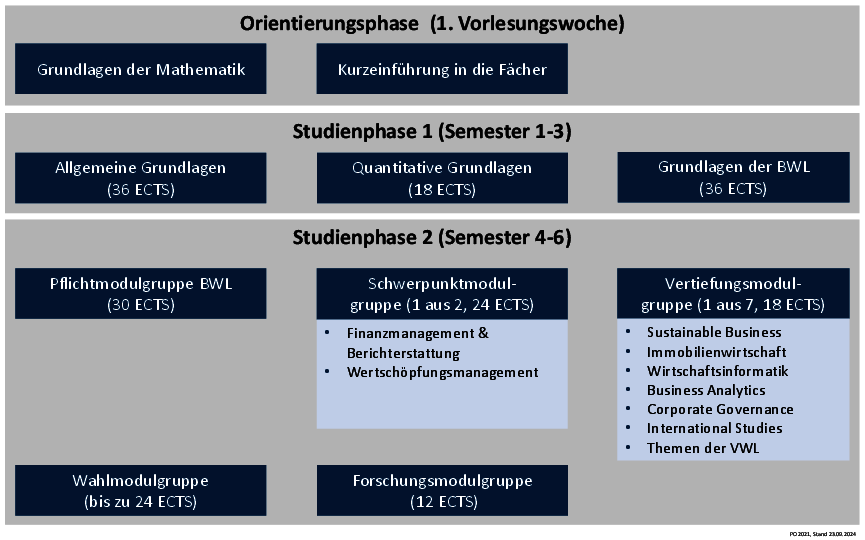
During the orientation phase in the first week of the regular lecture period, you will receive comprehensive information about the B.Sc. in Business Administration, as well as the opportunity to review basic mathematics and a brief introduction to the program’s courses. You can find more information on how to get off to a successful start in your studies here.
The bachelor’s program itself is divided into two phases, each lasting three semesters.
- In the first phase of the program, you will learn the fundamentals of business administration.
- In the second phase, you can deepen your knowledge in your specific areas of interest by selecting a major module and a minor module.
- You will complete the second phase by writing your bachelor’s thesis as part of the research module group.
More information about the B.Sc. Business Administration
Placement and Orientation Exam and Other Important Milestones in Your Studies
“Is the B.S. in Business Administration really the right degree program for me?”
To help you quickly gain clarity on this key issue, there is the Foundations and Orientation Exam. This exam consists of 6 modules totaling 36 credit points (CP), which must be completed in the required module groups “Quantitative Foundations” and “Fundamentals of Business Administration.”
- The Foundations and Orientation Exam must be passed by the end of the second semester.
- If the modules of the Foundations and Orientation Exam have not been passed by the end of the second semester, the Foundations and Orientation Exam is considered failed for the first time.
- It may be retaken once by the end of the following semester. If the modules of the Foundations and Orientation Examination have not been passed by the end of the following semester, the Foundations and Orientation Examination is considered permanently failed.
- A permanently failed Foundations and Orientation Examination also precludes enrollment in another degree program governed by the same examination regulations.
Changing majors does not interrupt the deadline for completing the foundational and orientation exams.
Other milestones during your studies
As part of your bachelor’s degree program, you will need to overcome various challenges in order to earn your degree. To help you stay on track, we have identified several milestones. We have also established criteria to provide you with timely feedback on whether your choice of major is the right one for you.
Incorporating Study Abroad Experiences
During your bachelor’s program, you can spend time studying abroad and have that experience count toward your degree at the University of Regensburg. The following options are available:
- Internship Abroad: You are applying for a corporate internship at a company based abroad. In accordance with the examination regulations, you may also count internships abroad toward your elective module group. You can find more information here.
Studying Abroad: You will spend a semester abroad at a university of your choice, such as one of our partner universities. For more information on how to organize your study abroad experience, click here. The following options are available for transferring credits earned abroad:
- Substitution of a module in the B.Sc. in Business Administration. This requires certification of equivalence by the module coordinator.
- Inclusion in the specialization module (minor) “International Studies”.
- Inclusion in the elective module group.
Be sure to check with the course coordinator before your study abroad to confirm that your planned courses will count toward your degree.
List of foreign credits already recognized
Your course credits will be recognized by the Registrar's Office after your stay abroad.
Recognition of Internships
How are internships credited?
A internship may be credited non-graded for 6 ECTS credits if:
- The internship lasts at least 6 weeks on a full-time basis (consecutively)
- The internship is related to the content of the student's coursework
The request for credit transfer must be submitted to the Economics Department's Registrar's Office no later than the following semester.
Structure of the elective module group
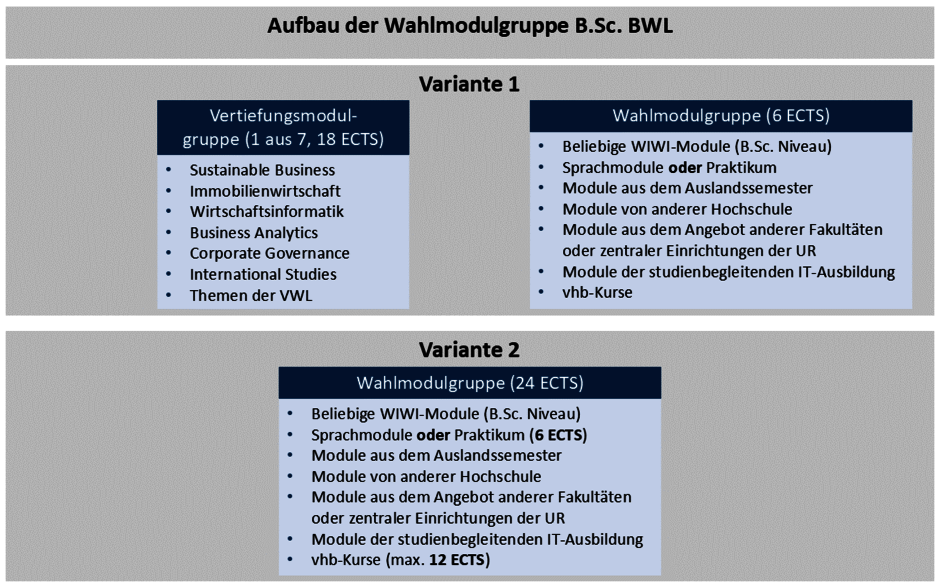
The elective module group in the B.Sc. in Business Administration comprises either 6 or 24 ECTS credits.
If a specialization module group (18 ECTS credits) is taken, the elective module group comprises 6 ECTS credits, which can be chosen freely.
If no specialization module group is taken, the elective module group comprises 24 ECTS credits, and modules from the individual specialization module groups can be included as desired.
Electives for students of business administration (external link, opens in a new window)
Bachelor's Thesis for the B.Sc. Business Administration
Assignment to departments
Assignments to departments for your bachelor’s thesis are handled centrally once a year. The assignment process takes into account both your preferences and the available supervision capacity.
Registration period: November 11 – December 12
Allocation results: Available no earlier than January 25 of the following year
Validity of the assignment: Summer semester and the following winter semester
SPUR Group Registration Portal: Online Registration for Bachelor's Theses in Business Administration (external link, opens in a new window)
- ID: 22668
- Please be sure to assign all five priorities!
Further information: GRIPS: Bachelor's theses in the B.Sc. in Business Administration – Information on assignment (external link, opens in a new window)
Introduction to Academic Writing
In conjunction with your bachelor’s thesis, you will take the module “Introduction to Academic Writing.” The course is offered by the department assigned to you and provides the ideal start to your bachelor’s thesis.
Submission of the Bachelor's thesis
The bachelor’s thesis must be submitted by the deadline in two hard-copy, bound copies to the Economics Examination Office and in electronic form to the examiner. Once submitted, a thesis cannot be withdrawn.
Mailing address
University of Regensburg
Examination Office for Economics
93040 Regensburg
 MCS, Benedikt Helmhagen
Consecutive M.Sc. in Business Administration
Is a bachelor's degree just your first step?
After successfully completing your bachelor’s degree, you will have the opportunity to pursue a master’s degree in business administration, among other options. You can find all the information regarding the application process, requirements, and structure of the M.Sc. in Business Administration here.
Transition between bachelor's and master's programs
To provide flexibility at the transition point between bachelor’s and master’s programs, master’s courses may be taken during the bachelor’s program under certain conditions. Bachelor’s students who have earned at least 150 ECTS credits and have not yet completed their studies may take up to 24 ECTS credits of master’s courses in advance. These advanced credits may not be applied toward the current bachelor’s program. If a student later transfers to a Master’s program in the Faculty of Economics, these advanced credits must be transferred. The number of exam attempts taken directly affects the Master’s program. The exact regulations can be found in the announcement from the Registrar’s Office on the FAQ page.
Contact Persons / Program Coordinators
Study counseling for Business, Economics and Real Estate
- Location: Recht und Wirtschaft, RW(S) 109a
 MCS, Benedikt Helmhagen