

Abstract Body Positivity - A Qualitative Analysis
The trend of body positivity counters the ideal of beauty conveyed by the media. No longer can you only find retouched images of supposedly flawless bodies on social media such as Instagram. This trend movement originated from a feminist-motivated fat acceptance movement in the United States and Canada.
The study examines how influencers present themselves to their followers on their accounts and under the hashtag #bodypositivity, thus reflecting the original idea of the movement. The algorithm was used to select four different influencers who offer a certain diversity in terms of their visual appearance.
This research has methodological components of digital humanities, media studies and cultural studies and draws on humanities and literary studies. Visual self-presentation should convey aspects such as appreciation of the uniqueness, self-acceptance and self-love of one's own body, which enables followers to identify with the influencer and thus accept and appreciate their own body.
The diversity of the movement's concept of beauty is determined through qualitative and quantitative research by looking at and analysing a large amount of data (big data) with regard to the image sections used and their motifs - this represents a contingency and frequency analysis. For this purpose, a category system was created consisting of two main categories and various subcategories. Anchor examples, which were specifically selected, serve to represent the individual categories. The linguistic translation of visuality conveys its values, which contrast with obsolete ideals of beauty.
Abstract Gender-specific self-staging: Analysing the marketing of ESN fitness products on Instagram
In our project, we analysed the marketing of ESN fitness products on Instagram, particularly with regard to gender-specific differences among fitness influencers. We used digital methods such as scraping, Optical Character Recognition (OCR) and image annotation to gain insights into the behaviour of male and female influencers.
Analysing the Instagram stories of nine accounts (the brand's own channel as well as four women and four men) over the course of a week revealed some interesting findings. The influencers often do not mention the ESN brand directly, but its products such as Designer Whey or Cinnamon Cereal. The audience is assumed to have a clear association of the names with the brand. The products are presented as part of everyday life - often without being labelled as advertising. Around 17.5% of the stories contained the ESN logo, whereby this was mainly posted by male influencers. Men thus focus more on the presentation of the products, while women stage themselves as brand ambassadors.
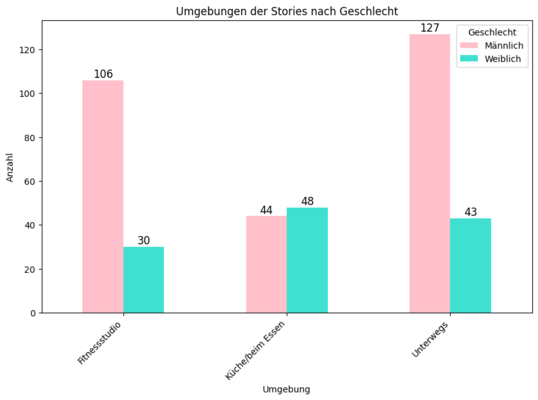
In terms of social interaction, it was found that women showed their faces and hands more often in their stories, with the apparent aim of creating a more personal connection with their followers. Men, on the other hand, tend to show less direct interaction and use social media more as an entertainment medium: they often show themselves more during activities. For example, the study of self-staging revealed that male fitness influencers are more often seen in public spaces, especially in the gym and "on the go", while female fitness influencers post less often from such environments, but - actually quite conservatively - from the kitchen.
This study offers exciting insights into the marketing strategies of fitness influencers for ESN products and illustrates the role of gender and self-staging in social media: our insight into a week in the world of Instagram fitness provided an almost clichéd service of classic role models.
Abstract OpenSea Project
In the age of digitalisation, artists are increasingly turning to technology to market their works online. OpenSea, the largest online marketplace for digital art, has seen rapid growth since its inception in 2017 and had over 300,000 users by 2021 (Kapoor et al. 622). In August 2021 alone, the platform recorded an astonishing trading volume of 3.4 billion US dollars (Kapoor et al. 622). This surge in popularity is due to the emergence of non-fungible tokens (NFTs), which provide unique identifiers for digital artworks. The landmark sale of Beeple's "Everydays: The First 5000 Days" for $69 million at a Christie's auction brought NFTs into the spotlight of the general public and revolutionised artistic expression and commercial exchange in the digital space (Reichert, 2021, 7). This study is dedicated to the unexplored field of NFT art, combining art history with digital humanities tools.
Our aim is to understand the factors that drive the success of NFTs on platforms such as OpenSea, focussing on internal communication and image content. By analysing market and cultural factors, we seek to identify trends and patterns within the NFT ecosystem. The research goes beyond the artwork itself and looks at the descriptions and statistics of the top 300 artists on OpenSea. Three key research questions guide the study: identifying common visual features among the top artists' artworks, determining the most commonly used words to describe and contextualise their art, and exploring the feasibility of training a CNN (Convolutional Neural Network) to detect visual features and trends in NFT art, given the large volume of images.