18th Regensburg Property Law Conference
18th Regensburg Property Law Conference on 25 October 2024
Report by Marcel Paukner:
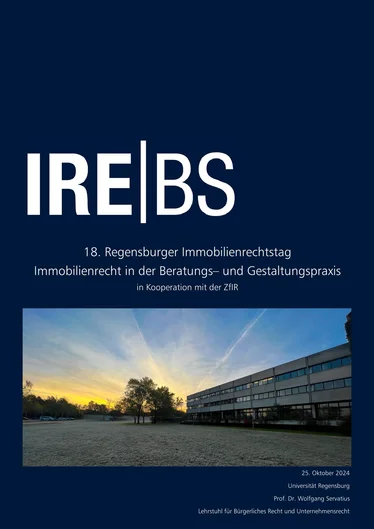
On 25 October 2024, the 18th Regensburg Real Estate Law Conference took place at the University of Regensburg, organised by Prof. Dr Wolfgang Servatius and retired notary Prof. Dr Dr Herbert Grizwotz in friendly cooperation with the ZfIR. Once again, civil law was the focus of the proceedings under the overarching theme ‘Real Estate Law in Advisory and Drafting Practice’.
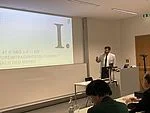
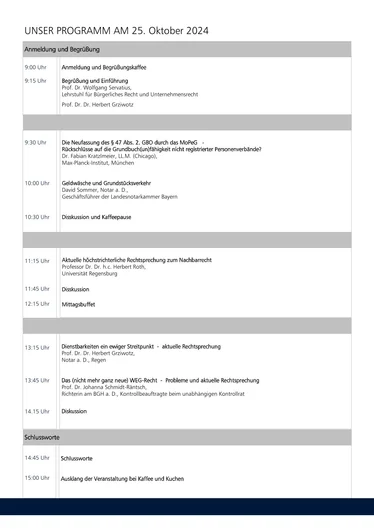
Dr Fabian Kratzlmeier (LL.M. Chicago) from the Max Planck Institute on ‘The revision of Section 47(2) of the Land Register Act (GBO) by the MoPeG – implications for the (in)eligibility of unregistered associations of persons for entry in the land register?’, in which he subjected recent judgements to a critical academic analysis. In addition to outlining the problems resolved and those newly raised by the MoPeG, the speaker also proposed solutions de lege ferenda for other associations of persons. Following a brief overview of the now applicable Sections 705 et seq. of the German Civil Code (BGB) concerning the register of companies, Kratzlmeieraddressed variouscase scenarios, examining the question of whether, in each specific instance, prior registration is required. Finally, the speaker focused his presentation on the question of whether other associations of persons are eligible for entry in the land register. The academically rigorous presentation was received with great interest by the participants. This was followed by an extensive discussion, including the disruptions to the overall system caused by Section 54 of the BGB (new version).
As the scheduled speaker, Notary Dr Holger Sagmeister, was unable to attend, the Managing Director of the Bavarian Regional Chamber of Notaries, retired Notary Dr David Sommer, stepped in as a high-profile replacement to speak on the topic of ‘Money laundering prevention by notaries, particularly in the property sector’. The detailed presentation was brought to life with the speaker’s own practical experience and proved very popular. It became clear that Germany has already taken effective countermeasures de lege lata – particularly when considering the situation several decades ago – and how various systems interact with one another both across Europe and internationally. In doing so, Sommer also highlighted areas where legislative action may be required and addressed outstanding projects of the governing coalition at the time. The lively discussion between the participants and the speakers centred on current (legal) issues relating to the Money Laundering Act (GwG), as well as legal-policy criticism and potential areas for improvement.
After a short break, Prof. Dr Dr h.c. Herbert Roth delivered his division on ‘Current supreme court case law on neighbour law’. In doing so, he addressed the existing dualism in German neighbour law and outlined possible interactions between the areas of law – some rightly and some wrongly assumed – as reflected in supreme court case law. Using selected issues in private law neighbour law as examples, he delved deeply into its legal theory and illustrated it with the aid of several practical cases. Roth concluded his lecture by noting that the factual circumstances are often simple, but the legal assessment is not; whilst drawing a conciliatory conclusion regarding the Federal Court of Justice case law that had been criticised. The ensuing discussion raised several topics, with the issue of renewable energy in particular being raised on multiple occasions.
Following a lively lunch break, retired notary Prof. Dr. Dr. h.c. Herbert Grziwotz took the floor under the heading ‘Easements, a perennial point of contention – current case law’. After an introduction to the law of easements in the *Corpus Iuris Civilis* and the law of immovable property in the *BGB*, which is shaped by German pandectist scholarship, he turned his attention to the sometimes contradictory case law of the Federal Court of Justice (BGH) regarding easements. Following a discussion of the issue of ‘easements of abstention’, he raised the question of whether building encumbrances were suitable as the subject matter of a servitude, referring in the process to recent BGH judgements. He also provided an in-depth analysis of the issues surrounding housing rights and restrictions under public law; towards the end of his lecture, Grziwotz addressed the question of whether a compensatory measure under nature conservation law can be secured by real encumbrances.
The final presentation was delivered by Prof. Dr Johanna Schmidt-Räntsch, a retired judge of the Federal Court of Justice (BGH) and Supervisory Commissioner of the Independent Supervisory Board for the Federal Intelligence Service (BND), under the title ‘The (no longer entirely new) WEG law – problems and current case law’. She began by noting that the amendment to the WEG had brought about a profound dogmatic shift from the previous legal situation. She illustrated this using the civil procedural issue of standing to be sued, according to which the action must now be brought against the association of flat owners (GdWE) itself. The speaker then addressed the case of the ‘failed action for the expiry of the limitation period’, drawing on a recent Federal Court of Justice (BGH) ruling from 2023. She subsequently shifted the focus to structural alterations, referring to a BGH judgement handed down just this year. Schmidt-Räntsch then addressed the issue of challenging a planning permission decision, discussing the divergent views on the matter and the case law of the Federal Court of Justice. Following her final topic, the administration of common property, she provided a brief outlook on possible future amendments to the German Condominium Act (WEG).
This year’s Property Law Day once again demonstrated that academia and professional practice can be brought together in a relaxed and fruitful exchange.

16th Property Law Conference
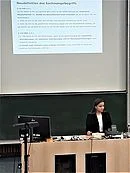
Under the chairmanship of Prof. Dr Wolfgang Servatius and retired notary Prof. Dr Herbert Grziwotz, the 16th Real Estate Law Conference took place on 18 November 2022 in collaboration with the ZfIR. Participants were delighted that the conference could once again be held in person, following a virtual event due to the coronavirus pandemic.
In keeping with the established alternation between civil law and public law, the theme of this year’s conference, ‘Current Issues in Real Estate Law’, focused on private law. The speakers gave presentations under the titles ‘The new estate agency law and provisions in property purchase contracts’, ‘MoPeG, the Transparency Register and the Companies Register – implications for property transactions’, ‘Issues in property development law’, ‘The New Law of Sale’ and ‘Practical Problems Relating to the Requirement for Approval of Declarations of Division, in Particular under Section 250 of the BauGB’, providing a detailed overview of the current state of affairs. The discussions that followed each presentation allowed for an in-depth examination of aspects relevant to practice.
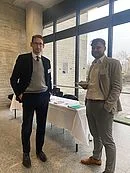
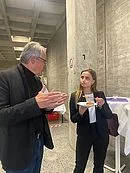

13th Property Law Conference
On 12 October 2018, the University of Regensburg hosted the Regensburg Property Law Conference in the cathedral city for the 13th time. Under the title ‘Current Issues in Real Estate Law’, this year’s event – organised jointly by Prof. Dr Wolfgang Servatius and Notary Prof. Dr Herbert Grziwotz in collaboration with the ZfIR – once again focused on civil law issues relating to real estate law. The speakers addressed, amongst other things, the implications of the new European Matrimonial Property Regime Regulation for property transactions, the latest developments in the field of property development law, and the structuring of property transactions involving people with dementia. The speakers’ contributions, as well as a detailed conference report (ZfIR 2019, 38–40), can be found in the Zeitschrift für real estate law.


11th Regensburg Property Law Conference

11th Regensburg Real Estate Law Conference – Current Issues in Property Transactions
On 14 October 2016, Prof. Dr Wolfgang Servatius, together with Prof. Dr Dr Herbert Grziwotz and in cooperation with the ZfIR, organised the 11th Regensburg Real Estate Law Conference at the University of Regensburg. Under the theme ‘Current Issues in Property Transactions’, this year’s event focused on various issues relating to civil law. As in previous years, renowned experts were invited to speak, and their presentations stimulated subsequent discussion and debate.
10th Property Law Conference
On 9 October 2015, Prof. Dr Wolfgang Servatius, together with Prof. Dr Jürgen Kühling and Prof. Dr Dr Herbert Grziwotz, organised the 10th Regensburg Real Estate Law Conference, the theme of which this year was ‘Real estate transactions at the expense of third parties’. Renowned experts gave presentations and opened the topics discussed up for debate.
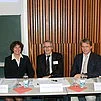
9th Property Law Conference
On 10 October 2014, Prof. Dr Servatius, together with Prof. Dr Dr Grziwotz, organised the 9th Regensburg Real Estate Law Conference, with this year’s focus on situations of imbalance in real estate law. Renowned experts delivered presentations, which formed the basis for subsequent discussions.