

We are working in the fields of theoretical particle physics and computational physics. We are investigating properties of quantum chromodynamics (QCD), the theory of strong interactions. At short distances, quantum effects can be taken into account by perturbative expansion in powers of the strong coupling constant, in a manner similar to quantum electrodynamics.
At long distances, larger than 0.1 fm (about one-tenth the size of the proton), the interaction becomes strong and the theory cannot be accessed by purely analytical methods. Therefore, we simulate it, discretized on a four-dimensional space-time grid, on supercomputers (Lattice QCD).
Research
Particle physics strives to discover physics beyond the Standard Model, which is known to be incomplete. Since quarks are always bound in hadrons — for example, pions (mesons) and protons (baryons) — comparison of experimental results with theoretical Standard Model predictions requires QCD calculations whenever interactions with quarks are encountered. Since baryons are everywhere, it is hard to avoid this, even when we do not intend to probe the quark sector of the Standard Model. We address these multi-scale problems using ab-initio first-principles calculations that do not introduce additional parameters or model assumptions and provide full control over theory uncertainties. This requires perturbative quantum field theory, lattice QCD and effective field theory.
Apart from phenomenology, strongly interacting quantum field theories are exciting from a theoretical point of view, and some of our research goes beyond QCD. For instance, relativistic string theory was invented in 1972/3 (along with QCD) to explain strong interactions. We now understand that super string theories and non-Abelian gauge theories (such as QCD) are closely related. Similarly, Einstein gravity is a non-Abelian gauge theory. Finally, we are continuously developing new methods and tools to gain deeper conceptional insight and to enable more efficient calculations.
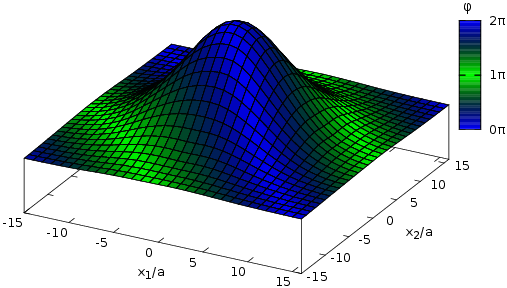
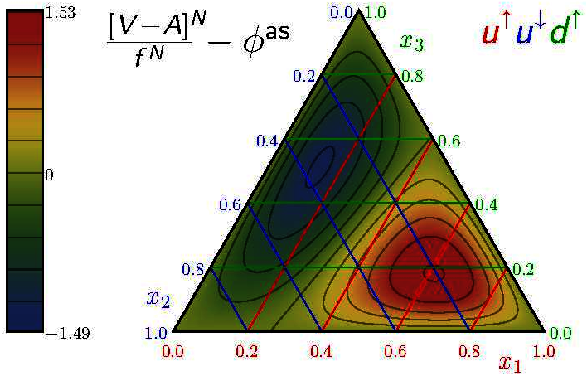
A list of my publications can be found here (external link, opens in a new window). Two publications with pretty pictures are highlighted above.
String breaking
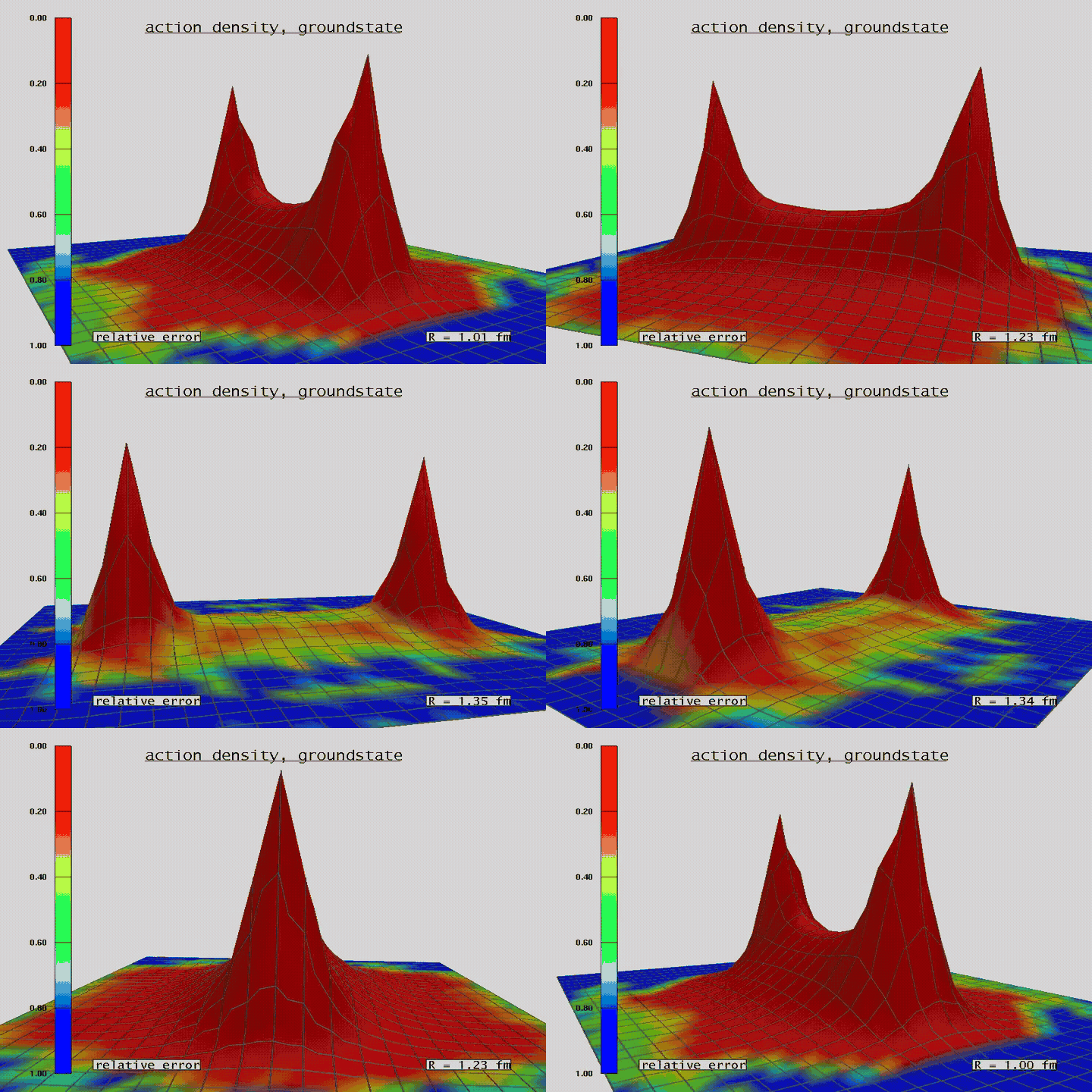
The animation shows what happens to the action density (similar to the energy density) of the gluon field as the distance r between a heavy quark and a heavy antiquark increases. The dipole field of electrodynamics would deeply penetrate into the transverse direction and its energy density at the midpoint would decrease with the fourth inverse power of r, while the force between the charges would decrease with the second inverse power of r. In contrast, in QCD a string-like flux tube forms. This means that the attractive force remains constant as r increases, so the work needed to separate the quark from the antiquark grows linearly with r. At some point, the energy stored in the gluon field becomes large enough to support the creation of a new light quark-antiquark pair, causing the string to break. As a result, the heavy quark-antiquark configuration decays into two heavy-light mesons. However, it is impossible to find a quark in isolation. This is the so-called confinement of colour charges.
Lattice QCD calculations were instrumental in confirming that long-distance QCD gives rise to the phenomena of confinement and the breaking of the so-called (approximate) chiral symmetry of the QCD vacuum. The latter explains why pions are much lighter than protons. We have also confirmed that hadron masses agree with experiment, as was done in QED/atomic physics a century ago.
Teaching
| Winter Semester 2026/27 | Title | Lecturer(s) |
|---|---|---|
| 52416 (external link, opens in a new window) | Quantum Chromodynamics (QCD) | Gunnar Bali |
| 52417 (external link, opens in a new window) | Exercises in Quantum Chromodynamics | Gunnar Bali, Yang Fu |