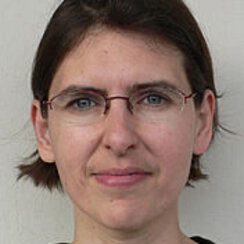
Prof. Dr. Sara Collins

We investigate how the properties of particles like the proton arise from the interactions of their fundamental constituents (quarks and gluons).

We perform numerical simulations of a discrete version of the quantum field theory quantum chromodynamics at supercomputing facilities in the EU.
Prof. Dr. Sara Collins
- E-mail address: sara.collins(at)ur.de (opens your email program)
- Tel: +49 941 943 2014 (starts a telephone call, if your device allows this)
- Location: PHY 4.1.15
Research
Quarks and gluons are always confined inside hadrons such as baryons (including nucleons, i.e. protons and neutrons). Almost all of the mass of known matter in the universe is due to nucleons. However, Standard Model- and to-be-discovered new forces interact with quarks and gluons. My research aims to unveil the structure of nucleons in terms of their quark and gluon degrees of freedom — a necessary step for the discovery of new physics. This is achieved through simulations of quantum chromodynamics on supercomputers (Lattice QCD). Other research interests include newly discovered exotic hadrons containing charm quarks and novel, glue-rich hadrons.
A list of my publications can be found here (external link, opens in a new window).
Teaching
| Summer semester 2026 | Title | Lecturer |
|---|---|---|
| 52402S (external link, opens in a new window) | Quantum Field Theory | S. Collins |
| 52403S (external link, opens in a new window) | Exercises for Quantum Field Theory | S. Collins |
Detailed course information and exercises for the tutorials will be provided on GRIPS (external link, opens in a new window).