
Welcome to our research group at the University of Regensburg, where we investigate fundamental interactions through perturbative Quantum Chromodynamics (pQCD) and precision collider phenomenology.
At the smallest scales of nature, matter and forces are governed by quantum fields whose interactions determine the behavior of elementary particles. Quantum Field Theory provides the fundamental framework for describing these interactions, while perturbative methods allow precise theoretical predictions for high-energy processes. In particular, perturbative Quantum Chromodynamics (QCD) and the Electroweak theory play a central role in interpreting data from modern particle colliders such as the Large Hadron Collider. Achieving the precision required by current and future experiments demands increasingly sophisticated theoretical tools. My research focuses on developing analytic and computational methods for multi-loop and multi-leg calculations in perturbative QCD and Electroweak theory, the computation of Feynman integrals, the study of threshold corrections and resummation, and their applications to collider phenomenology.
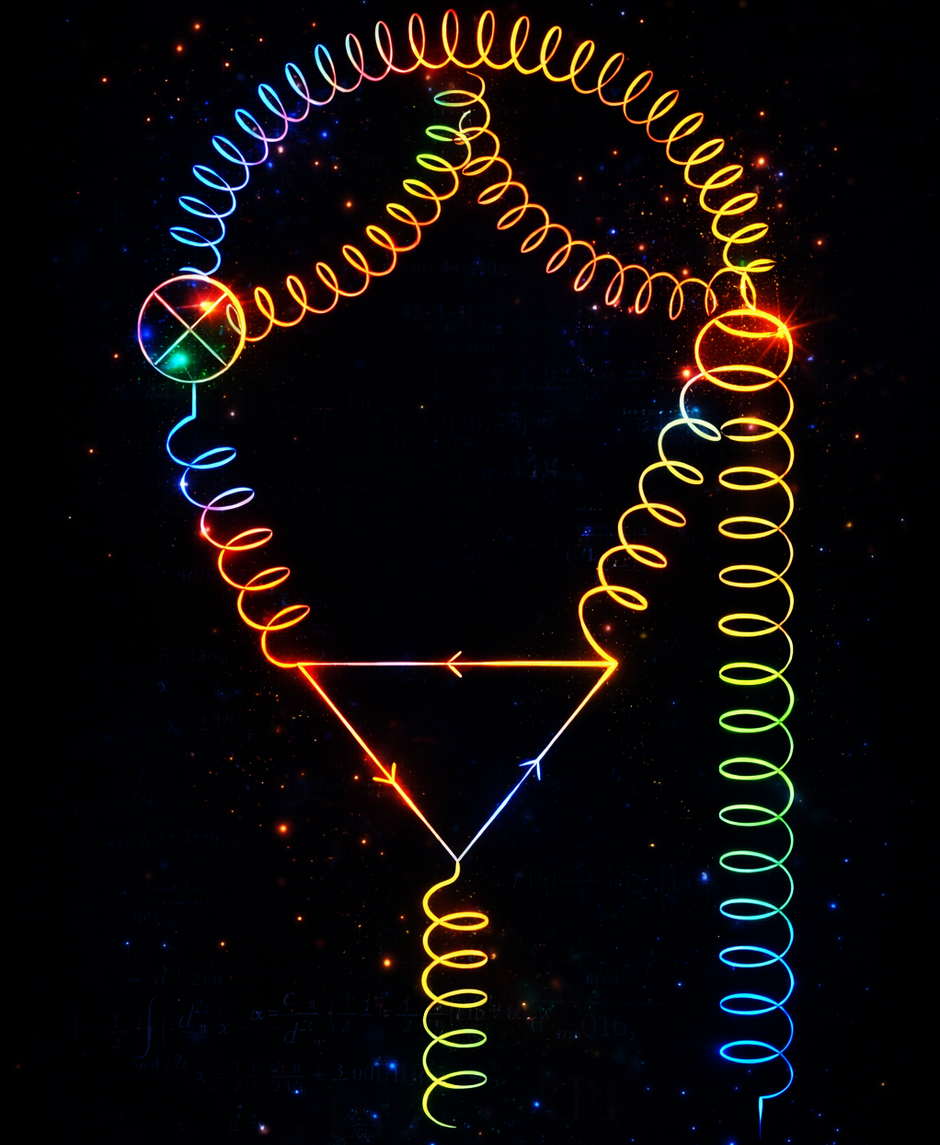
Our core research is centered on modern approaches to scattering amplitudes, where we refine and transcend the traditional Feynman diagrammatic framework using advanced analytic and computational techniques.
These techniques are not only mathematically elegant but also reveal deep underlying structures such as hidden symmetries and unexpected connections between different physical theories. As a result, they play a central role in advancing our understanding of quantum field theory itself.
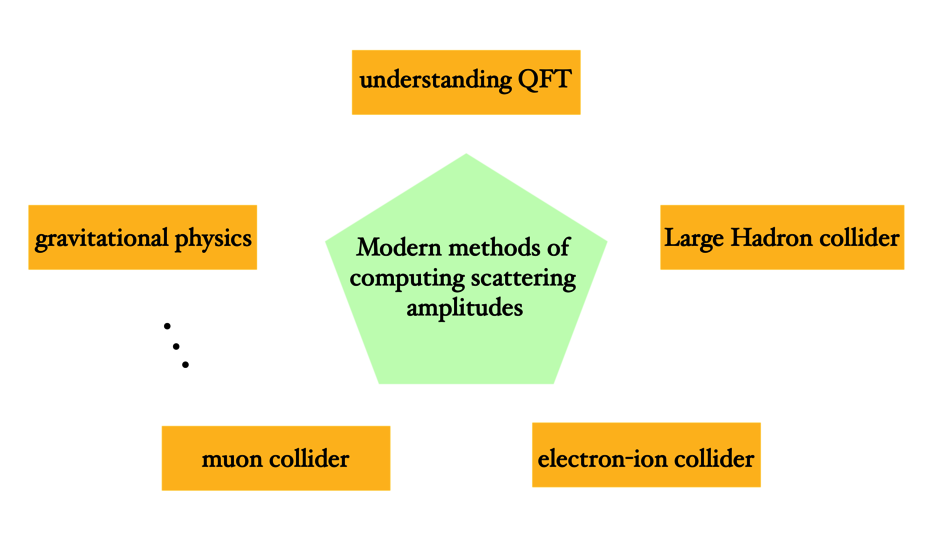
At the same time, these methods have direct impact on a wide range of physical applications. They are essential for high-precision predictions at the Large Hadron Collider (LHC), and are increasingly important for future experimental programs such as the electron–ion collider and proposed muon colliders. Beyond particle physics, they have also found remarkable applications in gravitational physics, including new ways to compute gravitational interactions.
Overall, modern amplitude methods form a unifying bridge between fundamental theory and experiment, connecting abstract developments in QFT with real-world collider physics and gravitational phenomena.
News: April 2026
Research Grant Awarded: MIT – UR Seed Fund
We are pleased to announce that our research team has been awarded a grant from the MIT Global Seed Funds under the MIT–Germany – University of Regensburg Seed Fund program.
The project, titled
“Exploring Non-Smooth Large-$N$ Behaviour in Quantum Field Theories via Mellin–Barnes Techniques,”
has been awarded.
This project brings together Prof. Hong Liu from Massachusetts Institute of Technology and me, along with my team members, Syed Mehedi Hasan and Andreas Rapakoulias.
The project aims to advance the understanding of non-smooth phenomena in large-$N$ quantum field theories using advanced analytic methods such as Mellin–Barnes representations.
We look forward to the exciting developments that will emerge from this collaboration.
Jan 2026
We are pleased to announce that Andreas Rapakoulias has received an offer for his first postdoctoral research position at Southern Methodist University, USA. Congratulations to him, and we wish him every success in this next stage of his career.