

- Multi-loop and multi-leg calculations in perturbative QCD & Electroweak theory
- Computations of Feynman integrals
- Threshold correction and threshold resummation
- Collider Physics phenomenology
- Cosmological Correlators
Phase-space integrals using Mellin-Barnes Representation
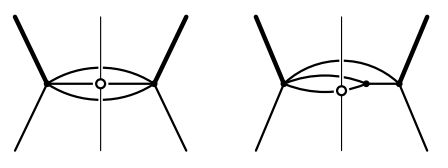
The analytic computation of scattering cross sections at high perturbative orders in quantum field theory is a cornerstone of modern collider phenomenology. With the increasing precision of experimental data from facilities such as the Large Hadron Collider (LHC) and future colliders, such as the Electron-Ion Collider (EIC), there is a strong demand for equally precise theoretical predictions. Such predictions require the evaluation of both virtual and real-emission contributions at next-to-leading order (NLO), next-to-next-toleading order (NNLO), and beyond. While the last two decades have witnessed tremendous advances in the analytic and numerical evaluation of multi-loop Feynman integrals for virtual amplitudes, the treatment of real-emission phase-space (PS) integrals—particularly their angular components—has progressed more slowly despite their equal physical importance. We develop a new analytical method to compute phase-space integrals in terms of analytic functions, such as multiple polylogarithms.
Phase-space integrals in dimensional regularization factorize into radial and angular parts in a suitably chosen reference frame. While the radial part depends on the details of a given scattering process, the angular part is universal and can be expressed in a process-independent form. Remarkably, these angular integrals can be rewritten in terms of propagator-like structures, allowing them to be systematically classified according to the number of denominators. As this number increases, the complexity of the integrals grows, in close analogy to multi-loop Feynman integrals. Such integrals arise ubiquitously in higher-order perturbative calculations. Depending on the number of real emission particles, which is governed by the perturbative order under consideration, the number of required denominators changes. We employ Mellin–Barnes (MB) representation to tackle these angular integrals, enabling their solutions to be expressed in terms of multiple polylogarithms or iterated integrals.
In recent publications, we have successfully computed angular integrals with three and four denominators. These results required the evaluation of six- and seven-fold Mellin–Barnes integrals, which we expressed analytically in terms of Goncharov polylogarithms (GPLs). To the best of our knowledge, this represents the first instance where such high-fold MB integrals have been solved analytically in terms of known special functions. We applied this novel method to solve the phase-space integrals required for NNLO QCD semi-inclusive deep inelastic scattering, a very important scattering process at the upcoming EIC.
Our approach is both algorithmic and scalable, making it a powerful tool for precision calculations. Its applicability extends well beyond angular phase-space integrals, offering new possibilities for tackling a wide class of problems in perturbative quantum field theory.
For further details, check out
Phys.Rev.D 112 (2025) 5, L051903 (external link, opens in a new window) (Letter)
Phys.Rev.D 112 (2025) 1, 014020 (external link, opens in a new window)
https://doi.org/10.1007/JHEP11(2025)152 (external link, opens in a new window)
Feynman integrals with massive particles
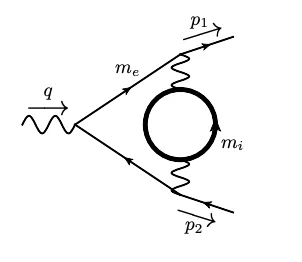
In high-energy particle physics, precise theoretical predictions require the evaluation of Feynman integrals, which describe quantum effects in scattering processes. These calculations become particularly challenging when heavy particles, such as massive quarks, appear inside quantum loops. In such cases, the mathematical structure of the integrals becomes significantly more complex and often goes beyond standard functions.
A striking feature of these problems is the emergence of elliptic integrals, which represent a new level of mathematical complexity compared to traditional approaches. These integrals arise naturally in multi-loop calculations involving multiple energy scales, and these can be connected to non-trivial geometries.
Our research focuses on developing analytic methods to compute these challenging Feynman integrals. By systematically identifying and solving the underlying structures—including elliptic contributions—we obtain precise results that are essential for understanding processes at the Large Hadron Collider. We apply the results of these integrals to compute scattering amplitudes to higher order in perturbation theory.
https://doi.org/10.1007/JHEP05(2024)064 (external link, opens in a new window)
https://doi.org/10.1007/JHEP12(2025)106 (external link, opens in a new window)
https://doi.org/10.1007/JHEP01(2024)010 (external link, opens in a new window)

How Quarks and Gluons Build Mass: A Renormalization-Group Invariant Perspective
Understanding the origin of hadron masses requires a consistent separation of quark and gluon contributions from the QCD energy-momentum tensor (EMT). However, this decomposition is inherently ambiguous due to renormalisation and scheme dependence.
We construct a general class of quark and gluon EMTs whose traces are invariant under the renormalisation group, ensuring scale-independent and physically meaningful matrix elements. We show that many existing decompositions arise as special cases within this framework and identify a preferred definition corresponding to a minimal modification of the standard MS scheme.
Applying our formalism, we compute quark and gluon contributions to the proton and pion masses up to four-loop order. The resulting RG-invariant decomposition eliminates scale dependence and provides a more robust interpretation of the mass structure of hadrons, even in the non-perturbative regime.
https://doi.org/10.1007/JHEP01(2023)077 (external link, opens in a new window)