


Previous News and Highlights

2025

Band structure calculations on a laptop (external link, opens in a new window)

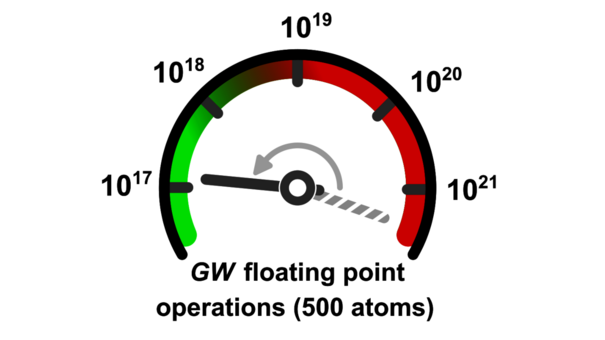
The GW approximation is the state-of-the-art Green’s-function method for calculating band structures beyond density-functional theory. We developed an atomic-orbital GW algorithm that enables band structure calculations of 2D crystals on a laptop, available open-source in CP2K and orders of magnitude faster than conventional plane-wave GW algorithms.


Physical Review B 112, 205130 (2025) (external link, opens in a new window) (selected as Editor's Suggestion)

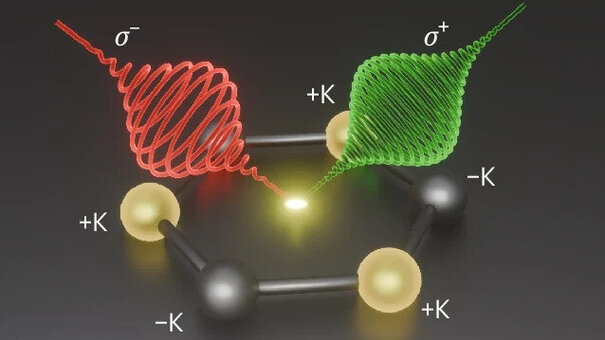
Probe of Broken Time-Reversal Symmetry with Second Harmonics (external link, opens in a new window)

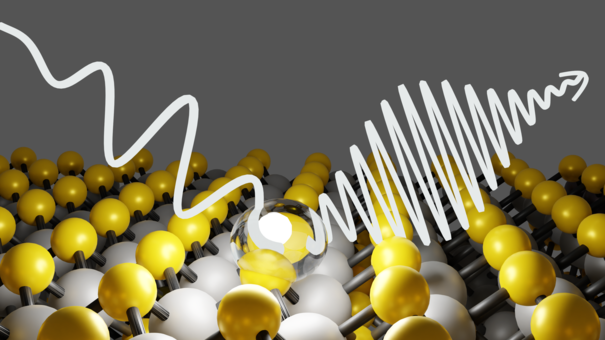
Symmetries are a fundamental constituent of condensed matter physics. Led by G. Soavi (Uni Jena), we developed an ultrafast optical method to detect broken time-reversal symmetry (TRS), i.e. differences of the band structure between crystal momenta +k and -k. Our theory reveals the mechanism of TRS breaking and detection.

 
Nature Photonics 19, 300 (2025) (external link, opens in a new window)

2024

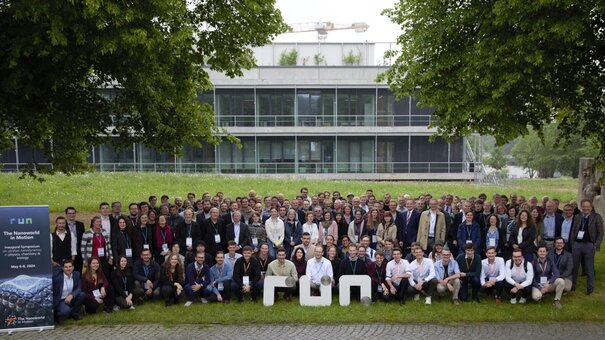
Opening of the Regensburg Center for Ultrafast Nanoscopy (external link, opens in a new window)

The Regensburg Center for Ultrafast Nanoscopy (RUN) celebrated its grand opening with an inauguration event that featured the interdisciplinary symposium "The Nanoworld in Motion" and a Science-Music crossover concert.


More details: RUN press release (external link, opens in a new window)


Find us in RUN, offices 1.12, 1.14 & 1.15!

Accelerating electronic band structure calculations by a factor > 10000 (external link, opens in a new window)

Interested in calculating the electronic band structure with GW? Check out how to reduce the computation time by 4 (!) orders of magnitude when using an atomic-orbital basis instead of plane waves. Ideal for 2D materials & moiré structures, open-source in the CP2K code.


J. Chem. Theory Comput. 20, 2202 (2024) (external link, opens in a new window)

Near-field optical tunneling emission (NOTE) microscopy (external link, opens in a new window)

Ever imagined capturing chemical reactions with atomic resolution on video? We take a step closer to this vision with ultrafast NOTE microscopy, developed by the group of Rupert Huber. Our TDDFT simulations confirm the mechanism: The NOTE signal is caused by the tunneling current between tip and substrate. 


Nature 629, 329 (2024) (external link, opens in a new window)

LDOS on ultrafast time scales (external link, opens in a new window)

What is the probability of finding an electron with energy E in a material at position r at time t ? It is the time-resolved local density of states (LDOS) ρ(r,E,t) which can be measured by the groups of Rupert Huber and Jascha Repp! Our theory explains ultrafast variations of ρ(r,E,t) by phonons and image charge effects.


Nature Photonics 18, 595 (2024) (external link, opens in a new window)

2023

Braumandl prize for Max Graml (external link, opens in a new window)

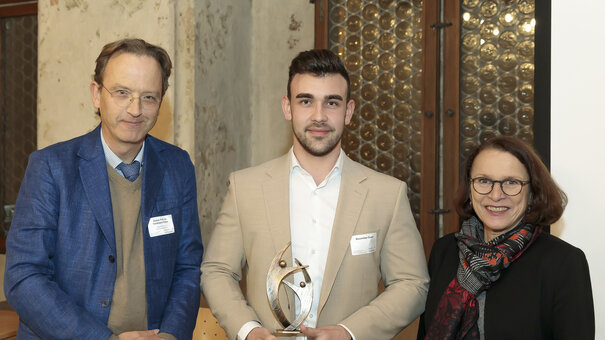
Congratulations to Max Graml for receiving the research prize of the Brigitta and Oskar Braumandl Foundation! The award recognizes Max's outstanding contributions to advancing our understanding of high-harmonic spectra. The prize was awarded in the city hall by Gertrud Maltz-Schwarzfischer, mayor of Regensburg.


Mittelbayerische, 13 November 2023 (external link, opens in a new window).

Improved understanding of high-harmonic spectra (external link, opens in a new window)

For high-harmonic generation, an intense laser pulse is targeted on a substrate producing high-frequency radiation. We derive a transparent analytical formula that describes the relation between laser pulse parameters and peak positions in the high-harmonic spectrum.


Physical Review B 107, 054306 (2023) (external link, opens in a new window) (selected as Editor's Suggestion)

2022

Funding within the Emmy Noether Programme (external link, opens in a new window)

We are very happy to receive funding within the Emmy Noether Programme of the German Research Foundation (Deutsche Forschungsgemeinschaft, DFG). In the project, we will analyze ultrafast exciton dynamics using first-principles simulations.


Link to the project in gepris (external link, opens in a new window)

Highly conductive single-molecule topological insulators (external link, opens in a new window)

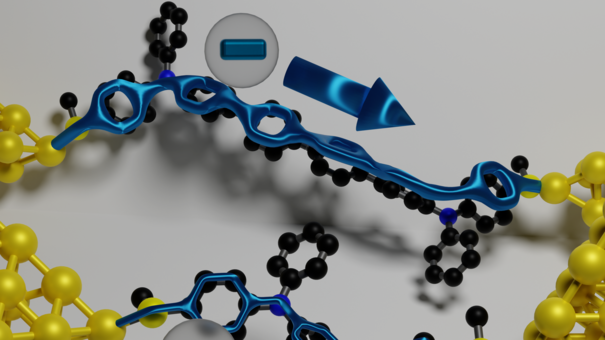
Researchers in Prof. Venkataraman's group (Columbia University, New York) have built organic topological-insulator wires. Longer wires show an unusual increase in conductance. Our theoretical models support an interpretation of this finding based on topology.


Nature Chemistry 14, 1061 (2022) (external link, opens in a new window)

2021

Topological high-harmonic generation (external link, opens in a new window)

Together with the groups of Rupert Huber, Klaus Richter and Ulrich Höfer, we describe a novel generation mechanism of high harmonics in the surface state of a topological insulator.


Nature 593, 385 (2021) (external link, opens in a new window)

Popular & Outreach

To top