

Ultrafast Electron Dynamics
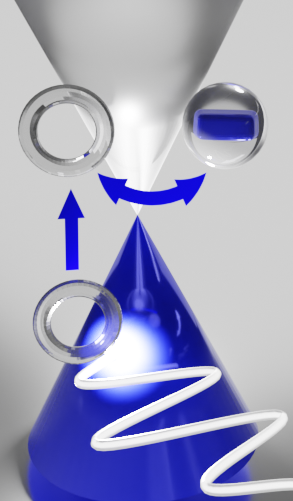
Recent advances in laser technology allow the generation of high-intensity, ultrashort laser pulses that drive electrons in solids on attosecond timescales. When such a pulse interacts with a material, the electric field accelerates the electrons and induces complex ultrafast dynamics whose fingerprints appear in the emitted light spectrum. These spectra often contain rich but non-intuitive signatures that require theory and simulation for interpretation.
Our group develops and applies theoretical and computational approaches to understand these ultrafast processes. Using our open-source code CUED (external link, opens in a new window)[1], we simulate real-time electron dynamics in solids to interpret and predict experiments such as second- and third-harmonic generation [2,3] (in collaboration with the group of Giancarlo Soavi, University of Jena) and high-harmonic generation [4,5] (in collaboration with the group of Rupert Huber, University of Regensburg).
We also use analytical frameworks for describing the nonlinear response of materials to ultrashort laser pulses. These methods provide compact analytical formulas for:
- Second- and third-harmonic generation in 2D materials [2,3], enabling ultrafast readout of band occupations and suggesting paths toward future light-wave electronics with terahertz-to-petahertz operation rates.
- High-harmonic generation spectra and their dependence on the carrier-envelope phase [5].
Because analytical models rely on approximations such as power-series expansions, we systematically validate them through first-principles simulations (see also Development of Green’s function methods for electronic excitations and electron dynamics). We aim to analyze the microscopic mechanisms behind ultrafast optical phenomena and to help understand experimental observations. Our theoretical work often guides the interpretation of measurements, in close collaboration with experimental groups in ultrafast optics and nanoscience [6].
[1] J. Wilhelm, P. Grössing, A. Seith, J. Crewse, M. Nitsch, L. Weigl, C. Schmid, F. Evers: Semiconductor Bloch-equations formalism: Derivation and application to high-harmonic generation from Dirac fermions, Physical Review B 103, 125419 (2021). (external link, opens in a new window)
[2] P. Herrmann, S. Klimmer, T. Lettau, T. Weickhardt, A. Papavasileiou, K. Mosina, Z. Sofer, I. Paradisanos, D. Kartashov, J. Wilhelm and G. Soavi, Nonlinear valley selection rules and all-optical probe of broken time-reversal symmetry in monolayer WSe2, Nature Photonics 19, 300-306 (2025) (external link, opens in a new window).
[3] F. Friedrich, P. Herrmann, S. S. Shanbhag, S. Klimmer, J. Wilhelm, G. Soavi, Measurement of optically induced broken time-reversal symmetry in atomically thin crystals, Nature Photonics (2025)
[4] C. P. Schmid, L. Weigl, P. Grössing, V. Junk, C. Gorini, S. Schlauderer, S. Ito, N. Hofmann, D. Afanasiev, J. Crewse, K. A. Kokh, O. E. Tereshchenko, J. Güdde, F. Evers, J. Wilhelm, K. Richter, U. Höfer, R. Huber, Tunable non-integer high-harmonic generation in a topological insulator, Nature 593, 385-390 (2021) (external link, opens in a new window)
[5] M. Graml, M. Nitsch, A. Seith, F. Evers, J. Wilhelm, Influence of chirp and carrier-envelope phase on noninteger high-harmonic generation, Physical Review B 107, 054305 (2023). (external link, opens in a new window)
[6] Nature Chemistry 14, 1061-1067 (2022) (external link, opens in a new window), Nature 628, 329 (2024) (external link, opens in a new window), Nature Photonics 18, 595 (2024) (external link, opens in a new window)
Development of Green's function methods for electronic excitations & electron dynamics
Understanding ultrafast phenomena requires not only time-dependent simulations but also highly accurate quasiparticle energies and excitations. The GW approximation, a Green’s function–based many-body method, provides a state-of-the-art description of electronic band structures and excitations in solids. It accounts for electron–electron interactions beyond density functional theory by evaluating the electronic self-energy from the one-particle Green’s function (G) and the dynamically screened Coulomb interaction (W). Such calculations are essential for predicting band gaps, level alignments at interfaces, and exciton binding energies, quantities that strongly influence light–matter interaction and ultrafast optical response.
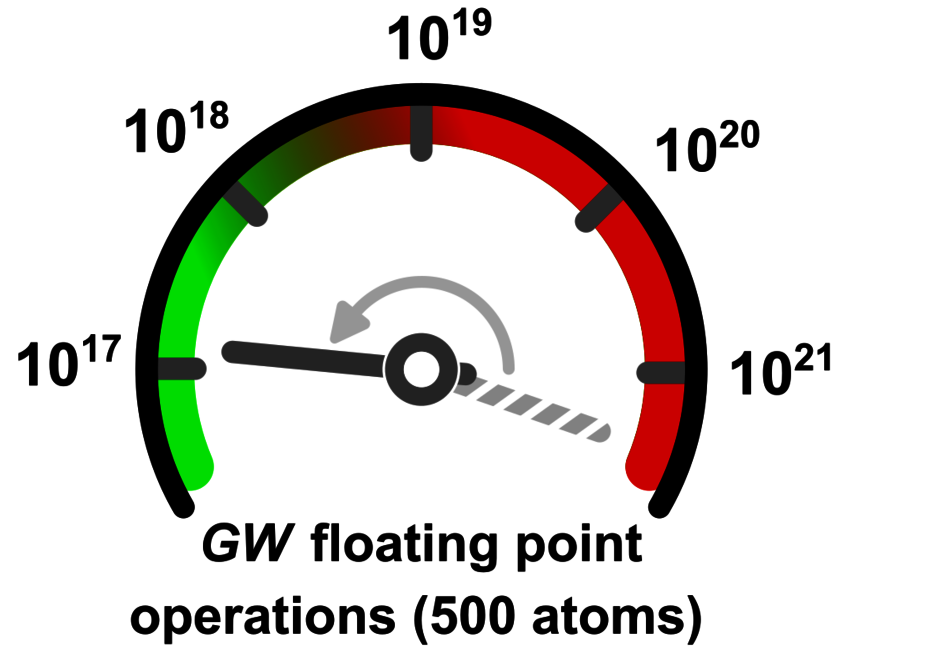
Conventional GW implementations scale steeply with system size and require today’s largest supercomputers for systems containing more than a few hundred atoms. This limits their use for realistic nanostructures, interfaces, and materials with defects, such as tailor-made graphene nanostructures for all-carbon electronics [7] or complex two-dimensional heterostructures [8]. Our group develops low-scaling GW algorithms [7,8] that reduce the computational cost to O(N²) with system size N. For two-dimensional materials, we demonstrated that this enables GW calculations up to five orders of magnitude faster than conventional approaches [8]. These developments make quasiparticle calculations feasible for thousands of atoms and open the door to quantitative studies of nanoscale materials previously out of reach. The algorithms are implemented in the open-source package CP2K, and their accuracy and efficiency are highlighted in community publications [9,10].
Looking ahead, we aim to extend these low-scaling concepts to the Bethe–Salpeter equation for excitons [11] and to real-time simulations of ultrafast electron dynamics [12], bridging the gap between quasiparticle theory and attosecond-scale phenomena.
[7] J. Wilhelm, D. Golze, L. Talirz, J. Hutter, C. A. Pignedoli: Toward GW calculations on thousands of atoms, The Journal of Physical Chemistry Letters 9, 306-312 (2018). (external link, opens in a new window)
[8] M. Graml, K. Zollner, D. Hernangomez-Perez, P. E. Faria Junior, J. Wilhelm, Low-scaling GW algorithm applied to transition-metal dichalcogenide heterobilayers, Journal of Chemical Theory and Computation 20, 2202 (2024) (external link, opens in a new window).
[9] T. D. Kühne, M. Iannuzzi, et al.: CP2K: An electronic structure and molecular dynamics software package - Quickstep: Efficient and accurate electronic structure calculations, Journal of Chemical Physics 152, 194103 (2020). (external link, opens in a new window)
[10] M. Iannuzzi, J. Wilhelm, et al.: The CP2K Program Package Made Simple, Journal of Physical Chemistry B (2025)
[11] M. Graml, J. Wilhelm, Optical excitations in nanographenes from the Bethe-Salpeter equation and time-dependent density functional theory: absorption spectra and spatial descriptors, arXiv:2510.25658 (2025) (external link, opens in a new window)
[12] Š. Marek, J. Wilhelm, Linear and Nonlinear Optical Properties of Molecules from Real-Time Propagation based on the Bethe-Salpeter Equation, Journal of Chemical Theory and Computation 21, 9814-9822 (2025) (external link, opens in a new window)