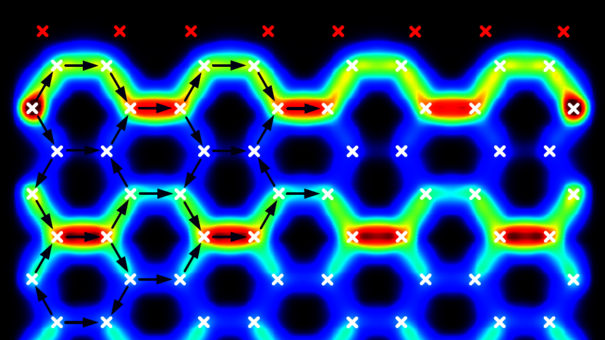
When irradiating solids with a laser pulse of frequency ω, the emitted radiation can feature high-harmonic frequencies nω, n∈N. We simulate high-harmonic generation by electron quantum dynamics to explore exciting physics in exotic materials.
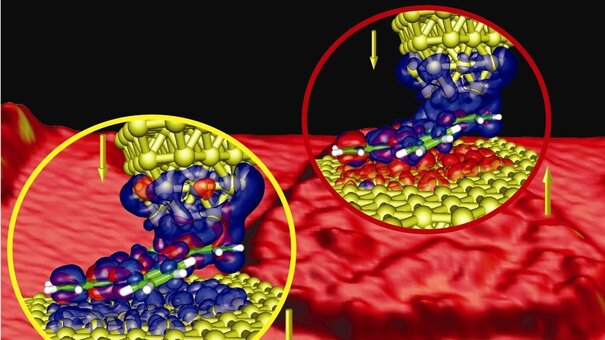
Molecules represent classes of quantum dots that exhibit unique properties. A profound fundamental interest is especially in molecular systems close to instabilities, because the latter tend to leave a pronounced effects on the transport characteristics.
Molecular Materials comprise a broad class of solids including graphene, supramolecular structures and hypothetical metamaterials. Their cooperative properties are rich, tunable and can often be obtained quantitatively with sophisticated ab intio methods.
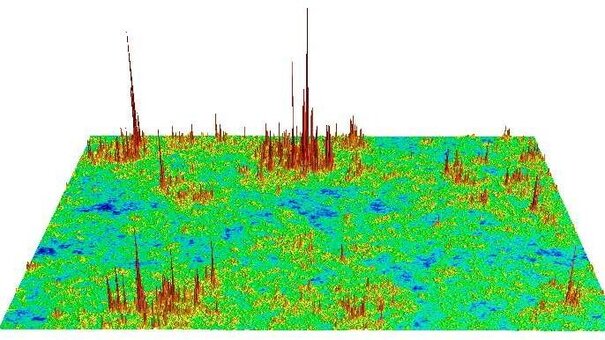
Disorder of some kind is a ubiquitous encounter in any macroscopic solid. From the fundamental point of view it creates novel material classes where interference, quantum phase transitions and the physics of rare events dominate the phase diagrams.
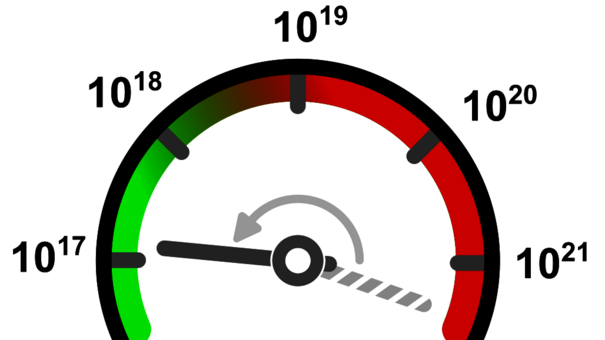
GW is the state-of-the-art method to compute band structures of solids and electronic levels in molecules. Today's largest supercomputers are required, when applying GW to systems with more than hundred atoms. We work on a low-scaling GW algorithm to enable GW for thousands of atoms.
Molecular Materials comprise a broad class of solids including graphene, supramolecular structures and hypothetical metamaterials. Their cooperative properties are rich, tunable and can often be obtained quantitatively with sophisticated ab intio methods.
When irradiating solids with a laser pulse of frequency ω, the emitted radiation can feature high-harmonic frequencies nω, n∈N. We simulate high-harmonic generation by electron quantum dynamics to explore exciting physics in exotic materials.
Disorder of some kind is a ubiquitous encounter in any macroscopic solid. From the fundamental point of view it creates novel material classes where interference, quantum phase transitions and the physics of rare events dominate the phase diagrams.
Molecules represent classes of quantum dots that exhibit unique properties. A profound fundamental interest is especially in molecular systems close to instabilities, because the latter tend to leave a pronounced effects on the transport characteristics.
GW is the state-of-the-art method to compute band structures of solids and electronic levels in molecules. Today's largest supercomputers are required, when applying GW to systems with more than hundred atoms. We work on a low-scaling GW algorithm to enable GW for thousands of atoms.
In order for our website to function technically, we set required cookies. In addition, optional cookies enable the best possible use of the site. By checking the checkboxes you give your consent. You can revoke this at any time. More info about this in our privacy policy.