

We study the building blocks of matter in the universe and the fundamental forces that operate between them. Physicists probe distances as small as 10-15 millimeter - by smashing particles into each other at very high energies at particle accelerators - and as large as 4x10²³ kilometers - by studying the large scale structure of the universe and properties of the microwave background with satellites. And we suspect that these two aspects are closely related!
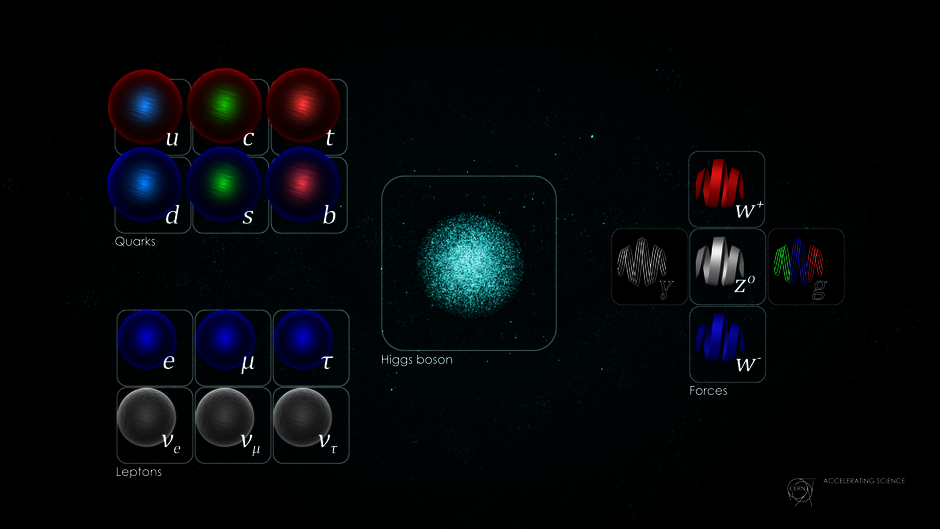
The "Standard Model" of elementary particles has been validated with the discovery of a Higgs-like particle at the Large Hadron Collider at CERN. Yet this theory does not explain the abundance of matter over antimatter around us or the nature of dark matter and dark energy, and what happens with gravity at very short distances where it becomes strong. Revealing these mysteries may require the existence of new fundamental forces and even the modification of the structure of space-time at very small distances.
 CERN
CERN
In Regensburg we provide the theory and analyses relevant to experiments at all major accelerator facilities in the world. The relevant formalism is provided by quantum field theories that are based on the concept of gauge symmetry. Our research is mostly in Quantum Chromodynamics (QCD) - the modern theory of strong interactions. We are working on all aspects of the theory, including analytic perturbative and numerical ab initio calculations, using some of the world's most advanced supercomputers, as well as on more mathematical and conceptional issues. We even develop custom-designed supercomputers for QCD and similar applications.
Our research is supported by the DFG, the BMFTR and the European Union.