

New experiments often require new instrumentation. In our group, we therefore continuously develop and characterize key components of our UTEM, from the electron source to the detector.
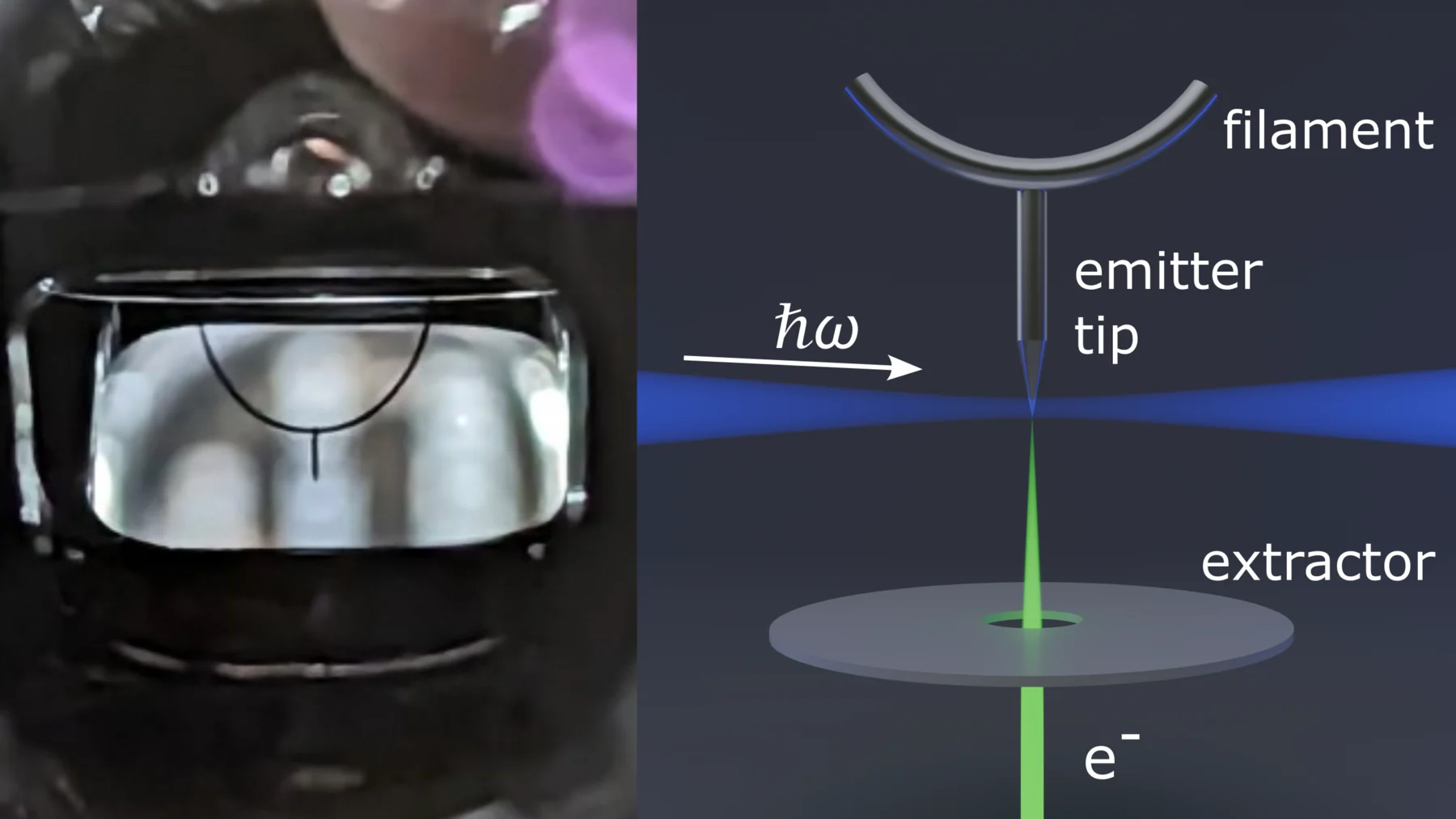
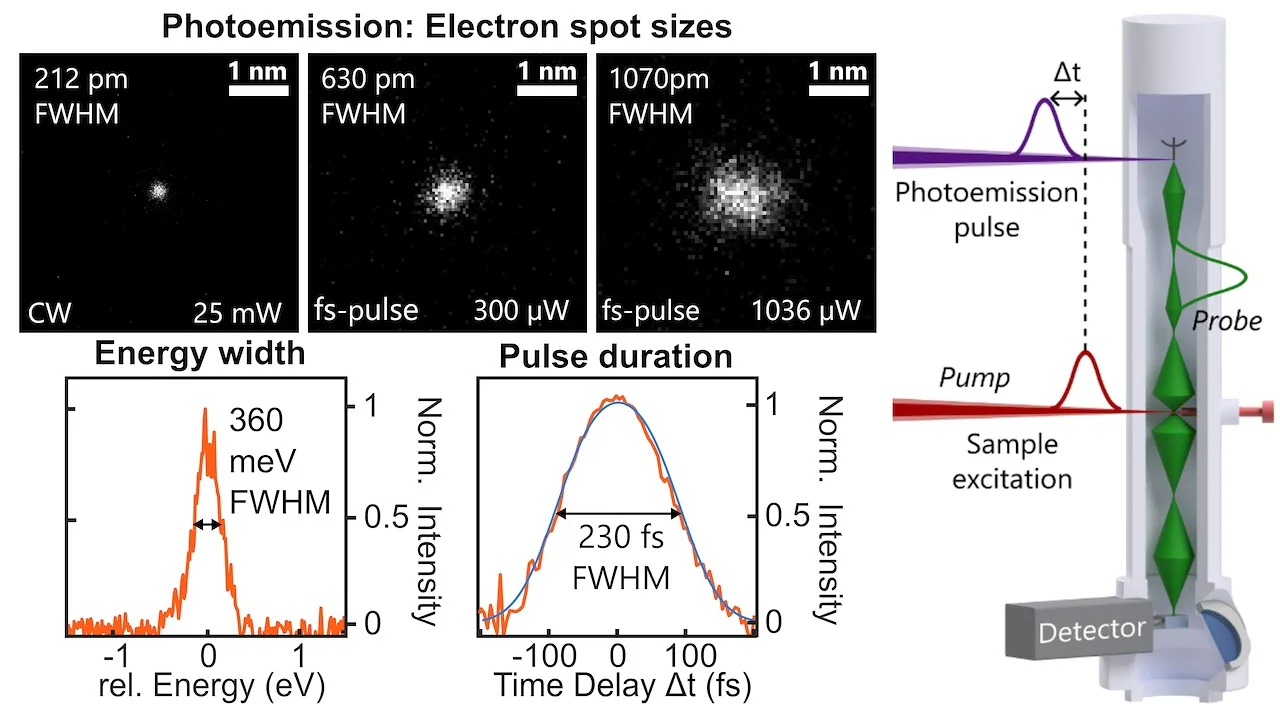
Together with JEOL, we have developed a new pulsed electron source for UTEM. We modified a conventional cold field emission gun (CFEG) so that femtosecond laser pulses focused onto its sharp tip trigger the emission of ultrashort electron pulses. Because the electrons originate from a tiny emission area, the beam is highly coherent: it can be focused to a very small spot, has a narrow energy spread, and the electron pulses are very short. This makes the source ideal for new experiments. In combination with a state-of-the-art aberration corrector, which compensates for imperfections of the electron lenses, the beam can be focused even more tightly. This is a promising route towards ultrafast scanning TEM.
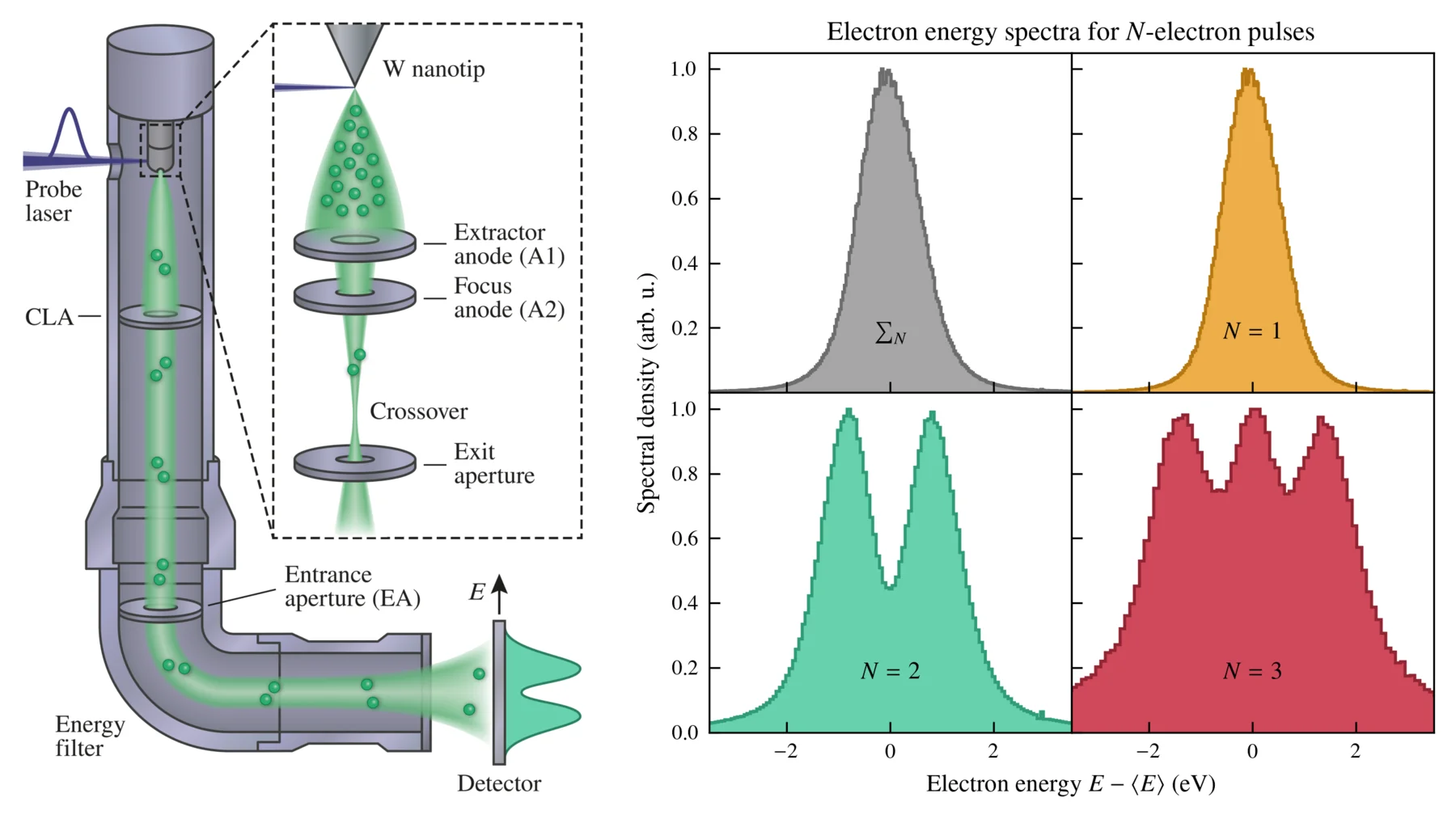
The emission process itself is also of great interest: when several electrons leave the tip within a very short time, they repel each other via the Coulomb force. These so-called space-charge effects change the properties of the pulse and create correlations between the electrons. Using an event-based detector, we can measure these correlations directly. Understanding the emission process and the resulting interactions may allow us to tune electron pulses for specific applications in ultrafast electron microscopy.
Selected Publications
A. Schröder, A. Wendeln, J. T. Weber, M. Mukai, Y. Kohno, and S. Schäfer, ‘Laser-driven cold-field emission source for ultrafast transmission electron microscopy’, Ultramicroscopy 275, 114158 (2025). (external link, opens in a new window)
A. Schröder, C. Rathje, L. van Velzen, M. Kelder, S. Schäfer, ‘Improving the temporal resolution of event-based electron detectors using neural network cluster analysis’, Ultramicroscopy 256, 113881 (2023) (external link, opens in a new window).