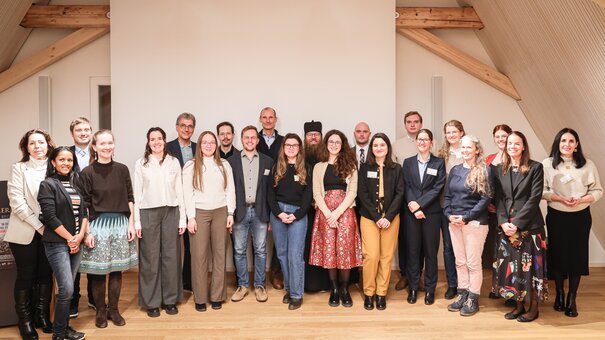

The Chair of Ancient History at the University of Regensburg looks back very positively on its conference on ambiguity in antiquity on 26/27 February 2026. The topics ranged from cults and religions to ambiguity in literary sources and contradictions in politics, representation, gender and identity.
As the Dean of the Faculty of Philosophy, Art History, History and Humanities at the University of Regensburg, Professor Dr Harriet Rudolph, emphasized in her welcoming address, the Haus der Begegnung could literally be taken as a conference venue: Researchers from various fields of classical studies came together here, as did different phenomena of ambiguity in the ancient world.
The topics ranged from cults and religions to ambiguity in literary sources and contradictions in politics, representation, gender and identity. The questions centered on the extent to which ambiguity was perceived in antiquity, when it was irritating or only latent and how contradictions were dealt with productively. It was also important to discuss how antiquity dealt with ambiguous phenomena in comparison to modernity. Important conceptual work was carried out and it was shown that such a research perspective offers a great deal of potential for further investigations and can be applied to a broad spectrum of areas.
After looking at cults in Greece and Rome in the first panel - focussing on the border sanctuary of Oropos, Venus Erycina and the god Mercury - the second panel turned its attention to literary ambiguity. Horatius in Livy and the Persian Great King Xerxes in Herodotus were analysed with regard to contradictions in their person and the ambiguity of their actions and thoughts. Images, genders and identities determined the third panel. While athletes of Greek poleis were able to play with affiliation on various levels, two contributions were dedicated to the question of gender - once in the reception of ancient Rome in modern video games and another time to the person of Sporus as the wife of Emperor Nero.
From an archaeological perspective, the visual ambiguity in the context of the depiction of Hellenistic rulers was studied in more detail on the basis of small bronzes. The contributions in the fourth panel were dedicated to the phenomena and changes in late antiquity. The focus here was on Christian authors, councils and the self-representation of the late antique official aristocracy. On the level of political ambiguity, contributions to the fifth panel examined the oaths in the domestic politics of Greek poleis, the structural similarities and differences between Sparta and Rome, and the challenges of ancient and modern democracies in the face of political contradictions.
Overall, the various topics were discussed in depth, and despite the diversity of the analyzed aspects, numerous conceptual similarities were found. Thus, the conference can point to future projects and provide important impulses for research and teaching.
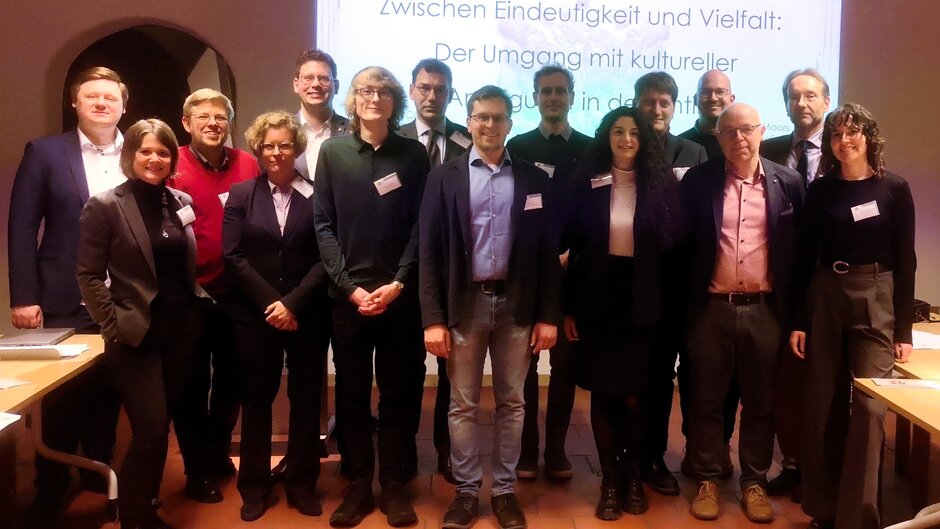 Foto: UR / Maike Baier
 Contacts
Adrian Linz
Ancient History
Faculty of Philosophy, Art History, History, and Humanities University of Regensburg
Mail to: adrian.linz@ur.de