

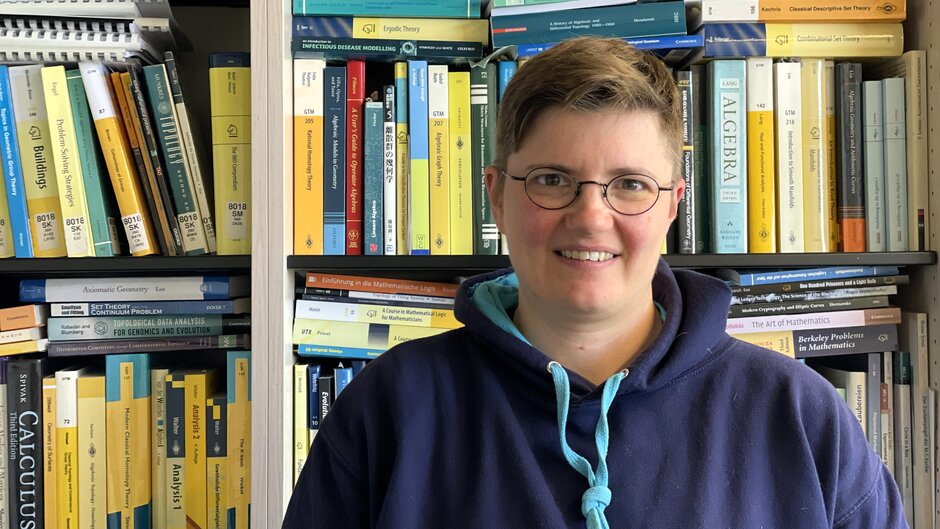
 UR/Tanja Wagensohn
#talktime © 2026, Tanja Wagensohn UR. All rights reserved.
You drop into a dim, moss-covered cavern. Faint green light filters through tangled roots above, and in the background you hear a soft, almost musical hum. You play as Hornet, standing poised with her needle and thread. With a quick leap, Hornet vaults across a gap, her movement fast and almost acrobatic.
When Professor Clara Löh, professor of pure mathematics at the University of Regensburg, wants to relax, Hornet is her friend, Silksong her game. The mathematician enjoys structure, symmetry, hidden connections. Her office at the faculty is neither eerie nor dreamy. Pretty sober, actually. There are packed bookshelves, a desk piled high with manuscripts, and a blue backpack leaning against it. Clara Löh likes paper. In an age when books are becoming scarce, even at universities, paper is a reassuring thing. “In 16 years,” she says, “you collect a lot."
Since 2010, she has been holding her professorship at UR’s Faculty of Mathematics. In mid-May, the German Research Foundation awarded more than 10 million euros for the establishment of a new Collaborative Research Center (SFB 1785 ‘Generalized Motivic Methods in Geometry’), of which she is the designated speaker.
Clara Löh does not need computers for her work. She gives all her lectures on the blackboard. If students are consulting her, she notes directly on paper so they can take the discussion with her home. The entire scientific process though happens in her head. Sometimes, she is busy with research questions for quite a while. “I can sit still a lot,” says the researcher.
Graphs and Groups
The satisfaction comes from seeing how everything connects, and things come together in a completely unexpected way.
Take Graphs, for instance. “They are a simple concept.” A graph has nodes that are connected by edges. Every network is a graph. The internet is a graph. So are the relationships between people or the roads that connect two cities. Depending on your intended use or modeling, a graph must meet certain requirements. An important issue in applications is constructing graphs with certain additional properties – such as particularly robust, large, or small graphs.
Such graphs can be found by exploiting mathematical theories such as group theory: “This introduces a completely different perspective, since group theory is fundamentally concerned with the symmetries of objects. At the same time, these symmetries can be studied in an abstract way and used to construct graphs with specific structural properties, says the mathematician. “If a group has the right characteristics, many of these properties are inherited by the corresponding graphs.”
This makes it possible to systematically construct entire families of graphs that are, for example, highly robust while requiring relatively few connections. “Such structures can be useful in networks where maintaining many connections is costly or logistically difficult,” says Löh. Ideally, the network should remain connected even if individual links fail, rather than immediately splitting into separate components. This illustrates how different areas of mathematics can interact in unexpected ways, says Löh, radiating.
Math and Music
"Mathematics is something beautiful to enjoy". Like Music. Clara Löh is one of many mathematicians who play instruments. “Music complements mathematics. Music is also very structured. But it's interesting when it's not following the pattern. That's how mathematics is." In music, too, "it's great when you can combine different elements." Is mathematics art? “To some degree.”
Music also brought her to mathematics. Clara Löh was not particularly interested in the latter, and her classical secondary school did not emphasize mathematics either. She enjoyed accompanying her friend, who played the violin, on the piano. In ninth grade, her friend participated in math competitions and related activities. That is when she became curious.
Puzzling, finding solutions became something the student loved to do. The Metroidvanian way. Progression is all about finding paths through a beautiful, only slightly hostile world, often with constraints like locked doors or abilities needed.
Fundamental Research and Universities
Clara Löh conducts fundamental research. She deals with theorems, corollaries, and elegant proofs. If you like observing the natural world, you should consider a career in biology.
"Understanding is what distinguishes mathematics from other subjects," says Löh. You have to question everything and then answer the questions. There’s a reason for everything you do. You can understand how everything is derived."
Most enthusiastic makes Clara Löh when things come together that do not really belong together. “Topology is one such area—a very beautiful one. It is a field that describes geometry, though not in the way geometry is taught in school, with lengths and angles.”
The professor is translating the world of groups—which is something very abstract—completely into the geometric world. “By using these topological methods, you can make statements about them that would not be so apparent in a purely algebraic description.”
Useful? Useless?
Does conducting fundamental research make it harder to justify your work? Is usefulness a quality criterion for research? “Increasingly. In Germany, the situation for fundamental research is still very good. In other countries, the pressure is much stronger.” However, fundamental research is not applied science.” Not everything I discover in mathematics is immediately useful.” But what about the holy transfer bible?
Clara Löh is very clear on this. "If I have a concrete application, I start a company. I develop a product, sell it, get rich, and make people happy." But the University also has another function: It explores interesting things! In any case, you never know what's coming.” She pauses to think.
“Take number theory, for example. It was pure; mathematicians were so proud of how pure and theoretical it was. Now, it's used in every cell phone and computer. Suddenly, bang! Something becomes useful.” Clara Löh laughs heartily. “However, the image of what a university can and should be is changing dramatically.”
Research and Teaching
Today, German universities enroll many more high school graduates than in previous years. "This sometimes conflicts with the fact that studying mathematics does not guarantee a specific job," says Clara Löh. “But that only becomes apparent later.” She would prefer fewer students and a stronger focus on the university's core mission. Would the mathematician prefer to do more research and teach less?
The answer is a definite no. Research and teaching are a perfect match for her. “I wouldn't want to separate the two. They belong together. We don't just fill knowledge into students; we interact.” As a researcher, what does she gain from teaching? “When I prepare a lecture, I select material. I think about what's important to me: How do I want to explain things? What are the important principles I want to convey? What are the obvious questions? Thinking about all these things is a valuable step because it informs my research. Sometimes, you can use simple things that you come across in the lecture.”
How students approach questions, what comes easily to them, and what questions arise are important to her. At the same time, she values interacting with her colleagues. Despite being the only woman in a male professorial collegium, she doesn’t perceive herself as a minority. "We have a fantastic, supportive team here, which is really special. For me, it was all very straight forward.”
Breaks
It’s not all about Hornet. Clara Löh still enjoys playing piano and clarinet to relax. Robert Schumann is currently her favorite composer. His music occupies her thoughts to the point that he distracts her when she can’t stop thinking about a mathematical problem. Watching “Boston Legal” or “Firefly” together with her family is helpful as well.
Or reading. The last time the 45-year-old professor moved household, the family had to buy more than 80 meters of additional bookshelves. Clara Löh enjoys reading, crime novels and Science Fiction, “The City and the City “ is among her favorite books. The most recent novel she read was “Qwert” by Walter Moers.
What else? In previous years, she has been learning Japanese. Clara Löh likes Tokyo, even though mountainous landscapes basically attract her more than mega cities. As a child, it was Switzerland and Allgäu, today it‘s Canada or Iceland. “If the Earth is that young, hiking is a completely different story”, she says.
Her free time, Clara Löh spends usually with her family. Her husband is a Haskell expert and studied mathematics like his wife. Does their daughter want to become a mathematician as well? Clara Löh leans back in her chair and folds her hands behind her head. She laughs. Playfully. Mischievously.
The ground beneath Hornet is uneven, dotted with small platforms and pools of glowing liquid. Somewhere ahead, something skitters. An insect enemy lunges from the shadows. Slash, midair bounce, dash away. Combat isn’t slow or cautious; it feels like a dance, fast and fluid.
Website of Clara Löh (external link, opens in a new window)
Website of the CRC 1785 (external link, opens in a new window) ‘Generalized Motivic Methods in Geometry’
Want to know what pure mathematics sounds like? Watch this:
https://www.youtube.com/watch?v=fRJi9Rdx78I (external link, opens in a new window)
https://www.youtube.com/watch?v=c1QjOF-iy6M (external link, opens in a new window)