

#talktime © 2026, Karoline Stürmer UR
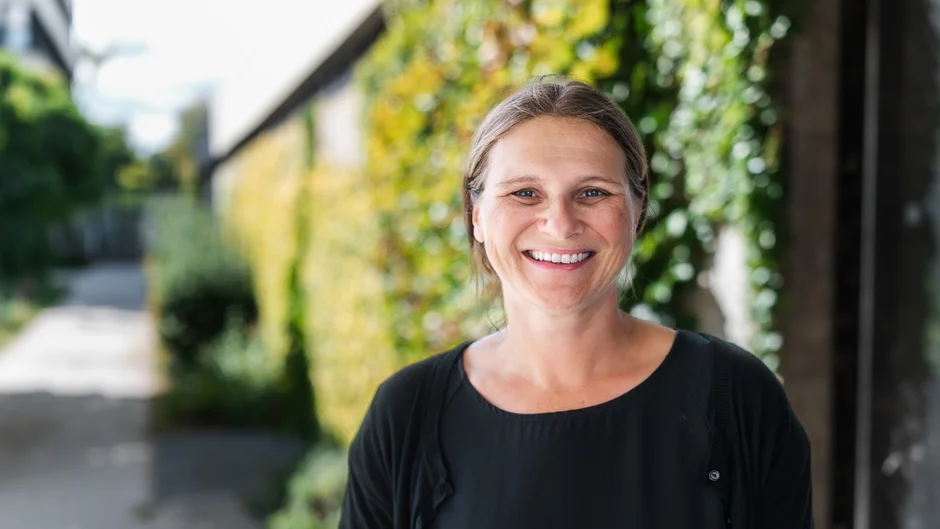
Anyone who meets Agnes Schröder quickly realizes that she loves to get things moving. She speaks openly, thinks in terms of solutions, and gets right to the point. The fact that meetings about research proposals sometimes take place on the sidelines of a soccer field fits her work style: she finds solutions, even when time is tight.
Her workday begins early in the morning so she has time for her children in the evening. Soccer practice, lifeguard duty, homework—there’s a lot that needs to be coordinated. She’s just as pragmatic in the lab. The fact that she still conducts experiments herself today is a given for her. A professorship with primarily administrative duties was never her goal. She doesn’t just want to oversee research—she wants to get her hands dirty. “I absolutely love being in the lab,” she says.
A Passion for Hands-On Research
She laid the foundation for this during her biology studies at Friedrich-Alexander University Erlangen-Nuremberg (external link, opens in a new window). For her doctoral work, she moved to the Department of Nephrology and Hypertensiology. She describes this time as formative. In particular, her collaboration with nephrologist Jens Marc Titze and immunologist Jonathan Jantsch showed her how fruitful different perspectives can be. While the two physicians contributed their clinical and immunological expertise, she developed the experimental concepts and planned the experimental series.
“We were as interdisciplinary as possible,” she recalls. The findings garnered international attention and were published in Nature Medicine (https://doi.org/10.1038/nm.1960 (external link, opens in a new window)), among other places.
Yet her career path could have taken a very different turn. After her first parental leave, she completed an internship at a facility for people with autism. She was so fascinated by the work that she seriously considered becoming a therapeutic educator. An offer from her former boss brought her back to the lab bench.
One Question That Never Let Go
One question from her doctoral studies never left her mind: How does table salt influence the immune system? When Agnes Schröder moved to the University of Regensburg in 2017, she brought this question with her. Whereas she had previously researched the interactions between table salt and immune cells primarily in a nephrological context, she is now investigating, at the Department of Orthodontics at Regensburg University Hospital, what role these mechanisms might play in tooth movement and in inflammatory diseases of the periodontium. For a long time, table salt was primarily regarded as a risk factor for high blood pressure. The fact that sodium also has a direct effect on immune cells is a relatively recent discovery and has opened up new fields of research. To this day, the role that table salt plays in processes within the oral cavity is only partially understood.
What is remarkable is the continuity of her research focus.
While her field of application shifted from nephrology to orthodontics, her scientific interest remained the same over the years: understanding the interactions between sodium chloride and immune cells.
Using an animal model, her research group has already shown that teeth move faster on a high-salt diet. This is an exciting observation for orthodontics. After all, braces rely on the controlled movement of teeth. However, tooth movement is not an exclusively mechanical process. For a tooth to move through the jawbone, remodeling processes must constantly take place in the tissue. Immune cells also play an important role in this. It is precisely these processes that appear to be influenced by sodium chloride. However, the significance of this for patients remains largely unclear. “In orthodontics, there are still an incredible number of questions that no one has investigated yet,” she says.
Her next project is now focused on periodontitis in relation to orthodontic tooth movement in adults. Together with colleagues from various disciplines, she wants to investigate whether and how table salt influences inflammatory diseases of the periodontium. If these connections are confirmed, they could lead to new approaches for prevention and treatment in the long term.
Training the Next Generation of Researchers
For Agnes Schröder, training the next generation of scientists is at least as important as her own research.
“Many dental students don’t really get an in-depth introduction to scientific work until they’re pursuing their doctorate,” says Schröder. That’s exactly where she comes in.
Students working toward their doctorate under her guidance learn not only laboratory work but the entire scientific spectrum: How do you turn an idea into a robust study? Why are control groups necessary? How do you critically evaluate scientific literature? How do you write a publication? For Prof. Agnes Schröder, these questions are just as much a part of the training as clinical skills. She wants to teach her doctoral students how scientific thinking works—not just how to conduct experiments. She is particularly delighted by those moments when students begin to develop their own ideas. “With some of them, you can really see the enthusiasm taking shape,” she says.