

M.A. Multilingualism and regionality (MA_MuR)
You have decided to enrol on the Master's degree programme in Multilingualism and Regionality (MA_MuR) at the University of Regensburg. Welcome to the programme! On these pages you will find extensive information to help you plan and complete your degree programme successfully.
The most important facts in brief
Apply now until 30 June 2026!
You can find more information on the application process under Application and FAQ.
Online information event via ZOOM on 3 June, 4 pm.
You can find more information here (external link, opens in a new window).
MA_MuR is
- research-orientated
- international
- interdisciplinary

This two-year, interdisciplinary Master's programme focuses on the topic of multilingualism research, its current methods, projects and international networks. It gives students a linguistic profile and provides in-depth knowledge of the theory and methodology of empirical multilingualism research.
With its focus on regionality and an integrated one-semester stay abroad at a renowned partner university, it is unique in Germany.
The Master's degree programme is aimed at graduates with a first degree in a BA programme in philology with a focus on linguistics (English language and literature, German language and literature, Romance languages and literature, general and comparative linguistics) who enjoy language and research.
Flyer MA_MuR (PDF) (opens in a new window). (This PDF is not accessible)
Why study multilingualism in Regensburg?
- Dynamic research environment: Regensburg linguistics is currently in a phase of intensive networking across individual philologies and subject boundaries. Initiatives such as the multilingualism and regionality forum and planned structural expansion steps towards an interdisciplinary research training group (including with psychology, DIMAS and information science) are also creating attractive prospects for the time after graduation.
- Diverse academic life: Regular guest lectures, colloquia, exhibitions as well as practical and outreach-orientated projects on living multilingualism in the region (e.g. in the Languages of Origin Forum).
- Regional focus: Special expertise on Eastern and South Eastern Europe, but also on German, English, French, Spanish in the world with a correspondingly broad and extensive range of languages.
- Broad understanding of multilingualism : In terms of content, the Master's programme is deliberately not limited to classic models of bilingual first language acquisition or didactics of multilingualism in schools, but covers a broad spectrum - from languages of origin to migration-related multilingualism in adulthood and minority languages to foreign and second language acquisition.
- Methodological diversity: Broad methodological and theoretical perspectives through the co-operation of numerous professorships and disciplines (cf. "Team").
Team
MA_MuR is a linguistics-oriented degree programme that is supported by the disciplines of German, Slavic, Romance and english linguistics as well as general and comparative linguistics. It also integrates selected aspects of cultural studies and anthropology.
The following chairs and professorships are involved (in alphabetical order):
- Chair of Social Anthropology with a focus on Southeast and East Europe - Prof. Dr Ger Duizings
- Chair of Slavic languages and literature - Prof. Dr Björn Hansen
- Chair of General and Comparative Linguistics - Prof. Dr Björn Hansen
- Chair of German as a second language - Prof. Dr Rupert Hochholzer
- Chair of Romance Cultural Studies - Prof. Dr Ralf Jünkerjürgen
- Professorship for Computational Linguistics - Prof. Dr Bernd Ludwig
- Bohemicum - Centre for Czech Studies - Prof. Dr Marek Nekula
- Chair of German Linguistics - Prof. Dr Paul Rössler
- Chair of German Linguistics - Prof. Dr Hermann Scheuringer
- Chair of Romance Linguistics - Prof. Dr Maria Selig
- Chair of German as a Foreign Language - Prof. Dr Maria Thurmair
- Professorship for Multilingualism - Prof. Dr Jonas Grünke
News & Events
No news available.
Study programme and documents
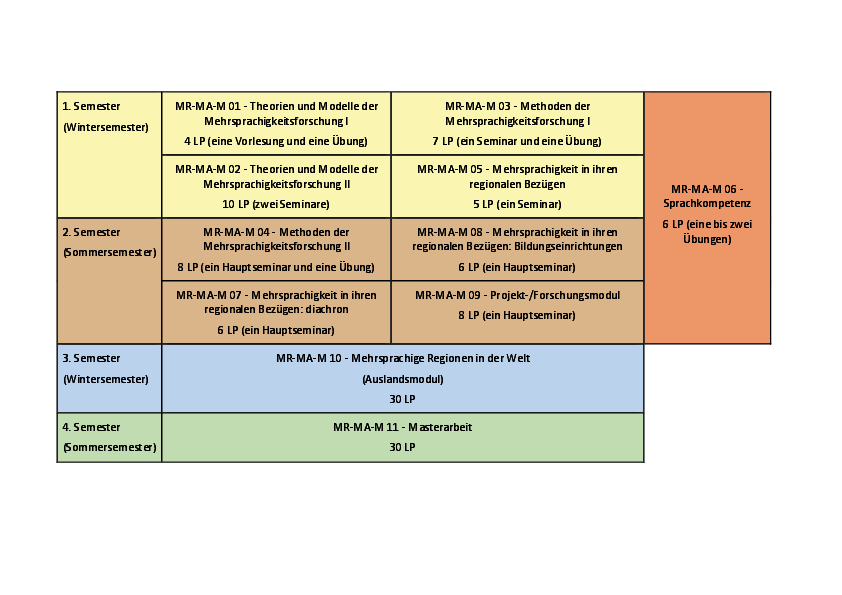
Modules
- MR-MA-M01 - Theories and models of multilingualism research I
- MR-MA-M02 - Theories and models of multilingualism research II
- MR-MA-M03 - Methods of Multilingualism Research I
- MR-MA-M04 - Methods of Multilingualism Research II
- MR-MA-M05 - Multilingualism in its regional contexts
- MR-MA-M06 - Language competence
- MR-MA-M07 - Multilingualism in its regional contexts: diachronic
- MR-MA-M08 - Multilingualism in its regional context: Educational institutions
- MR-MA-M09 - Project/research module
- MR-MA-M10 - Multilingual regions in the world (module abroad)
- MR-MA-M11 - Master's thesis
Study Plan

Career prospects
The degree program prepares students for professional activities in which multilingualism and regionality play a role, especially in the fields of science and education. Students are specifically involved in current research projects during their studies. This provides them with the necessary foundations for a subsequent doctoral programme.
Some current fields of research are
- Structures of heritage languages,
- Language stereotypes, language hierarchies,
- Language biographies, multilingual literature, multilingual films, reciprocal language influence, language dominance and language variation,
- Multilingualism in different communication domains,
- Research into the work of language mediators and language mediators,
- Research into multilingualism in companies,
- Historical multilingualism as a basis for area studies,
- Data Linguistics.
The career paths of graduates to date show a wide range of career prospects in science, education and project work. Several alumni work as academic staff in the field of German as a foreign and second language and are currently working towards a doctorate. Other graduates work in university project coordination as well as in educational and language promotion projects at various foundations and associations. Overall, the graduates make a very successful transition into professional fields appropriate to their qualifications.
It is currently possible to spend the third semester at the following partner universities abroad (partnership agreements are in preparation or have already been concluded):
- University of Innsbruck, Austria
- Università di Bolzano, Italy
- Università di Trento, Italy
- Eötvös Loránd Tudományegyetem (ELTE) Budapest, Hungary
- University of West Bohemia, Pilsen, Czech Republic
- Babeş Bolyai University of Clui, Romania
- University of Rijeka, Croatia
- University of Ljubljana, Slovenia
- Universidad de Buenos Aires (UBA), Argentina
- University of Tallinn, Estonia
The programme is constantly being expanded.
Important information about studying abroad:
The semester abroad usually takes place in the 3rd Master's semester. Ideally, you should start planning and preparing at the beginning of the 1st semester.
You will receive more detailed information about your stay abroad at the welcome event at the start of studies. We also provide a link to the International Office (external link, opens in a new window) website, which will help you with any questions you may have about studying abroad.
You are also welcome to make use of the Erasmus consultation hours (external link, opens in a new window) offered by the International Office to help you with your planning.
Application and FAQ
Application
Admission to the programme is only possible in the winter semester .
Requirements for admission to the Master's degree programme are
- University degree or equivalent degree with at least six semesters Standard Period of Study (180 CP) or comparable scope of study in the subject General and comparative linguistics, English language and literature/American studies, German language and literature, Romance languages and literature, Slavic languages and literature or a related subject with an average grade of at least 2.5 (for foreign degrees, conversion is based on the modified Bavarian formula),
- at least 50 credit points in linguistics and related fields
- for applicants who did not obtain their higher education entrance qualification or their first degree at a German-speaking educational institution, proof of German language proficiency at the level of the German Language Test for University Entrance Qualification for Foreign Applicants (DSH-2) or an equivalent German examination,
- proof of aptitude for the specific degree programme. The Eligibility Test is carried out once in the summer semester. The legal basis for the Aptitude Assessment is Annex 1 to the Examination Regulations for the Master's degree programme in Multilingualism and Regionality.
The following documents are required:
- Curriculum vitae
- Degree certificate; if the degree certificate cannot be submitted at the time of application, a current certified proof of the previous study and examination achievements from the degree program amounting to at least 150 CP as well as the average grade of the first degree achieved up to this point in time must be submitted; in this case, the degree certificate must be submitted by the end of the first semester at the latest,
- Proof of the study and examination achievements in the undergraduate degree programme by submitting a transcript of records or another certified list of the achievements,
- independently compiled overview of modules in linguistics and related fields totalling at least 50 CP,
- independently written essay in a language that is represented at the Faculty of Languages, Literatures, and Cultures at the University of Regensburg (German, English, French, Italian, Spanish, Russian, Polish, Czech, Slovakian, Serbian/Croatian) on a self-chosen topic of multilingualism of at least 500 words and a maximum of 800 words.
Please send your informal application for admission to the Eligibility Test for the winter semester 2025/26 with all the above-mentioned documents in digital form only (one pdf file) by 30 June 2026 to: info.mamur(at)ur.de (opens your email program)
FAQ
- Which Bachelor's degree programme must I have completed before applying for the MA_MuR Master's degree programme? General and comparative linguistics, English/American studies, German language and literature, Romance studies, Slavic languages and literature or a related subject with linguistics modules (at least 50 credit points)
- How do I finance my semester abroad? There are ERASMUS-plus agreements with the MA_MuR partner universities. Information is available from the International Office.
- How do I plan my semester abroad? The International Office will provide you with detailed advice on all aspects of your semester abroad. You will also receive further information about your stay abroad at our welcome event at the beginning of your degree programme.
- When should I start planning my semester abroad? Start planning your stay abroad early (ideally in the first semester). The International Office and the degree programme coordinator will help you with any questions you may have.
- Do I have to go abroad? No, a stay abroad in the 3rd semester is recommended, but you can also complete the substitute module (module MR-MA-MX) with an Internship instead.
- Which languages can I choose as part of the module "MR-MA-M06 - Language Competence"? In principle, all language courses offered by the Center for Language and Communication at the University of Regensburg. It would be advisable to choose one of the partner universities before starting your degree programme and to deepen your knowledge of the foreign language spoken there if required. However, it is also possible to choose another, new foreign language. Students whose mother tongue is not German have the opportunity to optimise their German language skills in DaF courses.
- How do I register for the Master's thesis? The application for admission to the Master's thesis and the topic notification can be found on the website of the responsible examination office under "Multilingualism and regionality".
- Who can I contact with suggestions for improvement and ideas about the degree programme? The degree programme team welcomes suggestions and feedback from students. If you have structural problems, a need for improvement or specific suggestions, you can contact us at any time by e-mail at info.mamur(at)ur.de. In this way, you make an important contribution to the continuous and participatory further development of the degree program.
- What can I do if I can't find the information I'm looking for? Please contact us so that we can clarify your question and add the information to the homepage if necessary.
- Where can I find further help, counselling and support services? The University of Regensburg offers numerous study-related support programmes. You can also find help and counselling services here.
Important contacts and addresses
- for questions about the application and general questions:
Prof Dr Jonas Grünke (e-mail: jonas.gruenke(at)ur.de) - for questions about studying and semesters abroad (course-related information and advice):
Prof Dr Jonas Grünke (e-mail: jonas.gruenke(at)ur.de) - for questions about the Master's thesis:
Prof Dr Björn Hansen (e-mail: bjoern.hansen(at)ur.de) - for suggestions for improvement, ideas and structural problems:
E-mail info.mamur@ur.de
Responsible management
Prof. Dr. Jonas Grünke
- E-mail address: Jonas.Gruenke(at)ur.de (opens your email program)
- Tel: +49 941 943 3046 (starts a telephone call, if your device allows this)
- Location: PT, 3.2.55
- Important information: Consultation hours: Please contact us by email to arrange an appointment. Unless otherwise agreed, consultations will take place online via Zoom.