


Course: Business Chemistry M.Sc.
- Chemistry and Pharmacy
- Business, Economics, Management Information Systems
The Master's degree program in Business Chemistry (M.Sc.) is an interdisciplinary degree program that systematically combines the fields of chemistry and economics. The aim is to train specialists who have both sound chemical expertise and business management know-how - a combination that is particularly in demand in the chemical industry.
The most important facts at a glance
Program Profile
The degree program is a combination of the well-established and very successful MSc Business Administration and MSc Chemistry programmes. Degree students on the MSc Business Chemistry programme will have in-depth theoretical and practical knowledge in the areas of chemistry that are most relevant in an economic context.
Is this the right program for me?
The Master's degree programme in Business Chemistry is aimed at anyone who wants to combine an interest in natural sciences with economic thinking. Do you want to understand how chemical products are created - and how they are successfully marketed? Then you've come to the right place.
This degree program is right for you if you...
- enjoy chemistry, mathematics and economic contexts
- like to think analytically and interdisciplinarily
- would like to work both in the laboratory and in management
- aspire to a career at the interface between research, development and business
- are interested in sustainable innovations and industrial processes
Typical future career fields: Product management, technical sales, project management in the chemical or pharmaceutical industry, management consultancy in a natural sciences environment.
What makes this program special?
Linking chemistry and business
At the Regensburg location, interdisciplinary training begins from the first semester: students learn chemistry and business administration in parallel from the outset. This close interlinking enables a holistic understanding of both subject areas and creates an interdisciplinary mindset at an early stage - an ideal preparation for later activities at the interface between research and management.

Unique in Bavaria:
The business chemistry degree program is only offered at a few universities nationwide - Regensburg is the only location in Bavaria. This means that the University of Regensburg offers a particularly attractive and rare degree programme for anyone who is interested in both natural sciences and economics.
Advantage for students:
Right from the start, you develop a feel for how scientific findings can be utilised commercially - instead of making connections later on in your studies.

Accreditation:
The degree program is accredited and is continuously adapted to current scientific and industrial developments.
What can I do with this degree?
After successfully graduating with a Master of Science in Business Chemistry, numerous opportunities will open up for your professional future. With a degree in business chemistry, you will have a unique combination of natural sciences expertise and business management skills. This degree qualifies you for a wide range of roles at the interface of research, development and management - particularly in the chemical, pharmaceutical and processing industries.
Important to know:
The Master's degree enables direct career entry into management positions or R&D-related activities.
Internships, working student activities and experience abroad significantly improve your chances on the labour market.
With a Master's degree, you will specialise further in your field and create even better career opportunities for yourself in the long term.
Typical areas of employment after the Master's programme:
-Product management and technical sales
-Quality assurance and production planning
-Project assistance in research & development
-Corporate consulting in a natural sciences context
-Interface functions between laboratory, marketing and management
A Master's degree also gives you the option of completing a doctorate later on - for example in the field of research, innovation or industrial development. A doctorate is not mandatory, but can be an advantage, especially in a research-related environment.
Structure of the Program
Program Structure
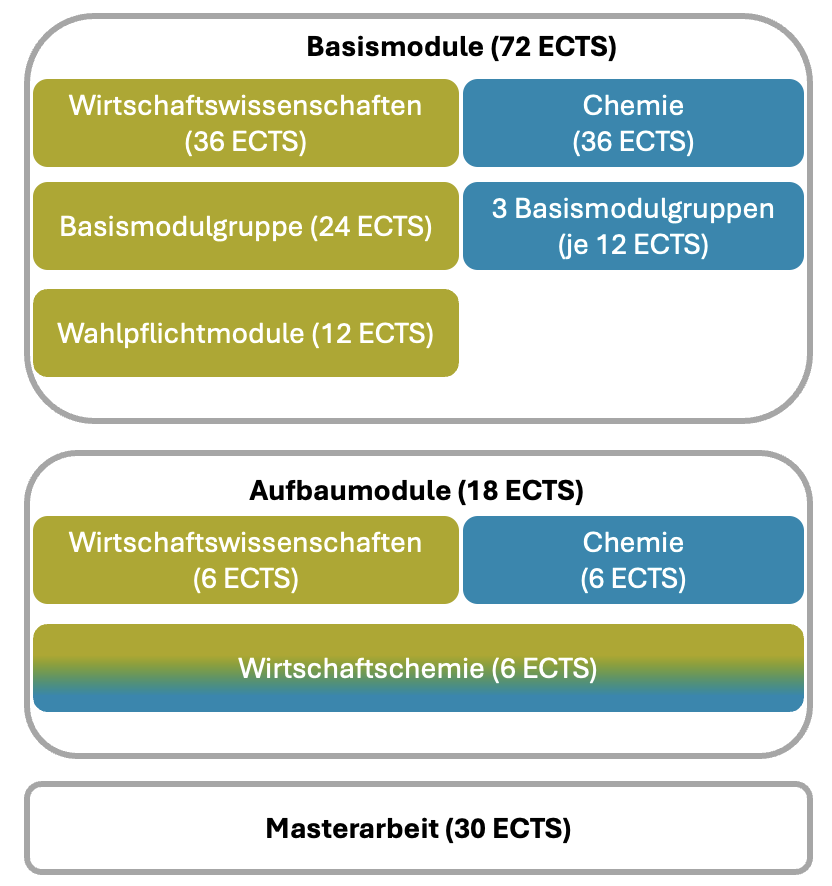
The programme concept initially provides for core modules in business administration (24 CP) and chemistry (3 x 12 CP). The chosen business administration specialisation is combined with two further compulsory elective modules (6 CP each). There is a wide range of options for both the business and chemistry specialisations. Students can choose from the following chemistry and business administration specialisations:
Economics:
- Basic module group 1 Management and leadership
- Basic module group 2 Financing
- Basic module group 3 Industrial Management
- Basic module group 4 Marketing
- Basic module group 5 Management information systems
Chemistry:
- Basic module group 1 Inorganic chemistry
- Basic module group 2 Organic Chemistry
- Basic module group 3 Physical Chemistry
- Basic module group 4 Bioanalytics Chemistry
The advanced modules build on this and serve to prepare students for their final thesis by means of a chemical research laboratory (6 CP) and an economics seminar (6 CP), in which scientific research methodology is taught and trained using case studies. In the advanced module in chemistry, students have the freedom to choose a specialisation for the chemical research laboratory course from the core modules they have completed. In the advanced module in business administration, students are free to choose the case study to be worked on. The intermediate level is supplemented by an interdisciplinary advanced module in business chemistry, which focuses on the "Sustainability Assessment of Chemical Products and Processes" (6 CP). The aim of this module is to teach members of the teaching staff from the chemical industry, among others, how aspects of economic and ecological sustainability can be considered, evaluated and optimised along the value chain of a chemical company.
Finally, an interdisciplinary final thesis (30 CP) must be completed, in which aspects from both sub-disciplines must be incorporated. Students choose one of the research topics offered by the working groups of the Faculty of Business Economics and Real Estate and, as part of the Master's thesis, develop an economic question closely linked to the topic, which they must work out by analysing the topic and with a member of the teaching staff from the field of economics.

Requirements
| Admission Restrictions / Selection Procedure | no |
| Pre-registration procedure | no |
| Eligibility Test / Aptitude Test | yes |
| Placement Test | no |
| Subject-Specific Language Requirements | English B2 |
| German Language Certificate for Students with Foreign University Entrance Qualification | yes |
| Other Requirements | no |
For binding information and the latest updates, please refer to the summary (German version) (opens in a new window). (This PDF is not accessible) provided by the Registrar's Office or the applicable examination regulations.
Details Requirements
Eligibility Test / Aptitude Test
IMPORTANT INFORMATION:
The application procedure for a study start in winter semester 2026/27 will be changed! Information will be published here as soon as possible! We ask for your patience! All previous information is without guarantee!
Expected application period for a start in winter semester 2026/27:
01.05 - 01 June 2026 (via the SPUR application portal)
Documents expected to be required:
from all applicants:
- Bachelor's certificate (if already available
- Transcript of Records (at least 140 LP) with provisional overall grade shown
- English language certificate: B2
- curriculum vitae in tabular form (German or English)
for applicants who have not obtained a Bachelor's degree in Chemistry at a German university:
- Information on course content (e.g. module handbook)
- Details of the university at which the Bachelor's degree was obtained
additionally for foreign applicants:
- German language skills DSH-2 or equivalent
Subject-Specific Language Requirements
Proof of knowledge of English at level B2 of the common european framework of reference for languages (CEFR) is required.
Admission, Application and Enrollment
 Foto ©iStock.com/mixetto
Academic Advising
Course-related information and advice
Initial contact for prospective students for questions about the degree programme and for specific information about the chemistry components:
Programme Coordination (Business) Chemistry
Dr Claudia Wanninger-Weiß
Chemistry/Pharmacy Building, Room CH 03.1.87
Phone 0941 943-4573
Email (opens your email program)
For specific questions about the Economics programme:
Programme Coordination Economics:
Markus Lang
Economics/Law section of the building, room RWS 109a
Phone 0941 943-2747
Email (opens your email program)
Course-related information and advice
General Student Advisory Service
The General Student Advisory Service (ZSB) supports you with all questions relating to your studies - from the decision to study, to the course of study, to successful graduation.
If necessary, the ZSB will refer you to the appropriate contact person.